
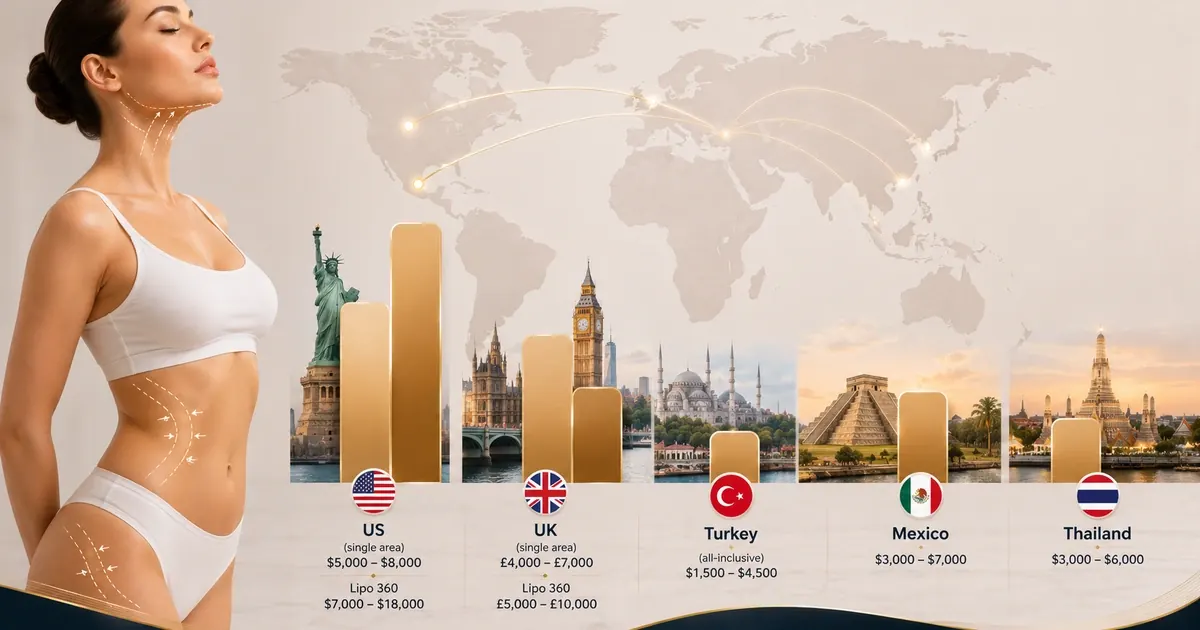
Country-by-Country Cost Comparison
The following table compares all-inclusive liposuction costs across the most popular countries for cosmetic surgery. "All-inclusive" means the total out-of-pocket cost including surgeon, facility, anaesthesia, and basic aftercare — the number you actually pay. Data is compiled from ASPS statistics, ISAPS global surveys, and provider pricing data.14
| Country | Single Area | Lipo 360 | Savings vs US | Accreditation |
|---|---|---|---|---|
| United States | $5,000–$8,000 | $7,000–$18,000 | — | AAAASF, JCAHO |
| United Kingdom | £4,000–£7,000 | £5,000–£10,000 | 10–20% | CQC regulated |
| Canada | CA$5,000–$9,000 | CA$7,000–$14,000 | 10–15% | Provincial regulation |
| Turkey | $1,500–$3,500 | $2,000–$4,500 | 60–75% | JCI, Turkish MoH |
| Mexico | $3,000–$5,000 | $3,500–$7,500 | 40–60% | Varies widely |
| Thailand | $2,500–$4,500 | $3,000–$6,500 | 40–55% | JCI (major hospitals) |
| Poland | €2,500–€4,500 | €3,500–€7,000 | 35–50% | EU medical standards |
| Colombia | $2,500–$5,000 | $3,000–$6,500 | 40–55% | Varies by facility |
| South Korea | $3,500–$7,000 | $5,000–$10,000 | 20–35% | JCI, KHA |
Cost by Body Area Across Countries
Different body areas have different cost ratios across countries. Smaller procedures show proportionally larger international savings because the fixed overhead (facility, anaesthesia) represents a bigger share of the total in high-cost countries.
| Body Area | US | UK | Turkey | Mexico | Thailand |
|---|---|---|---|---|---|
| Chin | $2,500–$5,500 | £2,000–£4,500 | $800–$1,800 | $1,200–$2,800 | $1,000–$2,500 |
| Neck | $2,500–$6,000 | £2,500–£5,000 | $1,000–$2,000 | $1,500–$3,000 | $1,200–$2,800 |
| Arms (bilateral) | $3,000–$7,000 | £3,000–£6,000 | $1,500–$3,000 | $2,000–$4,500 | $1,800–$3,500 |
| Abdomen | $4,000–$8,000 | £3,000–£7,000 | $1,500–$3,500 | $2,500–$5,000 | $2,000–$4,500 |
| Lipo 360 | $7,000–$18,000 | £5,000–£10,000 | $2,000–$4,500 | $3,500–$7,500 | $3,000–$6,500 |
Why Liposuction Prices Differ Between Countries
A published economic analysis of cosmetic surgery pricing across 15 US cities found that local economic conditions are the primary determinant of cosmetic procedure costs — not differences in surgeon training, equipment quality, or patient outcomes.2
Key Economic Drivers
The major factors that explain why the same procedure costs $15,000 in New York but $3,500 in Istanbul include:
- Surgeon wages: Reflecting local cost of living — a Turkish surgeon earning $150,000/year has equivalent purchasing power to a US surgeon earning $500,000
- Facility costs: Hospital rent, construction, and maintenance costs differ 3–5x between countries
- Staff wages: Nurses, anaesthesiologists, administrative staff — all priced at local market rates
- Malpractice insurance: US malpractice premiums ($50,000–$200,000/year for surgeons) have no equivalent in most other countries
- Regulatory costs: US compliance, documentation, and administrative overhead add significant cost
- Market competition: High-volume medical tourism markets (Turkey, Thailand) create pricing pressure
What Price Does NOT Tell You
According to a 2023 study on aesthetic surgery pricing factors, price is a poor predictor of the following:3
- Surgical skill: A $15,000 surgeon is not necessarily more skilled than a $5,000 surgeon in another country
- Complication rates: Facility accreditation and surgeon volume are better predictors
- Patient satisfaction: Results depend on surgeon-patient communication, realistic expectations, and technical execution
- Equipment quality: International medical device manufacturers (e.g., VASER by Solta Medical) supply the same equipment globally
Turkey: Lowest Cost, Highest Volume
Turkey consistently offers the lowest prices for liposuction among countries with internationally accredited facilities. According to ISAPS data, Turkey ranks in the global top five for cosmetic surgery volume and is the world's leading medical tourism destination for aesthetic procedures.4
Why Turkey Is Cheapest
- Scale: High patient volume allows fixed costs to be spread across more procedures
- Currency advantage: Turkish lira depreciation makes services cheaper for foreign patients paying in USD/GBP/EUR
- Government support: Turkish government actively promotes medical tourism as an economic driver
- Competition: Hundreds of facilities compete for international patients, keeping margins low
- All-inclusive model: Bundling reduces overhead vs itemised billing
Quality Indicators in Turkey
- JCI accreditation: 50+ hospitals in Turkey hold Joint Commission International accreditation — the gold standard
- Surgeon training: 6-year medical degree + 5–6 year plastic surgery residency + mandatory board certification
- Ministry of Health regulation: All medical tourism facilities must hold MoH operating licenses
- Volume experience: High-volume Turkish surgeons may perform 500+ liposuction procedures annually — exceeding most Western counterparts
Risks and Considerations
- Variable quality: Not all Turkish providers maintain JCI or equivalent standards — verify accreditation
- Follow-up logistics: Post-operative care transfers to a local provider after returning home
- Complication management: Ensure the facility has clear protocols for managing complications after patient departure
- Language barriers: Confirm that your surgeon (not just coordinator) speaks adequate English for informed consent
Mexico: Geographic Proximity for US Patients
Mexico is the most popular medical tourism destination for US patients due to geographic proximity and shorter travel times. Liposuction costs in Mexico are 40–60% less than the US.
Mexico Pricing by Region
- Border cities (Tijuana, Juárez): Cheapest — $2,500–$5,000 for common procedures. Convenient for same-day travel from Southern California or Texas.
- Guadalajara: Mid-range — $3,000–$6,000. Growing medical tourism hub with modern facilities.
- Mexico City: Higher end — $3,500–$7,500. Best selection of experienced surgeons and accredited hospitals.
- Resort areas (Cancún, Puerto Vallarta): Premium medical tourism pricing — $3,500–$7,000. Appeal is combining surgery with recovery vacation.
Quality Considerations for Mexico
- Certification: Seek surgeons certified by AMCPER (Mexican Association of Plastic, Aesthetic, and Reconstructive Surgery)
- Accreditation: JCI-accredited hospitals exist but are fewer than in Turkey or Thailand
- Variability: Quality varies more widely in Mexico than in Turkey — due diligence is especially important
- Follow-up advantage: Geographic proximity allows easier return visits if needed
Mexico vs Turkey: Direct Comparison
| Factor | Turkey | Mexico |
|---|---|---|
| Lipo 360 cost | $2,000–$4,500 | $3,500–$7,500 |
| Savings vs US | 60–75% | 40–60% |
| Flight time (from US East Coast) | 10–12 hours | 3–5 hours |
| JCI-accredited facilities | 50+ | ~10 |
| All-inclusive packages | Standard (hotel, transfers included) | Less common (often itemised) |
| Return visit feasibility | Difficult (long flight) | Easy (short flight, drive for border cities) |
| Cosmetic surgery volume ranking | Top 5 globally | Top 10 globally |
Thailand: Established Medical Tourism Infrastructure
Thailand was one of the earliest medical tourism destinations and has well-established international patient infrastructure, particularly in Bangkok.
Thailand Pricing
- Bangkok (Bumrungrad, BNH): $3,000–$6,500 for Lipo 360 — premium pricing for Thailand but includes world-class hospital facilities
- Bangkok (mid-tier hospitals): $2,500–$5,000 — accredited but less internationally marketed
- Phuket/Chiang Mai: $2,000–$4,500 — smaller facilities, often combined with recovery tourism
Thailand Strengths
- Bumrungrad International: One of the world's most internationally recognised hospitals — JCI accredited since 2002
- Established protocols: Decades of medical tourism experience with well-developed international patient services
- Recovery environment: Tropical setting with excellent post-operative recovery tourism infrastructure
- Nursing care: Renowned for attentive, high-quality nursing — important during recovery
Thailand Limitations
- Distance: 15–20+ hour travel time from US/Europe — challenging during early recovery
- Cost: Not as cheap as Turkey for equivalent procedures
- Specialisation: Less known specifically for body contouring than Turkey — stronger reputation for gender reassignment and facial surgery
Safety & Quality: What Actually Matters
A case series examining aesthetic surgery tourism complications identifies that adverse outcomes are linked to specific provider-level factors, not country-level pricing.5 A UK NHS study of cosmetic tourism complications found that managing complications from overseas surgery places a measurable financial burden on home-country health systems — underscoring the importance of choosing accredited providers with clear aftercare protocols.6
Evidence-Based Safety Indicators
The following factors predict safety far better than price:
- Facility accreditation: JCI (international gold standard), or national equivalent (CQC in UK, AAAASF in US)
- Surgeon board certification: Formal plastic surgery board certification in the operating country
- Surgeon volume: Higher procedure volume correlates with lower complication rates
- Patient selection: Responsible providers decline inappropriate candidates (high BMI, unrealistic expectations)
- Complication protocols: Clear plans for managing complications both during stay and after return home
- Aftercare continuity: Arrangements for post-operative monitoring after patient returns home
Red Flags Regardless of Country
- No verifiable accreditation or surgeon credentials
- Unusually low prices that seem "too good to be true" — even by local standards
- Pressure to book quickly without adequate consultation
- No clear complication management plan
- Operating in unregulated facilities (hotels, apartments, unlicensed clinics)
- Refusal to provide surgeon's full name and verifiable credentials
- No pre-operative medical assessment or health screening
Pre-Booking Safety Checklist
Before booking liposuction in any country, verify:
- Facility accreditation — verify directly on JCI website or national registry
- Surgeon credentials — check board certification with the relevant national board
- Before/after portfolio — request cases similar to your body type and desired outcome
- Complication protocol — ask what happens if you develop a seroma, infection, or asymmetry
- Aftercare plan — how will post-operative monitoring work after you return home?
- Written inclusions — get a detailed list of exactly what the quoted price covers
- Revision policy — what happens if you need a touch-up procedure?
The True Cost of Medical Tourism
To fairly compare local vs overseas surgery, calculate the true total cost including all travel-related expenses:
Total Cost Calculation: Turkey Example
For a US patient considering Lipo 360 in Turkey vs the US:
| Cost Component | US (Local) | Turkey (Medical Tourism) |
|---|---|---|
| Procedure (all-inclusive) | $12,000 | $3,500 |
| Flights | $0 | $700 |
| Hotel (beyond package) | $0 | $200 (2 extra nights) |
| Travel insurance | $0 | $100 |
| Local follow-up at home | Included | $200 (1 visit) |
| Compression garment (extra) | $150 | Included |
| Lymphatic massage (6 sessions) | $750 | $750 (at home) |
| TOTAL | $12,900 | $5,450 |
| Net savings | — | $7,450 (58%) |
When Overseas Surgery Makes Financial Sense
- Larger procedures (Lipo 360, multiple areas): Higher base cost = higher absolute savings
- Combined procedures (Lipo 360 + BBL): Savings of $8,000–$15,000+ make travel costs negligible
- Patients without financing options: Total cash price overseas may be less than monthly financing for US surgery
When Local Surgery Makes More Sense
- Small procedures (chin lipo): Absolute savings ($1,500–$2,500) may not justify travel time and logistics
- Complex medical history: Patients with significant health concerns benefit from local continuity of care
- Revision procedures: Operating on previously treated tissue carries higher risk — local follow-up is valuable
- Anxiety about travel during recovery: Some patients recover better in their home environment
Frequently Asked Questions
-
Turkey offers the lowest liposuction prices among countries with internationally accredited facilities — $1,500–$4,500 all-inclusive for most procedures. This represents 60–75% savings versus US pricing. The low cost reflects lower local wages, facility costs, and high surgical volume — not reduced quality at accredited hospitals. ISAPS data ranks Turkey in the global top 5 for cosmetic surgery volume.4
-
A peer-reviewed economic analysis confirms that cosmetic surgery pricing is driven by local economic conditions — not surgical quality.2 Turkey has lower surgeon wages (relative to living costs), cheaper facility rent, lower staff costs, minimal malpractice insurance burdens, and currency advantages. Additionally, Turkey's high volume (top 5 globally) creates efficiency and competition that further reduce prices.
-
Price alone does not predict safety. A UK NHS study found that cosmetic tourism complications requiring NHS treatment were linked to provider-level factors — facility accreditation, surgeon credentials, patient selection — not country-level pricing.6 JCI-accredited hospitals abroad maintain standards comparable to domestic facilities. However, unaccredited providers anywhere (including the US) carry higher risk.
-
Liposuction in Mexico costs $3,000–$7,000 for common procedures (40–60% savings vs US). Border cities (Tijuana) are cheapest; Mexico City is pricier but offers better hospital selection. Seek surgeons certified by AMCPER (Asociación Mexicana de Cirugía Plástica). Mexico's main advantage for US patients is geographic proximity — 3–5 hour flights versus 10–12 hours to Turkey.
-
Turkish all-inclusive packages typically cover: surgeon fee, anaesthesiologist, hospital facility, 1-night hospital stay, airport transfers, 3–5 nights hotel, compression garment, post-op medications, and 1–2 follow-up consultations. Some also include lymphatic massage sessions. Always confirm inclusions in writing before booking — items occasionally excluded are extra compression garments, extended stay for combined procedures, and revision surgery.
-
It depends on your procedure and priorities. Overseas makes sense for: larger procedures (Lipo 360, multiple areas, BBL combinations) where absolute savings are $5,000–$15,000+, and the facility is JCI-accredited with clear aftercare protocols. Local makes sense for: small procedures (chin lipo) where savings don't justify travel, complex medical histories requiring care continuity, and patients anxious about recovery away from home. For most body contouring procedures, accredited overseas surgery offers excellent value.