
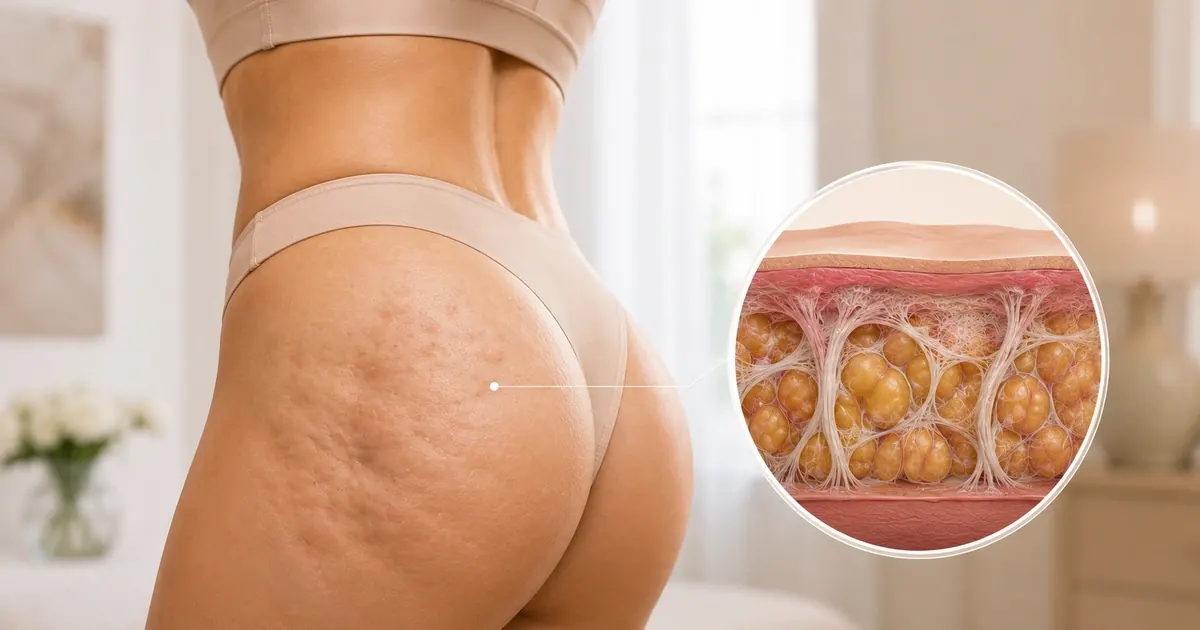
What Is Fibrosis?
Fibrosis is the formation of excess connective tissue (scar tissue) as part of the body's healing process. After liposuction, fibrosis develops in the subcutaneous layer — the space between the skin and underlying muscle where fat was removed. It presents as firm, dense areas under the skin that may feel lumpy, ropey, or like a hard shell beneath otherwise normal-looking skin. Browse all recovery guides for related topics including swelling, compression garments, and the overall healing timeline.
How Fibrosis Feels
Patients describe post-liposuction fibrosis in several ways: hard lumps or nodules under the skin, rope-like bands that run along the treated area, a thick or stiff texture when pressing the skin, reduced skin mobility compared to untreated areas, and a general tightness or hardness across the treatment zone. The affected area is typically not painful, though it can be tender to pressure and uncomfortable during certain movements or when wearing tight clothing.
Fibrosis vs Other Post-Op Findings
It is important to distinguish fibrosis from other post-operative changes. A 2016 study of imaging findings after surgical procedures identified the distinct characteristics that differentiate fibrosis from seromas, haematomas, and normal post-operative swelling.2
| Feature | Fibrosis | Seroma | Haematoma | Normal Swelling |
|---|---|---|---|---|
| Texture | Firm, dense, lumpy | Soft, fluctuant, fluid-filled | Firm and expanding | Soft, diffuse, even |
| Onset | Weeks 2–6 | Days 5–21 | Hours 0–72 | Hours 0–72 (peaks 48–72h) |
| Skin colour | Normal | Normal or slightly taut | Dark purple/blue | Normal or mild bruising |
| Pain level | Mild tenderness | Minimal to moderate | Significant | Soreness improving daily |
| Treatment | MLD, compression, time | Aspiration by surgeon | May need surgical drainage | Compression, rest, time |
| Resolution | 2–6 months | Days to weeks after drainage | 2–4 weeks | 3–6 months (gradual) |
Why Fibrosis Happens After Liposuction
Understanding the biological mechanism behind fibrosis helps explain why it is so common and why certain prevention strategies work. Fibrosis is not a complication in most cases — it is a predictable consequence of the body's wound-healing cascade.
The Wound-Healing Cascade
When the liposuction cannula passes through subcutaneous tissue, it disrupts fat cells, blood vessels, connective tissue fibres, and lymphatic channels. The body responds with a three-phase healing process: inflammation (days 0–7), proliferation (weeks 1–6), and remodelling (weeks 6 to months 6–12). Fibrosis occurs primarily during the proliferative phase, when fibroblasts — the body's collagen-producing cells — are activated and deposit new collagen to repair the damaged tissue.
The Role of Interstitial Fluid
Protein-rich interstitial fluid that accumulates in the dead space after fat removal is a key trigger for fibroblast activation. The more fluid that lingers in the tissues, the greater the fibroblast response and the more collagen is deposited. This is why compression garments and lymphatic drainage massage — both of which reduce fluid accumulation — are the primary prevention strategies for fibrosis.
Risk Factors for More Severe Fibrosis
While all liposuction patients experience some fibrosis, certain factors increase the likelihood of more significant or prolonged fibrosis:
- Large-volume liposuction: More tissue disruption = more inflammatory response = more fibrosis
- Lipo 360: Circumferential treatment disrupts tissue around the entire torso, increasing fibrosis risk substantially
- Seroma formation: Persistent fluid collections drive ongoing fibroblast activation
- Inconsistent compression: Inadequate or irregular garment wear allows fluid to accumulate
- Early strenuous activity: Exercise during the first 4 weeks increases inflammatory markers and fluid production
- Revision procedures: Operating on previously treated tissue encounters pre-existing scar tissue
- Individual healing variation: Some patients produce more collagen than others; those prone to keloid or hypertrophic scarring may be at higher risk
Normal vs Problematic Fibrosis
The critical clinical distinction is between normal, self-resolving fibrosis and problematic fibrosis that may require intervention. The vast majority of post-liposuction fibrosis falls into the normal category.
| Feature | Normal Fibrosis | Problematic — Discuss with Surgeon |
|---|---|---|
| Onset | Weeks 2–6 | Can be delayed if triggered by late seroma |
| Distribution | Diffuse across treated area; relatively symmetric | Focal, localised lumps; markedly asymmetric |
| Trajectory | Gradually softening from week 6–8 onward | Not improving or worsening after week 8 |
| Pain | Mild tenderness; not painful | Increasingly tender; painful without pressure |
| Skin changes | None — skin colour and temperature normal | Redness, warmth, dimpling, or retraction |
| Response to MLD | Softens with massage over weeks | No improvement despite consistent MLD |
| Resolution | 2–4 months | Persists beyond 6 months without improvement |
Contour Irregularity vs Fibrosis
Patients sometimes confuse fibrosis with contour irregularity (uneven fat removal). Fibrosis is a tissue texture issue — firm, lumpy tissue beneath skin that will soften over time. Contour irregularity is a shape issue — visible dents, bumps, or unevenness in the body's silhouette. The two can coexist, but fibrosis resolves while contour irregularity may be permanent. Your surgeon can distinguish between them at a follow-up visit.
Fibrosis Timeline
Fibrosis follows a relatively predictable timeline that mirrors the body's wound-healing phases. Knowing what to expect at each stage reduces the anxiety many patients feel when they encounter firmness and lumps during recovery.
| Phase | Timeframe | What You'll Feel | What to Do |
|---|---|---|---|
| Onset | Weeks 2–3 | First areas of firmness developing | Continue compression 24/7; begin MLD if approved |
| Peak | Weeks 3–6 | Maximum firmness, lumpiness; may feel alarming | MLD 2–3x/week; compression; gentle self-massage if approved |
| Early resolution | Weeks 6–10 | Fibrosis beginning to soften; lumps becoming less defined | Continue MLD weekly; transition to part-time compression |
| Progressive resolution | Months 3–4 | Significantly softer; most lumps resolved | Self-massage; surgeon follow-up to assess |
| Full resolution | Months 4–6+ | Tissue returns to normal texture | No intervention needed; final result visible |
Why Fibrosis Peaks When Swelling Decreases
Many patients notice fibrosis becoming more prominent just as swelling improves — typically around weeks 3–6. This is because swelling was "masking" the underlying fibrosis. As fluid clears, the firm tissue underneath becomes more palpable and sometimes more visible. This does not mean fibrosis is worsening — it means it is becoming more noticeable as the surrounding swelling resolves.
Prevention: Compression & Lymphatic Drainage
Preventing fibrosis is significantly more effective than treating it once established. The two most important prevention strategies are consistent compression garment wear and manual lymphatic drainage (MLD). Both work by reducing the interstitial fluid accumulation that drives fibroblast activation.
Compression Garment Wear
The compression garment is the single most important tool for fibrosis prevention. By applying continuous external pressure, the garment minimises the dead space where fluid accumulates, reduces the volume of interstitial fluid available to activate fibroblasts, and holds the skin against the underlying tissue to prevent adhesion irregularity. Patients who wear their garment 24/7 for the first 3 weeks and part-time for weeks 4–6 consistently report less fibrosis than those who wear it inconsistently.
Manual Lymphatic Drainage (MLD)
A 2014 clinical study demonstrated that MLD significantly reduces post-liposuction oedema.1 By stimulating the lymphatic system to clear protein-rich interstitial fluid more efficiently, MLD directly addresses the primary trigger for fibrosis formation. The recommended protocol is 4–8 sessions beginning 1–2 weeks post-surgery, performed by a Vodder- or LANA-certified therapist.
Activity Restriction
Most surgeons recommend following structured activity guidance during the first 4–6 weeks, as this produces better outcomes. Strenuous exercise during early recovery increases inflammatory mediators and fluid production in treated areas, directly increasing fibrosis risk. Light walking is encouraged from day 1–2, but resistance training, high-impact exercise, and heavy lifting should wait until week 6.
Hydration and Nutrition
Adequate hydration (2–3 litres of water per day) supports lymphatic function. A low-sodium diet during the first 4 weeks reduces fluid retention. Protein intake supports tissue repair. While no specific supplement has been proven to prevent fibrosis, overall nutritional health contributes to an efficient healing response.
Treatment Options for Established Fibrosis
When fibrosis persists beyond the expected timeline or is more severe than anticipated, several treatment options are available. For a detailed exploration of each treatment modality, see our comprehensive fibrosis management guide.
Continued MLD and Professional Massage
For persistent fibrosis, extending MLD sessions beyond the initial 4–8 is the first-line approach. Some therapists incorporate deeper tissue mobilisation techniques once acute healing is complete (after week 8) — working more firmly on fibrotic bands and nodules to break down adhesions and improve tissue pliability. This should only be done by a qualified therapist and with your surgeon's approval.
Therapeutic Ultrasound
External therapeutic ultrasound uses sound waves to generate deep tissue heating, which increases blood flow, loosens collagen fibres, and promotes tissue remodelling. Several practitioners use this modality for post-liposuction fibrosis that has not responded adequately to MLD alone. Treatment is typically performed in clinic over 4–6 sessions.
Radiofrequency Therapy
Radiofrequency devices deliver controlled heat energy to the subcutaneous tissue, stimulating collagen remodelling and tissue softening. This modality is used for stubborn fibrosis that persists beyond 4–6 months. It is non-invasive and performed in a clinical setting.
Steroid Injections
For focal, particularly firm fibrotic nodules that have not responded to conservative measures, corticosteroid injection may be considered. The steroid reduces local inflammation and can soften scar tissue. This approach is reserved for discrete, problematic nodules — not for diffuse fibrosis — and carries risks including skin thinning and atrophy at the injection site.
| Treatment | How It Works | When Used | Sessions |
|---|---|---|---|
| Extended MLD | Lymphatic drainage clears fluid driving fibroblast activation | First-line for all persistent fibrosis | 6–12+ sessions |
| Deep tissue mobilisation | Firmer massage breaks down adhesions and fibrotic bands | After week 8 when acute healing complete | 4–8 sessions |
| Therapeutic ultrasound | Sound waves heat tissue, loosening collagen fibres | Fibrosis not responding to MLD at 3–4 months | 4–6 sessions |
| Radiofrequency | Controlled heat stimulates collagen remodelling | Stubborn fibrosis persisting beyond 4–6 months | 3–6 sessions |
| Steroid injection | Corticosteroid reduces local inflammation and softens scar tissue | Focal nodules unresponsive to conservative measures | 1–3 injections |
| Surgical revision | Release adhesions; possible additional liposuction | Last resort after 12+ months | Single procedure |
Surgical Revision
In rare cases where fibrosis causes significant contour irregularity that persists beyond 12 months, surgical revision may be considered. This involves releasing adhesions and fibrous bands, sometimes with additional liposuction to even out the contour. Revision is a last resort, typically considered only after all conservative measures have been exhausted and at least 12 months have passed since the original procedure.
When to See Your Surgeon
Most fibrosis resolves with time and conservative measures. However, certain presentations warrant a conversation with your surgeon to rule out complications or determine whether additional intervention is needed.
Expected — No Urgent Concern
- Generalised firmness across treated areas at weeks 2–8
- Small lumps that are gradually softening
- Fibrosis that responds to massage (becomes softer after MLD sessions)
- Fibrosis that is less prominent with each passing week
Discuss at Next Follow-Up
- Fibrosis that has not improved at all by month 3
- Discrete hard nodules that are not softening
- Visible contour irregularity that concerns you
- Persistent asymmetry between treated sides
Contact Surgeon Promptly
- Hard lumps accompanied by redness, warmth, or fever — possible infection
- Growing or increasingly painful firm areas — may indicate seroma or haematoma
- Soft, fluid-filled swelling developing alongside fibrosis — possible seroma requiring aspiration
- Skin retraction or dimpling that appears to be worsening
Frequently Asked Questions
-
Yes. Some degree of fibrosis — firmness and lumpiness under the skin — is a normal and expected part of healing after liposuction. It occurs because the body produces collagen to repair tissue disrupted by the cannula. Mild to moderate fibrosis resolves over 2–4 months with compression and lymphatic drainage massage.
-
Mild fibrosis peaks at 3–8 weeks and resolves over 2–4 months. Moderate cases may persist 4–6 months. Severe fibrosis — particularly after large-volume procedures or Lipo 360 — can persist 6–12 months. Consistent compression and MLD accelerate resolution.
-
Yes. MLD is the most widely recommended intervention. A 2014 clinical study found MLD significantly reduces post-operative oedema — the fluid that drives fibrosis formation. Most surgeons recommend 4–8 sessions starting at 1–2 weeks post-surgery.1
-
Fibrosis feels like firm, dense areas under the skin — hard lumps, ropey bands, or a tight "hard shell" texture. It is typically not painful but may be tender when pressed. It is distinctly different from the soft, fluid-filled feeling of a seroma or the diffuse softness of normal swelling.
-
The main strategies: wear your compression garment consistently (reduces fluid that triggers fibrosis), attend MLD sessions starting 1–2 weeks post-surgery, avoid strenuous activity for 4–6 weeks, stay hydrated, and follow all surgeon instructions. Prevention is more effective than treating established fibrosis.
-
Mild firmness at weeks 2–8 is normal. Contact your surgeon if: fibrosis has not improved by 3–4 months, firm areas have redness, warmth, or fever (infection), lumps are growing or very tender, or you develop a soft fluid-filled swelling (possible seroma). Most fibrosis resolves with time, compression, and massage.