
Who Is a Good Candidate for Liposuction?
Liposuction candidacy involves multiple interrelated factors — no single measurement determines eligibility. The ideal candidate presents with a specific combination of physical characteristics, health status, and psychological readiness that together predict safe surgery and satisfying results, as outlined in the StatPearls clinical review.1 This guide is part of our all safety topics section, where you can also review risks, scarring, and evidence-based safety data.
The Ideal Candidate Profile
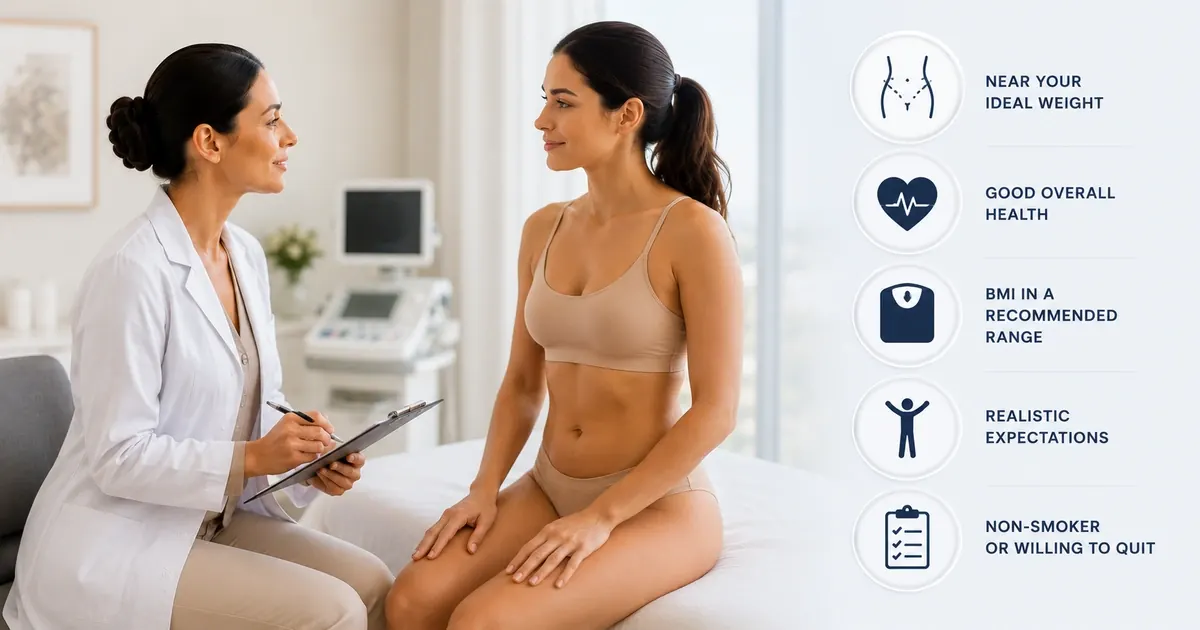
Board-certified plastic surgeons generally describe the ideal liposuction candidate as someone who meets the following criteria:
- Within 30% of ideal body weight: Close to their goal weight but struggling with specific fat deposits
- Good skin elasticity: Skin that snaps back when pinched, without excessive laxity
- Localized fat deposits: Specific areas (abdomen, flanks, thighs, arms) that don't respond to diet and exercise
- Good general health: No uncontrolled chronic conditions, adequate cardiopulmonary function
- Non-smoker: Or willing to quit for at least 4 weeks before and after surgery
- Realistic expectations: Understanding that liposuction contours the body rather than causing dramatic weight loss
- Stable weight: Weight has been consistent (within 5–10 lbs) for at least 6 months
Self-Assessment Checklist
Before your consultation, honestly evaluate yourself against these criteria. Answer "yes" or "no" to each — candidates who answer "yes" to most of these questions are likely to be strong candidates:
- Are you within 30% of your ideal body weight?
- Have specific areas of fat that persist despite consistent exercise and healthy eating?
- Is your weight stable (not actively losing or gaining)?
- Does your skin feel firm and elastic (not loose or crepey)?
- Are you free from serious uncontrolled medical conditions?
- Are you a non-smoker or willing to quit before/after surgery?
- Do you understand liposuction is body contouring, not weight loss?
- Are you able to take 1–2 weeks off work for initial recovery?
Candidacy Differences: Men vs. Women
While the fundamental criteria are identical regardless of sex, there are practical differences in how candidacy is assessed:
- Men tend to have denser, more fibrous fat (particularly in the abdomen and flanks), which requires more aggressive technique and may slightly extend recovery
- Women typically have softer subcutaneous fat that is easier to remove but may have more concerns about skin laxity post-procedure
- Male chest (gynecomastia) candidates require assessment of glandular vs. fatty tissue — pure fat responds to liposuction, while glandular tissue may need excision
BMI & Weight Guidelines
Body Mass Index (BMI) is the most commonly discussed metric in liposuction candidacy, though it is far from the only factor surgeons consider. Understanding what BMI means in the context of liposuction — and its limitations — helps set appropriate expectations, as a nationwide analysis of 69,424 patients demonstrates.2
BMI Categories & Liposuction Eligibility
| BMI Range | Classification | Candidacy Status | Notes |
|---|---|---|---|
| 18.5–24.9 | Normal weight | Ideal candidate | Best safety profile and aesthetic outcomes |
| 25.0–29.9 | Overweight | Good candidate | Most common candidacy range; excellent results with realistic expectations |
| 30.0–34.9 | Obese Class I | Possible candidate | Requires experienced surgeon; higher complication risk; limited volume removal |
| 35.0–39.9 | Obese Class II | High-risk candidate | Many surgeons decline; weight loss recommended first; select cases only |
| ≥ 40.0 | Obese Class III | Generally not a candidate | Risks outweigh benefits; bariatric referral often recommended |
Why BMI Matters for Safety
BMI correlates with several risk factors that directly affect liposuction safety:
- Anesthetic risk: Higher BMI increases difficulty with airway management and medication dosing
- Venous thromboembolism (VTE): Blood clot risk increases significantly above BMI 303
- Wound healing: Obesity impairs blood flow to skin, increasing infection and delayed healing rates
- Fat embolism risk: Large-volume liposuction in higher-BMI patients carries elevated risk
- Aesthetic limitations: More fat remaining after surgery means less dramatic visible change
Limitations of BMI as a Measure
BMI is an imperfect tool that doesn't account for:
- Muscle mass: Athletic individuals may have a high BMI with low body fat
- Fat distribution: Where fat is located matters more than total amount
- Body composition: Two people with identical BMIs can have vastly different body fat percentages
- Visceral vs. subcutaneous fat: Liposuction only removes subcutaneous fat — visceral (organ-surrounding) fat is not accessible
For this reason, surgeons evaluate candidacy through physical examination rather than relying on BMI alone. A muscular person with BMI 28 and excellent skin may be a better candidate than a sedentary person with BMI 24 and poor skin quality.
Safe Volume Limits
The amount of fat that can safely be removed in a single session also affects who qualifies:
| Category | Maximum Volume | Setting | Monitoring Required |
|---|---|---|---|
| Small-volume | < 1,000 mL (1 liter) | Office-based or ambulatory | Standard monitoring |
| Moderate-volume | 1,000–3,000 mL | Accredited surgical center | Extended monitoring, fluid replacement |
| Large-volume | 3,000–5,000 mL | Hospital or accredited center | Overnight observation, IV fluids, blood work |
| Mega-volume | > 5,000 mL | Hospital with ICU access | Intensive monitoring, staged approach may be safer |
The 5,000 mL upper limit (approximately 11 lbs of fat) is widely regarded as the maximum safe volume for a single session, as established by safety guidelines from major plastic surgery organizations.1
Skin Elasticity: The Critical Factor
If BMI determines whether liposuction is safe, skin elasticity determines whether it will look good. Even a patient with perfect BMI and health can have disappointing results if their skin lacks the ability to contract and conform to the new body contour after fat removal.
Why Skin Elasticity Matters
When fat is removed through liposuction, the skin must shrink to fit the reduced volume beneath it. Skin with good elasticity — rich in collagen and elastin fibers — contracts smoothly over weeks to months, creating a tight, natural-looking result. Skin with poor elasticity may sag, ripple, or appear loose after fat removal, sometimes requiring secondary procedures to correct.
The Pinch Test (Skin Assessment)
During consultation, surgeons perform a simple but informative pinch test:
- The surgeon pinches the skin in the treatment area between thumb and forefinger
- The skin fold is lifted away from underlying tissue and held for several seconds
- The skin is released and observed for how quickly it snaps back
Good elasticity: Skin snaps back immediately (within 1–2 seconds) and returns to its flat position without wrinkles. Moderate elasticity: Skin returns slowly (3–5 seconds) with minor residual creasing. Poor elasticity: Skin remains tented or creased, returning sluggishly or not fully.
Factors That Reduce Skin Elasticity
- Age: Collagen production decreases approximately 1% per year after age 30
- Sun damage: UV radiation degrades elastin fibers — years of sun exposure significantly reduces elasticity
- Smoking: Accelerates collagen breakdown and impairs new collagen synthesis
- Significant weight fluctuations: Repeated stretching and relaxing weakens skin structure
- Pregnancy: Hormonal changes and physical stretching can permanently alter abdominal skin elasticity
- Genetics: Some individuals have naturally thinner, less resilient skin
Options for Patients with Poor Elasticity
Poor skin elasticity doesn't necessarily mean you cannot have liposuction — but it may mean you need a modified approach:
- Combined procedures: Liposuction with concurrent skin-tightening (e.g., mini-abdominoplasty, arm lift)
- Energy-assisted techniques: VASER, radiofrequency-assisted liposuction (BodyTite), or laser liposuction can stimulate some skin contraction
- Conservative volume removal: Removing less fat to avoid overwhelming the skin's contractile capacity
- Staged approach: Initial liposuction followed by skin-tightening procedure after assessment of natural contraction
Health Requirements & Medical Clearance
Liposuction is elective surgery performed under anesthesia, and patients must meet basic health standards to safely undergo the procedure. The pre-operative assessment evaluates cardiovascular fitness, bleeding risk, infection susceptibility, and wound healing capacity, as documented in a nationwide analysis of liposuction complications.2
Standard Pre-Operative Testing
Depending on age, health history, and planned procedure extent, your surgeon may require:
- Complete blood count (CBC): Checks for anemia and platelet function
- Metabolic panel: Evaluates kidney function, electrolytes, blood sugar
- Coagulation studies (PT/INR): Ensures normal clotting ability
- ECG (electrocardiogram): Typically required for patients over 40 or with cardiac history
- Chest X-ray: For patients over 50 or with pulmonary history
- HbA1c: For patients with diabetes or pre-diabetes
- Pregnancy test: Required for all women of childbearing age
Medications That Affect Candidacy
Several common medications require adjustment or temporary discontinuation before liposuction:
| Medication Category | Examples | Concern | Typical Protocol |
|---|---|---|---|
| Blood thinners | Warfarin, rivaroxaban, apixaban | Excessive bleeding | Stop 3–7 days before (with prescriber approval) |
| Anti-platelet agents | Aspirin, clopidogrel | Impaired clotting | Stop 7–10 days before |
| NSAIDs | Ibuprofen, naproxen | Increased bruising/bleeding | Stop 7 days before |
| Herbal supplements | Fish oil, ginkgo, vitamin E, garlic | Blood-thinning effects | Stop 2 weeks before |
| Immunosuppressants | Methotrexate, biologics | Impaired healing, infection risk | Individualized — requires specialist coordination |
| Weight-loss medications | Semaglutide (Ozempic/Wegovy) | Nausea, delayed gastric emptying under anesthesia | Hold for 1–2 weeks before (emerging guidelines) |
Smoking Cessation Requirements
Smoking is one of the most significant modifiable risk factors in elective surgery. Nicotine constricts blood vessels (vasoconstriction), reducing oxygen delivery to healing tissues by up to 50%. Carbon monoxide in cigarette smoke further reduces the oxygen-carrying capacity of hemoglobin, as confirmed in a systematic review of liposuction risks.3
Most surgeons require:
- Complete cessation of all nicotine products (cigarettes, vaping, patches, gum) for 4 weeks before surgery
- Continued abstinence for 4 weeks after surgery
- Some surgeons verify compliance with urine cotinine testing
Age Considerations
Age affects liposuction candidacy primarily through its impact on skin elasticity, healing capacity, and the likelihood of concurrent medical conditions. However, chronological age is far less important than biological health status.
Candidacy Considerations by Age Group
| Age Group | Typical Candidacy | Key Considerations | Common Treatment Areas |
|---|---|---|---|
| 18–29 | Excellent | Best skin elasticity; ensure weight is stable and goals are realistic; may still be maturing physically | Flanks, submental (chin), gynecomastia |
| 30–39 | Excellent | Peak candidacy decade; good elasticity; stable lifestyle; common post-pregnancy procedures | Abdomen, flanks, thighs, arms |
| 40–49 | Very good | Slightly reduced elasticity; may need energy-assisted techniques for skin tightening | Abdomen, back, flanks, submental |
| 50–59 | Good (with assessment) | Elasticity varies widely; more pre-op testing needed; may benefit from combined procedures | Abdomen, back, arms, knees |
| 60–69 | Possible (individualized) | Higher medical clearance threshold; skin elasticity often limited; cardiovascular screening important | Small-area contouring, submental |
| 70+ | Case-by-case | Must demonstrate excellent health; limited skin contracture expected; conservative approach | Localized areas only |
Considerations for Younger Patients (18–25)
While young adults have excellent skin elasticity and healing capacity, surgeons evaluate additional factors:
- Body maturity: Some patients' bodies are still changing in their early 20s
- Weight stability: Young adults often experience lifestyle changes (college, career) that affect weight
- Psychological readiness: Ensuring realistic expectations and that the desire for surgery isn't driven by temporary body image concerns
- Future pregnancies: Women planning pregnancy soon may be advised to wait, as pregnancy can reverse abdominal liposuction results
Considerations for Older Patients (60+)
Older patients can absolutely be excellent candidates when health criteria are met. Additional considerations include:
- More comprehensive cardiac and pulmonary screening
- Review of all medications (polypharmacy is common)
- Realistic discussion about skin contraction limitations
- Potentially smaller treatment areas and conservative fat removal
- Longer recovery timeline may be expected
Conditions That May Disqualify You
Certain medical conditions present unacceptable surgical risks or predict poor outcomes. These are categorized as absolute contraindications (surgery should not proceed) and relative contraindications (surgery may proceed with modifications or after optimization), per the StatPearls clinical review.1
Absolute Contraindications
The following conditions generally preclude liposuction under any circumstances:
- Active systemic infection: Any ongoing infection must be fully resolved before elective surgery
- Severe cardiac disease: Uncompensated heart failure, unstable angina, recent myocardial infarction (within 6 months)
- Severe pulmonary disease: Inability to tolerate anesthesia safely (e.g., severe COPD, oxygen-dependent)
- Uncontrolled coagulopathy: Bleeding disorders without adequate factor replacement
- Active deep vein thrombosis (DVT) or pulmonary embolism: Requires treatment and extended anticoagulation before any elective surgery
- Pregnancy or breastfeeding: Anesthetic and surgical risks to mother and child
- Body dysmorphic disorder (severe): When expectation-reality mismatch cannot be resolved through counseling
- Lidocaine allergy: Tumescent technique relies on lidocaine — alternative anesthetic approaches may be possible but require specialist evaluation
Relative Contraindications
These conditions don't automatically exclude patients but require careful evaluation, optimization, or modified approaches:
- Controlled diabetes (Type 1 or 2): HbA1c must be below 7.5–8.0%; higher levels significantly impair wound healing
- Controlled hypertension: Blood pressure must be well-managed; uncontrolled hypertension increases bleeding risk
- Autoimmune conditions: Lupus, rheumatoid arthritis, and similar conditions may impair healing; timing around flares and medication adjustments needed
- History of DVT/PE: Requires prophylactic anticoagulation protocol and risk-benefit discussion
- HIV/hepatitis (well-controlled): Adequate immune function (CD4 > 200) required; standard precautions
- Obesity (BMI 30–35): Higher complication rates but may proceed with experienced surgeon and limited scope
- Current smoking: Relative contraindication that becomes non-issue after 4 weeks of cessation
- Mental health conditions: Stable, well-managed depression or anxiety doesn't disqualify — but active severe psychiatric illness may
Lifestyle Disqualifiers
Beyond medical conditions, certain lifestyle factors may temporarily delay candidacy:
- Active weight loss or weight gain: Weight should be stable for 6+ months
- Recent pregnancy/breastfeeding: Wait at least 6 months after breastfeeding cessation for hormonal normalization and body stabilization
- Upcoming major life events: Wedding, athletic competition, or travel within 4–6 weeks (insufficient recovery time)
- Cannot commit to compression garment wear: Typically 4–6 weeks post-op — essential for results
What Liposuction Cannot Do (Setting Realistic Expectations)
Unrealistic expectations are perhaps the most important non-physical "disqualifier" for liposuction. Patients who understand the procedure's limitations are consistently more satisfied with their results. Surgeons routinely decline patients whose expectations cannot be met, as noted by the American Society of Plastic Surgeons.4
Liposuction Is Not Weight Loss Surgery
This distinction cannot be overstated. Liposuction typically removes 2–5 liters of fat (roughly 4–11 lbs). For a 170-lb patient, this represents only 2–6% of total body weight. The procedure is designed to reshape and contour, not to achieve significant scale changes.
- Patients expecting to "lose 20+ lbs" will be disappointed
- The visual impact is about proportional change, not weight change
- Clothing fit improvement is a more realistic metric than scale numbers
- Patients seeking major weight loss should be referred to nutritional counseling or bariatric surgery evaluation
Cellulite & Loose Skin Limitations
Liposuction has specific limitations regarding:
- Cellulite: Liposuction does not treat cellulite and may actually worsen its appearance by removing the fat that provides a smooth contour beneath dimpled skin
- Loose skin: Cannot remove excess skin — patients with significant skin laxity need excisional procedures (tummy tuck, arm lift, thigh lift)
- Visceral fat: The fat surrounding internal organs is not accessible through liposuction — only subcutaneous fat (beneath the skin) can be removed
- Stretch marks: Not improved by liposuction
Realistic Expectations Checklist
| Expectation | Realistic? | Explanation |
|---|---|---|
| "I want my love handles gone" | Yes — very realistic | Flanks respond extremely well to liposuction with high satisfaction rates |
| "I want a flat stomach" | Partially realistic | Removes subcutaneous fat but cannot address visceral fat or muscle separation |
| "I want to lose 30 lbs" | Not realistic | Maximum safe removal is ~11 lbs in one session; this is not weight-loss surgery |
| "I want to get rid of cellulite" | Not realistic | Liposuction does not treat and may worsen cellulite appearance |
| "I want slimmer inner thighs" | Yes — very realistic | Inner thighs respond well; good skin elasticity needed for smooth result |
| "I want defined abs" | Partially realistic | High-definition liposuction can create definition in lean patients with good muscle tone |
| "I don't want any scars" | Not realistic | Small 3–5 mm scars are unavoidable but typically fade to near-invisible |
| "I want to look good in clothes" | Yes — very realistic | Improved proportions and clothing fit is one of the most consistently achieved goals |
What to Ask at Your Consultation
A thorough consultation is the definitive candidacy assessment. Come prepared with these questions for your surgeon:
- Based on my body type and goals, am I a good candidate?
- What technique do you recommend for my specific areas and why?
- How much fat can realistically be removed?
- Do you think my skin elasticity is adequate for a good result?
- Are there any health concerns that need addressing first?
- Would I benefit from a combined procedure (e.g., lipo + mini tuck)?
- What results can I realistically expect — and what can't be achieved?
- Can I see before/after photos of patients with similar body types?
- What is your complication rate and how do you handle them?
- What credentials and board certifications do you hold?
Frequently Asked Questions
-
Most surgeons prefer candidates with a BMI of 30 or below for optimal safety and results. Some experienced practitioners will treat patients up to BMI 35, and large-volume liposuction may be performed up to BMI 40 in select cases with appropriate facility support. However, BMI alone doesn't determine candidacy — overall health, fat distribution, and skin quality are equally important factors that your surgeon will assess during consultation.
-
There is no strict upper age limit for liposuction. Patients in their 60s and 70s undergo successful procedures when they meet health criteria. The key consideration is skin elasticity, which decreases with age — older patients may need combined procedures (liposuction plus skin tightening) for optimal results. Most surgeons require patients to be at least 18 years old, and some prefer to wait until the early 20s when body development is complete.
-
Being overweight doesn't automatically disqualify you, but liposuction is not a weight-loss procedure. It is designed to remove localized fat deposits resistant to diet and exercise. Candidates more than 30% above their ideal weight are typically advised to lose weight first, as this improves both safety and aesthetic outcomes. An experienced surgeon will evaluate your individual case during consultation.
-
Absolute contraindications include active infections, uncontrolled diabetes, severe cardiac or pulmonary disease, bleeding disorders, active deep vein thrombosis, pregnancy, and current anticoagulation therapy that cannot be safely paused. Relative contraindications — conditions that require careful evaluation but don't automatically disqualify — include controlled diabetes, managed hypertension, autoimmune conditions, and prior history of blood clots.
-
Skin elasticity is one of the most critical factors in liposuction candidacy — it may be even more important than BMI for predicting aesthetic outcomes. Good elasticity allows the skin to contract smoothly over the newly contoured area. Poor elasticity (loose, crepey, or thin skin) may result in sagging, rippling, or irregularities after fat removal. Your surgeon will perform a pinch test during consultation to assess your skin quality.
-
If your concern is excess fat with good skin tone and no significant loose skin, liposuction alone is appropriate. If you have significant loose skin, separated abdominal muscles (diastasis recti), a skin apron, or stretch marks that bother you, a tummy tuck — possibly combined with liposuction — is more appropriate. Many patients benefit from a combination approach. Your surgeon will assess skin quality, muscle integrity, and fat distribution during consultation to recommend the right procedure.