
Technique Overview
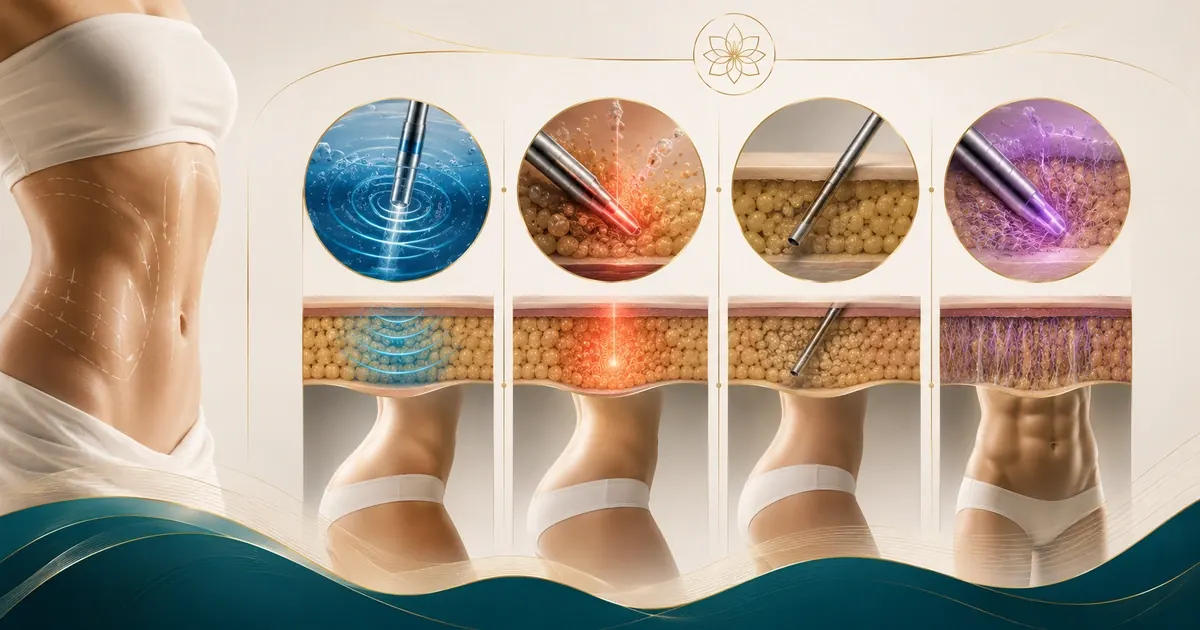
Understanding which liposuction technique is right for you starts with understanding that all modern techniques share the same foundation: tumescent infiltration of dilute anesthetic solution, followed by fat removal through small incisions. The differences between techniques lie in what happens between infiltration and aspiration — how the fat is disrupted before suctioning.
A nationwide analysis of 69,424 liposuction procedures found that outcomes are predominantly determined by patient selection, surgeon experience, and adherence to safety protocols — rather than the specific technology used.1 This finding is critical: the best technique is the one your surgeon is most experienced with for your specific goals. This guide brings together all the approaches covered in our liposuction types hub for a direct head-to-head analysis.
The Six Main Approaches
- Traditional SAL (Suction-Assisted Lipoplasty): Manual cannula movement physically dislodges fat before suctioning. The original and simplest technique.
- Tumescent: Technically an infiltration method (not an aspiration method), but often used to describe standard liposuction with tumescent local anesthesia and manual aspiration.
- VASER (UAL): Ultrasound energy emulsifies fat selectively before gentle aspiration. Tissue-selective — preserves vessels and nerves.
- Laser/SmartLipo (LAL): Laser fibre thermally liquefies fat and stimulates collagen before aspiration.
- PAL (Power-Assisted Lipoplasty): Motorised cannula vibrates rapidly, breaking apart fat with less surgeon effort. Brand names: MicroAire, Tickle Lipo.
- HD Liposuction: Not a technology but a technique — sculpting superficial fat for muscular definition, typically using VASER.
How Each Technique Works
Energy Source & Mechanism
| Technique | Energy Source | How Fat Is Disrupted | Tissue Selectivity |
|---|---|---|---|
| Traditional SAL | Mechanical (surgeon's arm) | Cannula physically tears fat from connective tissue | Low — non-selective mechanical force |
| VASER (UAL) | Ultrasound (36 kHz) | Cavitation bubbles rupture fat cell membranes; resonance frequency targets adipose | High — preferentially disrupts fat |
| Laser (LAL/SmartLipo) | Laser (1064–1440 nm) | Thermal energy liquefies fat; heats dermis for collagen stimulation | Moderate — thermal damage somewhat non-specific |
| PAL | Motorised vibration (2,000–4,000 rpm) | Rapid small-excursion oscillation breaks fat loose efficiently | Low–moderate — mechanical but more efficient than manual |
| HD Lipo (VASER-assisted) | Ultrasound + artistic sculpting | VASER emulsifies superficial fat; surgeon sculpts along muscle lines | High (VASER) + high precision (technique) |
What All Techniques Share
Despite their differences in fat disruption, all modern techniques share:
- Tumescent infiltration: All begin with dilute lidocaine-epinephrine solution
- Small incisions: All use 2–5 mm access ports
- Aspiration: All physically remove fat from the body via suction
- Compression garments: All require post-operative compression
- Similar recovery: All have broadly comparable recovery timelines
- Permanent fat removal: All produce permanent results (treated cells do not regenerate)
- Volume limits: All bound by the same 5-litre maximum safety guideline
Master Comparison Table
The following comprehensive table compares all major liposuction techniques across key decision factors:
| Factor | Traditional SAL | VASER | Laser (SmartLipo) | PAL |
|---|---|---|---|---|
| Fat disruption | Manual cannula | Ultrasound emulsification | Thermal liquefaction | Motorised vibration |
| Tissue selectivity | Low | High | Moderate | Low–moderate |
| HD sculpting | Possible (expert only) | Excellent (gold standard) | Limited | Good |
| Skin tightening | Via retraction only | Mild thermal effect | Moderate (collagen stimulation) | Via retraction only |
| Best volume range | Any (small to large) | Medium to large | Small to medium | Medium to large |
| Fibrous area performance | Difficult; high surgeon effort | Excellent | Moderate | Good (reduced fatigue) |
| Surgeon fatigue | Highest | Low (pre-emulsified fat) | Moderate | Lowest |
| Bruising | Moderate–high | Low–moderate | Low–moderate (coagulation) | Moderate |
| Fat transfer suitability | Moderate cell viability | High cell viability | Low (thermal damage to cells) | Moderate cell viability |
| Equipment cost to clinic | Lowest ($5K–$20K) | Highest ($80K–$150K) | High ($75K–$120K) | Moderate ($15K–$40K) |
| Patient cost premium | Baseline | +15–35% | +10–30% | +5–15% |
| Recovery speed | Standard | Slightly faster (less trauma) | Standard | Standard |
| Learning curve | Moderate | High (especially HD) | Moderate–high | Low–moderate |
Best Technique by Goal
Different goals require different approaches. This section helps match your primary objective to the most suitable technique.
| Your Primary Goal | Best Technique | Why | Alternative |
|---|---|---|---|
| General fat reduction / contouring | Traditional SAL or PAL | Most cost-effective; proven results; no unnecessary technology premium | VASER if fibrous areas involved |
| Six-pack / muscular definition | VASER HD | Gold standard for superficial sculpting; tissue-selective safety | PAL with experienced HD surgeon |
| Skin tightening + fat removal | Laser (SmartLipo) | Strongest evidence for collagen stimulation; small areas | Any technique + Renuvion adjunct |
| Large-volume removal (3–5 L) | PAL or VASER | PAL: reduced surgeon fatigue. VASER: less blood loss | Traditional SAL with experienced surgeon |
| Brazilian butt lift (fat transfer) | VASER | Highest fat cell viability for grafting; gentle harvest | PAL (moderate viability) |
| Male chest (gynecomastia) | VASER | Handles fibrous glandular tissue best; precise sculpting | Laser (coagulation benefit) |
| Chin / neck contouring | Laser or VASER | Laser: skin tightening in visible area. VASER: precision | Traditional SAL (effective at lower cost) |
| Lowest cost / budget priority | Traditional SAL | No proprietary equipment cost; effective for standard goals | PAL (minimal premium; efficiency saves time) |
| Revision / secondary liposuction | VASER | Navigates scar tissue; tissue-selective in previously treated areas | PAL (mechanical efficiency in fibrous tissue) |
Important Nuances
While the table above provides guidance, several important caveats apply:
- Surgeon expertise trumps technology. An experienced traditional SAL surgeon will outperform an inexperienced VASER surgeon every time. Choose the surgeon first, then discuss technology.
- Marketing ≠ evidence. Laser lipo's skin-tightening claims are supported but often overstated in marketing. The clinical difference between techniques for skin quality is modest for most patients.
- Combined approaches are common. Many surgeons use VASER for emulsification then PAL for aspiration, or traditional SAL for bulk removal then VASER for refinement.
Best Technique by Body Area
Different body areas have different fat characteristics — density, fibrousness, skin quality — that affect technique suitability.
| Body Area | Fat Characteristics | Recommended Technique | Rationale |
|---|---|---|---|
| Female abdomen | Soft; moderate depth | SAL, PAL, or VASER | Soft fat responds to any technique; choose by goal/budget |
| Male abdomen | Denser; more fibrous | VASER or PAL | Fibrous male fat benefits from pre-treatment; HD sculpting common goal |
| Flanks (love handles) | Moderately fibrous | VASER or PAL | Efficient disruption of dense flank fat |
| Upper back / bra rolls | Highly fibrous | VASER (preferred) | Most fibrous area — VASER's tissue selectivity excels |
| Male chest | Dense; glandular component | VASER | Handles mixed glandular/fat tissue; pectoral sculpting |
| Inner thighs | Soft; delicate skin | SAL or Laser | Soft fat; laser for skin tightening benefit in lax area |
| Outer thighs | Moderate density | SAL or PAL | Responds well to standard techniques |
| Arms | Soft; visible area | Laser or VASER | Skin tightening valuable in visible area; reduced bruising |
| Chin / neck | Small volume; thin skin | Laser or VASER | Precision important; skin quality critical in visible zone |
| Knees / ankles | Small, targeted deposits | SAL or Laser | Small areas; no technology premium justified for simple removal |
Safety Comparison
A systematic review of liposuction risks and complications across all techniques found that major complication rates are low and comparable when surgeons adhere to established safety protocols — particularly volume limits and appropriate patient selection.2
Technique-Specific Safety Considerations
| Technique | Unique Risk | Blood Loss | Overall Safety |
|---|---|---|---|
| Traditional SAL | Contour irregularity (aggressive technique) | Low (tumescent) | Excellent — longest track record |
| VASER | Thermal burns (rare; improper technique) | Very low (tissue-selective) | Excellent — 261-case study: zero major complications |
| Laser (SmartLipo) | Skin burns (inadequate probe movement) | Low (coagulation) | Good — safe when temperature monitored |
| PAL | Minimal unique risks beyond standard lipo | Low (tumescent) | Excellent — well-established; minimal additional risk |
| HD Lipo | Contour irregularity (superficial work); seroma | Low (VASER-assisted) | Good — higher minor complication rate (5–15%) |
What Matters Most for Safety
Based on published evidence including the 69,424-patient nationwide analysis, the factors that most strongly predict safety are:1
- Volume limits: Staying within 5 L maximum; ideally under 5% of body weight
- Surgeon experience: Higher case volume = lower complication rates
- Anesthesia choice: Local/MAC safer than general for liposuction alone
- Patient selection: Appropriate BMI, no uncontrolled comorbidities
- Facility accreditation: Proper emergency equipment and protocols
- Avoiding combined procedures: Adding tummy tuck or other surgeries increases risk
The specific liposuction technology used ranks lower than all of the above factors in determining patient safety. For comprehensive safety information, see our Is Liposuction Safe? evidence review.
Cost Comparison
Cost differences between techniques reflect equipment costs (passed to patients), additional operative time, and specialist expertise premiums. The following table shows total patient costs (surgeon + facility + anesthesia) by technique for common treatment scopes:
| Treatment Scope | Traditional SAL | VASER | Laser (SmartLipo) | PAL |
|---|---|---|---|---|
| Single small area (chin) | $2,500–$4,500 | $3,500–$6,000 | $3,500–$6,000 | $3,000–$5,000 |
| Single medium area (abdomen) | $3,500–$6,500 | $5,000–$9,000 | $4,500–$8,000 | $4,000–$7,000 |
| Abdomen + flanks | $5,500–$9,000 | $7,000–$12,000 | $6,500–$11,000 | $6,000–$10,000 |
| Lipo 360 | $7,000–$12,000 | $10,000–$16,000 | $9,000–$14,000 | $8,000–$13,000 |
| HD multi-area | N/A (not typical) | $12,000–$18,000+ | N/A (not typical) | $10,000–$15,000 |
Turkey All-Inclusive Pricing
| Treatment Scope | Traditional/PAL | VASER | HD VASER |
|---|---|---|---|
| Single area | $1,500–$3,000 | $2,500–$4,000 | $3,500–$5,500 |
| Abdomen + flanks | $2,500–$4,000 | $3,500–$5,500 | $5,000–$7,500 |
| Lipo 360 | $3,000–$5,000 | $4,500–$7,000 | $6,000–$9,000 |
| Full body (5+ areas) | $4,000–$6,500 | $5,500–$8,500 | $8,000–$12,000 |
Turkey all-inclusive prices cover surgeon, hospital, anesthesia, compression garments, medications, hotel (3–7 nights), and airport transfers. For detailed cost breakdowns by country, see our comprehensive liposuction cost guide. For Turkey-specific information, see our liposuction in Turkey guide.
Value Analysis: When Is the Premium Worth It?
- VASER premium IS worth it for: HD sculpting, fibrous areas, fat transfer harvesting, patients who can't afford revision
- VASER premium may NOT be worth it for: Simple soft-fat contouring (thighs, soft abdomen) where SAL/PAL achieves equivalent results
- Laser premium IS worth it for: Small areas (chin, arms) where skin tightening adds meaningful benefit
- Laser premium may NOT be worth it for: Large areas, patients with good skin elasticity, straightforward fat reduction
- PAL minimal premium is almost always worth it: Reduced surgeon fatigue means more consistent results in longer procedures
Recovery Comparison
Recovery timelines are broadly similar across techniques because the primary determinant of recovery is the volume of fat removed and tissue disruption rather than the specific technology. However, some differences exist:
Where Recovery Differs
- Bruising: VASER typically produces less bruising due to tissue selectivity; laser's coagulation may also reduce it slightly
- Swelling: HD lipo produces more swelling than standard (superficial work); otherwise similar
- Anesthesia recovery: The biggest differentiator — awake/local anesthesia means immediate post-op alertness vs hours of grogginess after GA
- Return to work: 2–7 days for all techniques (depending on job physicality and areas treated)
- Return to exercise: 2–4 weeks for standard; 4–6 weeks for HD
- Final result: 3–6 months for all techniques
For a detailed week-by-week breakdown applicable to all techniques, see our liposuction recovery timeline.
Frequently Asked Questions
-
There is no single "best" technique — the ideal choice depends on your goals, treatment area, fat volume, and budget. Traditional SAL is best for general contouring at the lowest cost. VASER is best for HD sculpting and fibrous areas. Laser (SmartLipo) may benefit small areas where skin tightening is a priority. PAL is most efficient for large volumes. Most importantly, the surgeon's expertise with their chosen technology is the strongest predictor of outcome — choose the surgeon first, then discuss technology.
-
VASER offers specific advantages: HD body sculpting capability, better performance in fibrous areas (male chest, back), less bruising from tissue-selective disruption, and higher fat cell viability for transfer procedures. For standard contouring in softer fat areas (female thighs, arms), traditional SAL produces comparable results at 15–35% lower cost. A randomised comparison found VASER produces higher fat-to-aspirate ratios, confirming its tissue-selective mechanism.3
-
All modern techniques have comparable safety when performed correctly. The anesthesia choice matters more than the device: tumescent local anesthesia has zero fatalities in 15,336 patients.4 The factors that most strongly predict safety are: volume limits, surgeon experience, appropriate patient selection, and facility accreditation. The nationwide 69,424-patient analysis confirms that safety is driven by surgeon protocols, not technology choice.1
-
Laser lipo (SmartLipo) has the strongest evidence for collagen stimulation — histological studies confirm new collagen formation from thermal energy. VASER also produces some thermal effect. In clinical practice, the skin-tightening difference between them is modest for most patients. Neither replaces surgical skin excision for significant laxity. For small areas (chin, arms) where skin tightening is the primary secondary goal, laser may have a slight edge. For larger areas, the choice is less meaningful.
-
All techniques can safely remove up to the recommended 5-litre maximum per session — the limiting factor is patient safety, not technology. For very large-volume cases, PAL may be most efficient (reduced surgeon fatigue over extended procedures) and VASER's pre-emulsification facilitates smoother large-volume aspiration. The maximum safe volume is determined by the patient's body size and medical status, not the device. All techniques produce comparable total fat removal when the same volume target is planned.
-
Recovery timelines are broadly similar across all techniques — determined primarily by fat volume removed and number of areas treated. VASER may produce slightly less bruising (tissue selectivity). The biggest recovery differentiator is anesthesia type: awake/local procedures have immediate post-op alertness versus hours of grogginess after general anesthesia. All techniques: 2–7 days to desk work, 2–4 weeks to exercise, 3–6 months for final result.