
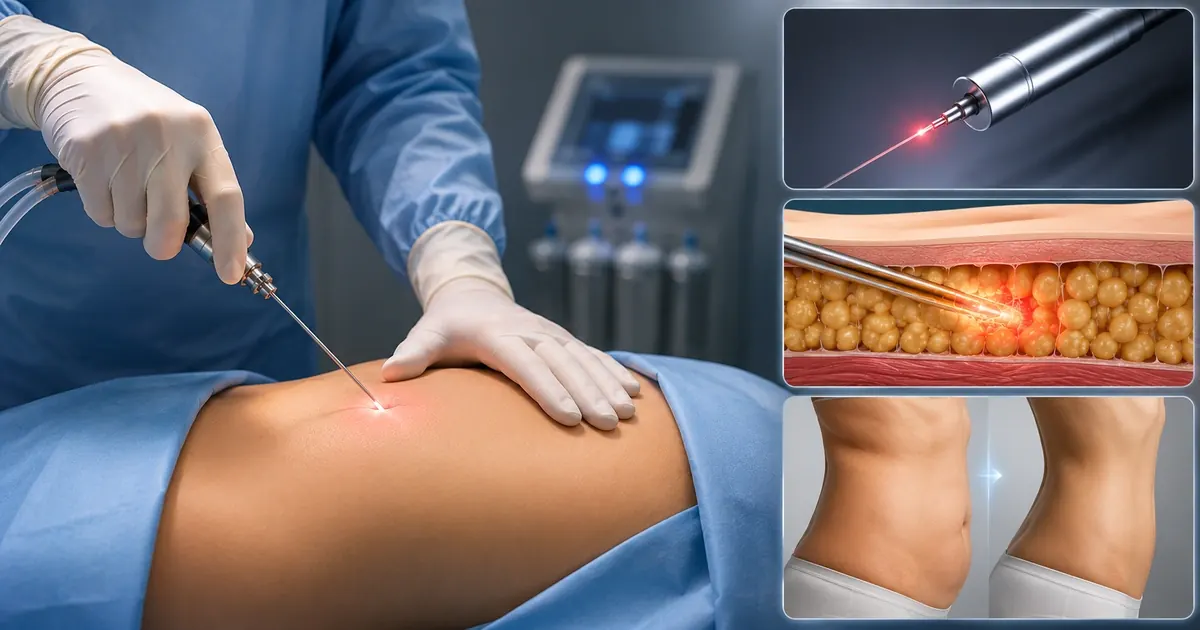
What Is Laser Liposuction?
Laser liposuction — marketed under brand names such as SmartLipo — is a form of liposuction in which a thin laser fibre is inserted through the same small cannula incisions used in traditional tumescent liposuction. The laser energy heats and ruptures fat cell membranes, liquefying the fat before it is suctioned out.
The term "laser liposuction" is often misunderstood. It is not a non-surgical or non-invasive treatment. It is surgical liposuction with laser assistance — incisions are still made, fat is still physically removed, and recovery is comparable to standard liposuction.
Different systems use different wavelengths: 1064 nm (SmartLipo's Nd:YAG), 924 nm and 975 nm (SlimLipo), 980 nm (diode laser systems), and 1320 nm (Nd:YAG second wavelength). Histological evaluation confirms that the 1064 nm Nd:YAG laser causes direct adipocyte rupture and coagulation, which is the mechanism behind fat liquefaction and the proposed skin-tightening effect.1 To see how laser lipo stacks up against every other method, visit our liposuction techniques overview.
How Laser Lipo Differs From Traditional & VASER
Laser lipo, traditional tumescent liposuction, and VASER (ultrasound-assisted) all remove subcutaneous fat through small incisions. The difference is how fat is broken up before aspiration.
| Feature | Traditional Tumescent | Laser Lipo | VASER |
|---|---|---|---|
| Fat disruption method | Manual cannula movement | Laser heat (liquefaction) | Ultrasound energy (emulsification) |
| Skin tightening claim | None specific | Yes — collagen stimulation | Some — thermal effect |
| Blood loss | Minimal (tumescent) | Minimal — coagulation reduces bleeding | Minimal |
| Best volume | Small to large | Small to medium | Medium to large |
| HD / definition work | Possible | Limited | Best suited |
| Relative cost | Baseline | +10–30% | +15–35% |
Research into the thermal effects of 1064/1320 nm laser-assisted lipolysis shows that the tissue heating reaches the dermis — which is the proposed mechanism for collagen remodelling and skin tightening — but the depth and uniformity of heating depends significantly on the surgeon's technique.2
Does Laser Lipo Actually Work? The Evidence
Laser lipo removes fat — that is not in question. The more nuanced question is whether it produces better outcomes than standard techniques, particularly the marketed benefit of skin tightening.
A randomised clinical trial comparing 980 nm diode laser-assisted lipolysis to traditional liposuction for submental fat found that both techniques were safe and effective at reducing fat volume, with no statistically significant difference in patient satisfaction or complication rates between the two groups.3
A 2025 review of laser-assisted lipolysis concluded that the technique is a safe and effective alternative to traditional liposuction, with particular advantages in smaller treatment areas — but acknowledged that high-quality randomised trial data comparing skin-tightening outcomes remains limited.4
What the evidence supports: Laser lipo removes fat as effectively as traditional lipo. It causes less intraoperative bleeding due to laser coagulation. The skin-tightening effect is real but variable — most pronounced in patients with mild-to-moderate skin laxity and good baseline elasticity.
What is not proven: A clinically meaningful, reliably superior improvement in skin tightening over standard tumescent liposuction in head-to-head randomised trials with long follow-up.
Best Candidates & Treatment Areas
Laser lipo is best suited to patients with small-to-medium fat deposits where some degree of skin tightening is also desired. Common treatment areas:
- Chin and neck — excellent results; skin tightening benefit most visible here
- Inner arms — popular for mild-to-moderate fat with some skin laxity
- Inner thighs — skin quality is key; significant laxity may need a thigh lift
- Abdomen and flanks — effective but VASER or standard tumescent may be preferred for larger volumes
- Male chest (pseudo-gynecomastia) — laser energy useful for fibrous male breast tissue
Laser lipo is not the best choice for: very large fat volumes (risk of overheating), significant skin laxity requiring surgical tightening, or high-definition abdominal etching (where VASER is better established).
As with all liposuction techniques, the procedure is appropriate for adults near their target weight with localised, diet-resistant subcutaneous fat — not for weight loss or visceral fat removal.
Results & Recovery
Recovery from laser liposuction is broadly similar to standard liposuction for the same area. The compression garment is worn for 3–6 weeks. Social downtime is typically 1–2 weeks; strenuous exercise resumes at 4–6 weeks.
Results timeline: initial contouring visible at 2–4 weeks as swelling subsides; final result — including any skin-tightening response — at 3–6 months. The skin-tightening component of the result continues to develop for up to 6 months as collagen remodelling progresses.
Read our full liposuction recovery timeline for a week-by-week breakdown of what to expect after any liposuction procedure.
Cost
Laser liposuction costs 10–30% more than standard tumescent liposuction for the same area, reflecting the cost of proprietary laser hardware and the longer operating time the technique requires. US total costs (surgeon + facility + anaesthesia + garment) typically run $3,500–$8,000 per area. Turkey all-inclusive prices for laser lipo average $1,800–$4,000.
Whether the premium is worth it depends on the specific case. For areas where skin tightening is a genuine secondary goal — arms, chin, inner thighs — the additional cost may be justified. For straightforward fat removal in larger areas, standard tumescent or VASER may produce equivalent results at lower cost. Read our full liposuction cost guide for country-by-country pricing.
Frequently Asked Questions
-
Yes — it removes fat effectively. A randomised trial found comparable fat reduction to traditional liposuction.3 The skin-tightening benefit is real but variable — it is not a replacement for surgical skin procedures when significant laxity is present.
-
SmartLipo is a brand name for laser-assisted liposuction using a 1064 nm Nd:YAG laser fibre (plus a 1320 nm wavelength in some models). Other brand names — SlimLipo, LipoLite, CoolLipo — use the same laser-liquefaction principle with slightly different wavelengths. All are surgical procedures with the same recovery requirements.
-
Neither is universally superior. VASER (ultrasound) is generally preferred for larger volumes, fibrous areas (male chest, upper back), and high-definition work. Laser lipo may be preferred for smaller areas where skin tightening is a primary secondary goal. The surgeon's experience with their chosen technology matters more than the technology itself.
-
Under anaesthesia (tumescent local with sedation or general), the procedure itself is not painful. Post-operative soreness, swelling, and bruising are expected for 1–2 weeks — similar to standard liposuction. The heat from the laser can cause mild additional tenderness near the skin surface in the first few days, which typically resolves with standard pain relief.
-
To a moderate degree — collagen stimulation from the heat does improve skin firmness over 3–6 months. But laser lipo is not a substitute for a surgical procedure (arm lift, neck lift, tummy tuck) when significant skin laxity is present. If skin elasticity is already good, laser lipo can maintain or slightly improve skin firmness — not dramatically reverse laxity.