
Why Lipo 360 Recovery Is Different
Lipo 360 (also called circumferential liposuction) treats the entire midsection — front (abdomen), sides (flanks), and back — in a single procedure. This circumferential approach means significantly more tissue is disrupted than in single-area liposuction, which directly affects recovery duration, swelling severity, fibrosis risk, and the timeline to final results. For general principles that apply to every procedure, start with our recovery hub.
Larger Treatment Area = Longer Recovery
A review of 1,000 consecutive abdominoplasty-with-circumferential-liposuction cases demonstrated that while outcomes are excellent, the circumferential approach requires careful post-operative management due to the scale of tissue disruption.1 The larger the treatment area, the more inflammatory response the body mounts, the more fluid accumulates, and the longer the lymphatic system takes to clear it. This is why Lipo 360 recovery consistently takes 2–4 weeks longer than single-area procedures to reach equivalent milestones.
Higher Volume = More Swelling
Lipo 360 typically involves removing more total fat volume than single-area liposuction — often 2–5 litres across all treated zones. Higher volume removal creates more dead space, more inflammatory fluid production, and more prolonged swelling. This is why the final result after Lipo 360 can take 4–6 months to become fully visible, compared to 3–4 months for smaller procedures.
Circumferential Compression Is Mandatory
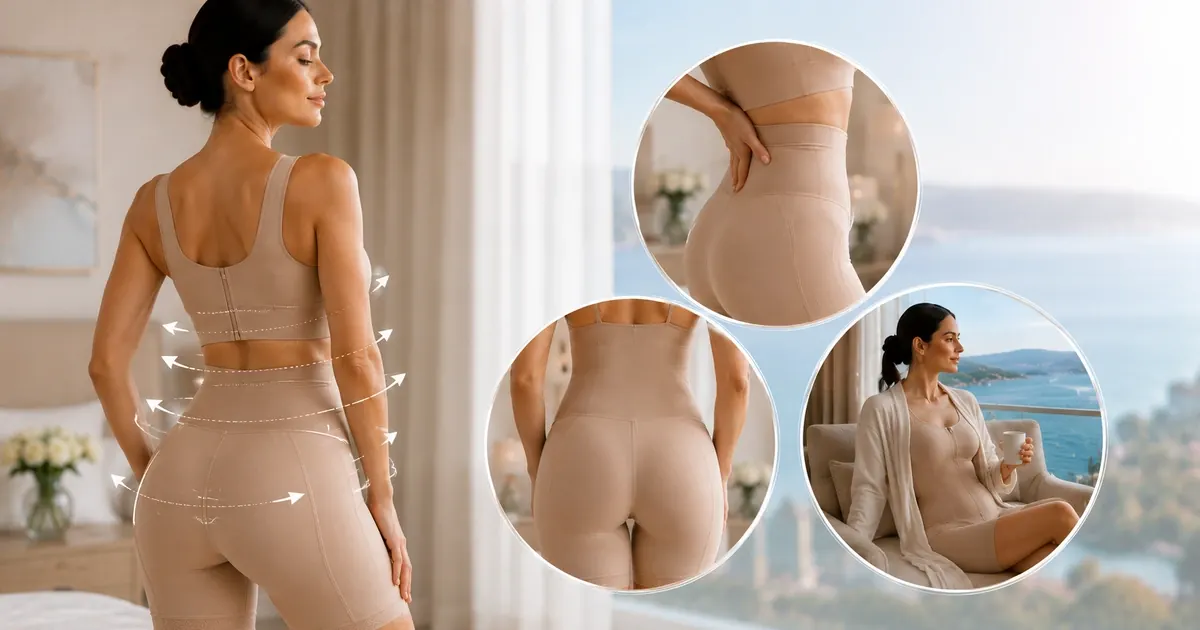
Because the treatment wraps around the entire torso, the compression garment must provide 360-degree coverage. A garment that only covers the front (as might be used for isolated abdominal liposuction) leaves the flanks and back unsupported, allowing fluid to migrate to unsupported areas and increasing the risk of asymmetric healing and fibrosis.
| Recovery Milestone | Single-Area Lipo | Lipo 360 |
|---|---|---|
| Return to desk work | 5–10 days | 7–14 days |
| Compression garment duration | 6 weeks | 8 weeks |
| Light cardio | Week 3 | Weeks 4–5 |
| Full exercise | Week 6 | Weeks 6–8 |
| Swelling 80% resolved | Month 2 | Month 3 |
| Final result visible | 3–4 months | 4–6 months (up to 9) |
| Fibrosis risk | Moderate | Higher |
| MLD importance | Recommended | Strongly recommended |
Day-by-Day Lipo 360 Recovery Timeline
The following timeline is specific to Lipo 360 and reflects the extended recovery inherent to circumferential procedures. Individual timelines vary based on the volume removed, whether additional procedures were performed (such as BBL), and individual healing response.
| Day / Week | What to Expect | What to Do |
|---|---|---|
| Day 0 (surgery) | Discharged in full-body compression garment; groggy from anaesthesia; tumescent fluid draining | Rest; have someone with you; absorbent pads under you; take prescribed medication |
| Day 1 | Significant swelling around entire torso; heavy fluid drainage; soreness; stiffness | Gentle short walks every 1–2 hours (DVT prevention); stay hydrated; sleep on back elevated |
| Days 2–3 | Peak swelling at 48–72h; bruising emerging on abdomen, flanks, back; fluid drainage slowing | Continue walking; shower if approved (48h); manage pain with prescribed medication |
| Days 4–7 | Swelling beginning to soften; bruising spreading (may migrate to hips/thighs); drainage mostly stopped | Increase walking distance; light household tasks; stay in compression garment 24/7 |
| Week 2 | Bruising fading; swelling significant but improving; first signs of contouring under garment | Desk work if tolerated; begin MLD sessions if surgeon approves; low-sodium diet |
| Weeks 3–4 | Bruising largely resolved; swelling reducing; fibrosis developing (firmness around torso) | MLD 2–3x/week; transition to Stage 2 garment if approved; gentle outdoor walks |
| Weeks 5–6 | Contour emerging clearly; fibrosis peaking; swelling 50–60% resolved | Light cardio (stationary bike); part-time compression; continue MLD |
| Weeks 7–8 | Fibrosis beginning to soften; swelling 60–70% resolved; garment may be discontinued | Resume full exercise gradually; final garment phase; surgeon follow-up |
| Months 3–4 | 80–90% of final result visible; residual fibrosis softening; skin retracting | Full activity; self-massage for residual fibrosis; hydration |
| Months 4–6+ | Final result visible; all swelling resolved; skin fully conformed; contour stable | No restrictions; maintain result with healthy lifestyle |
Week 1: The Most Challenging Phase
The first week after Lipo 360 is more challenging than after single-area liposuction because the entire torso is swollen and sore simultaneously. Simple tasks like getting out of bed, dressing, and showering require more effort. Having someone to help you during the first 3–5 days is essential — not optional. Prepare your recovery space in advance: a recliner or bed with extra pillows, water and medications within reach, absorbent pads for drainage, and loose clothing that doesn't need to go over your head.
Weeks 2–4: Steady Improvement
A prospective study of 360 patients treated with liposuction, lipoabdominoplasty, and abdominoplasty confirmed that the most significant improvement occurs during weeks 2–6 as swelling resolves and the contour begins to emerge.2 This is also when lymphatic drainage massage (MLD) has its greatest impact — starting at weeks 1–2 and continuing through week 6. Most patients feel significantly better by the end of week 2 and are able to manage daily activities independently.
Compression for Lipo 360
Compression is arguably more important for Lipo 360 than for any other liposuction procedure. The circumferential nature of the treatment means that fluid can accumulate anywhere around the torso — and without 360-degree compression, it will migrate to the area of least resistance, causing asymmetric swelling and potentially asymmetric results.
Full-Body 360° Garment
Lipo 360 requires a purpose-designed full-body compression garment that provides even pressure around the entire circumference of the torso. The garment should extend from below the chest to the hips (or lower if the thighs were also treated). Front-closure designs are essential for the first 3 weeks when mobility is limited. The garment must not ride up, gap, or create pressure ridges — these can cause uneven fluid distribution and contour irregularity.
Extended Compression Protocol for 360
While standard liposuction uses a 6-week compression protocol, Lipo 360 typically requires 8 weeks:
- Weeks 1–3: Stage 1 garment, 24 hours/day (remove only to shower)
- Week 3: Transition to Stage 2 garment (surgeon approval required)
- Weeks 4–6: Stage 2 garment, 12–16 hours/day (night + part of day)
- Weeks 7–8: Stage 2 garment, night-only or as directed
- After week 8: Discontinued (or continued at patient preference for comfort)
Board and Foam Inserts
Some surgeons prescribe ab boards (flat foam inserts) or lipo foam to be worn under the garment over the first 3–4 weeks. These inserts provide additional, targeted compression to the abdomen — the area most prone to fluid accumulation and fibrosis. They help prevent garment bunching and ensure even pressure across the front of the torso. Follow your surgeon's specific recommendations regarding inserts.
Sleeping Positions After Lipo 360
Sleep positioning after Lipo 360 is more restrictive than after single-area liposuction because every surface of the torso has been treated. Any sleeping position that places direct, prolonged pressure on one treated area can cause uneven fluid distribution, compression marks, and potentially affect the final contour.
| Position | When Permitted | Notes |
|---|---|---|
| Back (elevated 20–30°) | From day 0 — the recommended position | Use a wedge pillow or stacked pillows; reduces swelling; easiest for getting up |
| Back (flat) | From week 2 | Acceptable once acute swelling subsides; pillow under knees for comfort |
| Side sleeping | From week 3–4 (surgeon approval) | Pillow between knees; alternate sides; avoid prolonged pressure on one flank |
| Stomach sleeping | From week 6+ (surgeon approval) | Last position to resume; places direct pressure on abdomen; avoid until fibrosis is resolving |
Why Elevation Matters
Sleeping with the upper body elevated at 20–30 degrees during the first 2 weeks serves multiple purposes: it reduces abdominal swelling by encouraging gravitational fluid drainage, it makes getting in and out of bed easier when your core muscles are sore, and it reduces pressure on the back and flanks compared to lying completely flat. A foam wedge pillow is the most comfortable option — regular pillows tend to shift during the night.
Tips for Comfortable Sleep
Sleep is often disrupted during the first 1–2 weeks after Lipo 360. Practical tips: place a pillow under your knees to reduce lower back strain, keep the compression garment on (it provides support), use light bedding to avoid overheating, take prescribed pain medication 30 minutes before bed, and keep water and a phone within arm's reach so you don't need to twist or strain to reach them.
Activity Restrictions for Lipo 360
Most surgeons recommend following structured activity guidelines, as this produces better outcomes than self-directed early return to exercise. For Lipo 360, activity restrictions are slightly more conservative than for single-area procedures.
Walking: From Day 1
Gentle walking is not just permitted — it is strongly encouraged from day 1–2. Short walks (5–10 minutes) every 1–2 hours while awake help prevent DVT (deep vein thrombosis), promote lymphatic drainage, reduce stiffness, and improve mood. Do not remain sedentary or in bed all day. Walking speed and distance gradually increase over the first 2 weeks.
Return to Work
Desk or remote work: 7–14 days. Physical or standing work: 2–3 weeks minimum. If your job involves heavy lifting, bending, or strenuous physical activity, expect 3–4 weeks before you can work comfortably. Many patients who work from home return to light tasks within 5–7 days.
Exercise Progression
- Weeks 1–3: Walking only — increasing distance and pace gradually
- Weeks 4–5: Light cardio — stationary cycling, gentle swimming, elliptical (low resistance)
- Week 6: Moderate cardio — brisk walking, cycling with resistance, swimming laps
- Weeks 6–8: Light resistance training — upper body first; avoid core-intensive exercises
- Week 8+: Full exercise including core training — crunches, planks, deadlifts, HIIT
Activities to Avoid
During the first 6 weeks: heavy lifting (more than 5 kg during weeks 1–3; more than 10 kg during weeks 4–6), running or high-impact exercise, sexual activity (first 2–3 weeks), hot tubs, saunas, or steam rooms, prolonged sun exposure on treated areas, and any activity that causes the compression garment to become displaced.
Fibrosis Risk with Circumferential Liposuction
Fibrosis is more common and potentially more significant after Lipo 360 than after single-area liposuction. The circumferential treatment disrupts tissue around the entire torso, creating a larger inflammatory response and more dead space for fluid to accumulate — the primary driver of fibroblast activation and collagen deposition.
Why 360 Increases Fibrosis Risk
The total volume of tissue disrupted in Lipo 360 is 2–4 times greater than in a single-area procedure. More disrupted tissue means more inflammatory mediators released, more dead space created, more interstitial fluid produced, and consequently more fibroblast activation. Additionally, the circumferential compression garment — while essential — can create zones of slightly uneven pressure at seams and edges, leading to localised fluid accumulation and potentially localised fibrosis.
Prevention Is Critical
Because fibrosis risk is elevated, prevention measures are particularly important for Lipo 360 patients:
- Compression: 8 weeks of consistent wear (not 6) — the extended protocol is specifically because of the higher fibrosis risk
- MLD: Start early (1–2 weeks post-surgery) and attend at least 6–8 sessions. Consider additional sessions if fibrosis is developing significantly.
- Activity: Avoid strenuous exercise for 6–8 weeks. Early exercise increases inflammation and fluid production.
- Hydration: 2–3 litres of water daily to support lymphatic clearance
- Follow-up: Attend all scheduled surgeon follow-ups. Early detection of excessive fibrosis allows early intervention.
Managing Fibrosis If It Develops
If fibrosis develops despite preventive measures (which is common), continue compression, increase MLD frequency, consider self-massage once approved by your surgeon, and be patient — most Lipo 360 fibrosis resolves over 3–6 months. For persistent fibrosis beyond 4–6 months, treatment options include therapeutic ultrasound, radiofrequency therapy, and in rare cases, steroid injection or revision. See our detailed fibrosis guide for comprehensive management strategies.
When to See Final Results After Lipo 360
The timeline to final results after Lipo 360 is one of the most common questions — and one of the most important to set realistic expectations for. The final contour is not visible at 2 weeks, 4 weeks, or even 2 months. Patience is essential.
| Timepoint | What You'll See | % of Final Result |
|---|---|---|
| 2 weeks | Bruising fading; still very swollen; some early contouring visible under garment | 20–30% |
| 4 weeks | Swelling reducing; contour emerging; fibrosis may distort appearance | 40–50% |
| 6 weeks | Clearer contour; fibrosis peaking; swelling 50–60% resolved | 55–65% |
| 3 months | Near-final contour; fibrosis softening; skin retracting | 80–90% |
| 4–6 months | Final result for most patients; all swelling resolved; contour stable | 95–100% |
| 6–9 months | Final result for large-volume or slow-healing patients | 100% |
Why Patience Matters
It is extremely common for patients to feel disappointed or anxious at 2–4 weeks after Lipo 360 because they do not yet see the result they expected. The swollen, firm, sometimes lumpy appearance at this stage is normal healing — not the final result. Comparing your appearance at 3 weeks to a surgeon's "after" photo (typically taken at 3–6 months) is misleading and anxiety-inducing. Trust the process: the best results come to patients who wear their garment consistently, attend their MLD sessions, follow activity restrictions, and allow the full timeline for healing.
Factors That Delay Final Results
Certain factors can extend the timeline beyond 6 months: very large volume removed (more than 4–5 litres), significant fibrosis that is slow to resolve, inconsistent compression garment wear during the first 8 weeks, combined procedures (such as BBL with Lipo 360), and individual variation in inflammatory response and skin retraction speed.
Frequently Asked Questions
-
Desk work: 1–2 weeks. Compression garment: 8 weeks. Full exercise: 6–8 weeks. Final result: 4–6 months (up to 9 months for large-volume cases). Recovery is longer than single-area lipo due to the circumferential treatment, as documented in the 1,000-case review.1
-
On your back, elevated 20–30° for the first 2 weeks. Use a wedge pillow or stacked pillows. Side sleeping from week 3–4 (surgeon approval; pillow between knees). Stomach sleeping from week 6+. Avoid positions that put prolonged pressure on one treated area.
-
Walking from day 1–2. Light cardio at weeks 4–5. Full exercise at weeks 6–8. Core-intensive exercises (crunches, planks, deadlifts) should wait until week 8+ because they engage the entire treated circumference.
-
Yes — fibrosis risk is higher after Lipo 360 because the circumferential treatment creates more tissue disruption, more inflammation, and more dead space. Consistent compression (8 weeks) and early MLD sessions are particularly important for 360 patients.
-
Early improvement at 2–4 weeks. 80–90% visible at 3–4 months. Final result at 4–6 months (up to 9 months for large-volume cases). Do not judge your result at 2–4 weeks — swelling and fibrosis at this stage are masking the final contour.