
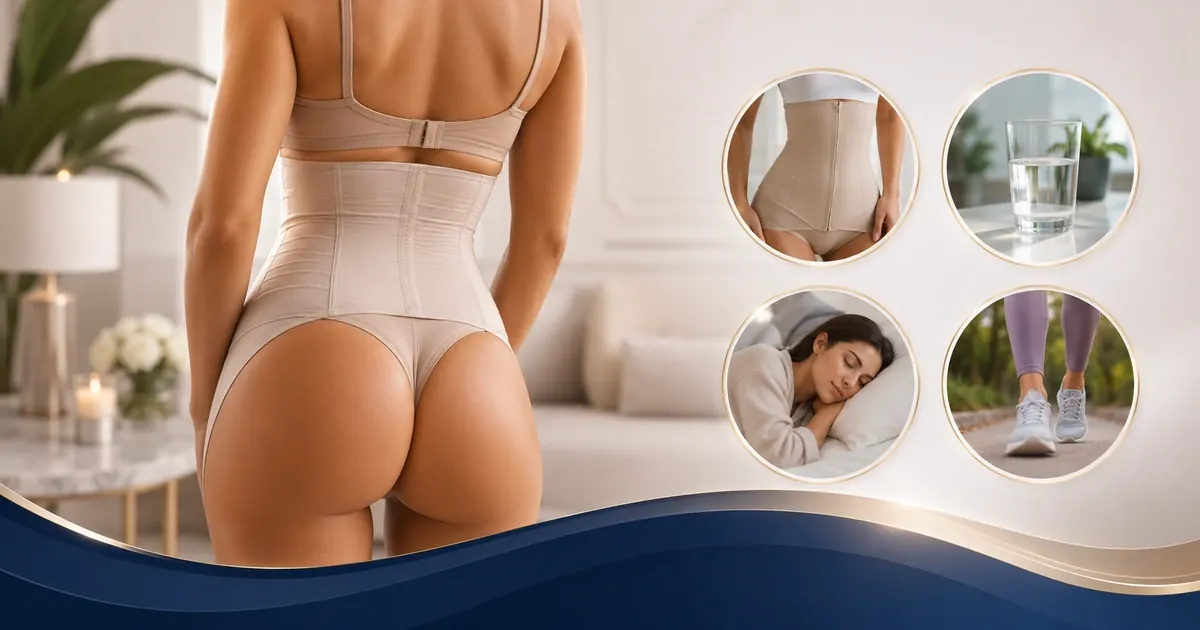
The First 72 Hours After Lipo 360
The first three days are the most physically demanding part of recovery. Because Lipo 360 treats the full midsection — abdomen, flanks, love handles and lower back — the total area of tissue disturbance is greater than with single-site liposuction.
What to expect immediately after surgery:
- Tumescent fluid drainage: Surgical fluid (tumescent solution) drains from the small incision sites for 12–36 hours post-operatively. This is normal and expected — the incisions are intentionally left partially open to allow drainage. Blood-tinged fluid on the compression garment and dressings is typical. Have absorbent pads available.
- Swelling begins immediately and increases over the first 2–3 days. This is normal inflammatory response.
- Compression garment: Applied in the operating room and worn continuously for the first 2–3 weeks. Do not remove it without your surgeon's instruction in the first 48 hours.
- Pain and soreness: The midsection feels sore and tight. Prescribed pain medication or NSAIDs as directed by your surgeon manages this. Most patients describe it as feeling like severe muscle soreness.
- Mobility: Walking slowly is encouraged from day 1 to promote circulation and reduce DVT risk. Do not remain sedentary.
- Sleeping position: Most surgeons recommend sleeping on your back with knees slightly elevated. Side sleeping is uncomfortable in the first week and may put uneven pressure on treated areas.
Managing Tumescent Drainage
During tumescent liposuction, large volumes of saline solution mixed with lidocaine and epinephrine are injected into the fat before removal. A significant proportion of this fluid — typically 30–70% — remains in the tissue immediately after surgery and drains out through the small incision points over the following 24–36 hours.
This drainage can look alarming: it is often blood-tinged or pink and can soak through dressings and the compression garment. This is entirely expected and does not mean something has gone wrong. Practical management steps include:
- Absorbent pads: Place disposable incontinence or surgical pads between your skin and the compression garment during the first 24 hours. Replace as needed.
- Protect your bedding: Sleep on a waterproof mattress protector or old towels for the first night or two. Drainage is most significant during the first 12 hours.
- Do not plug or seal the incisions during the drainage phase — this is a common mistake. The fluid needs to escape to reduce swelling. Your surgeon will let you know when the incision sites can be closed or covered.
- When drainage stops: Most patients find drainage has ceased or become minimal by the end of day 2. If active drainage is still present after 48 hours, contact your surgeon.
Pain Management in the First 48 Hours
Pain after Lipo 360 is typically moderate — most patients describe the sensation as severe muscle soreness or a deep aching tightness rather than sharp surgical pain. The use of tumescent solution containing lidocaine provides local anaesthetic effect for the first 8–18 hours post-operatively, which means pain often intensifies somewhat as the lidocaine wears off.
Standard pain management approaches after Lipo 360 include:
- Prescribed analgesics: Your surgeon will typically prescribe a short course of oral pain medication (commonly paracetamol/acetaminophen combined with a mild opioid for the first 1–3 days, or NSAIDs where appropriate). Take as directed — do not wait for pain to become severe before taking your first dose.
- NSAIDs: Some surgeons prefer ibuprofen for its combined analgesic and anti-inflammatory effect; others avoid NSAIDs in the immediate post-operative period due to bleeding concerns. Follow your surgeon's specific instruction on this point.
- Avoid aspirin in the first 2 weeks unless specifically prescribed, as it increases bleeding risk.
- Cold compresses: Applying a covered ice pack to the outer surface of the compression garment (never directly on the skin) for 15–20 minutes at a time can reduce discomfort and swelling in the first 48 hours.
- Positioning: Keeping a pillow under your knees while lying on your back reduces pressure on the abdominal area and can meaningfully decrease discomfort.
Pain that is severe, getting significantly worse after day 2, or accompanied by fever should be reported to your surgeon promptly — these are not typical features of normal Lipo 360 recovery.
Weeks 1–2: Bruising, Swelling, Returning to Work
Most of the visible changes — bruising and peak swelling — occur and then begin to improve during weeks 1–2. A large study on postoperative activity restrictions after plastic surgery procedures confirmed that most patients return to desk work within 1–2 weeks following liposuction.1
| Timeframe | Typical experience | Activity level |
|---|---|---|
| Day 1–3 | Peak soreness; drainage from incisions; begins swelling. Bruising appears (may look alarming initially — this is normal). | Rest at home; slow walking encouraged |
| Day 3–5 | Swelling at its maximum. Bruising begins to colour-shift (purple → green/yellow). Drainage stops. Less pain but significant tightness. | Light around-the-home activity; short walks |
| Days 5–10 | Swelling begins to reduce. Bruising fading. Energy returning. Most patients feel comfortable being upright for longer periods. | Return to sedentary/desk work possible for most |
| Week 2 | Visible bruising largely resolved in most patients. Swelling still present (noticeable mainly in morning). Social activity becomes comfortable. | Desk work; light daily activity; no lifting |
A note on the "three-week lump": Many patients notice firmness or lumpy texture in treated areas at weeks 1–3. This is early-stage fibrosis (scar tissue formation) and is a normal part of healing, not a complication. It typically resolves over 2–3 months.
Fibrosis after liposuction — causes, prevention and treatment →When You Can Return to Work
The timing of returning to work after Lipo 360 depends significantly on the nature of your job. Most patients can return to sedentary or desk-based work within 5–10 days, but physically demanding jobs require a longer absence.
| Job type | Typical return window | Notes |
|---|---|---|
| Desk / office / remote | Days 5–10 | Take breaks to walk every 60–90 minutes to reduce DVT risk. Sitting for long periods increases abdominal pressure on treated tissue. |
| Light standing work (retail, reception) | Weeks 1–2 | Prolonged standing increases swelling. Compression garment must be worn. Take seated breaks when possible. |
| Physical / manual labour | Weeks 3–6 (surgeon-directed) | Lifting, bending, and physical exertion must be avoided until week 6. Modified duties may allow earlier return. |
If you work remotely, many patients find they can manage light work from home by day 5–7, interspersed with rest. The key limiting factors in the first week are fatigue from anaesthesia, discomfort in a seated position, and the need to wear and manage the compression garment. Discuss your specific work circumstances with your surgeon before planning your return.
Weeks 3–6 & Beyond: Contour Emerging, Final Results
From week 3 onward, the body's healing accelerates. Swelling reduces significantly, early fibrosis softens with massage and time, and the new contour begins to emerge.
| Timeframe | What's happening | Activity |
|---|---|---|
| Weeks 3–4 | Majority of swelling resolved. Skin retraction ongoing. Firmness in treated areas (fibrosis) softens. Early contour visible. | Light cardio (walking, light cycling); no weight training |
| Weeks 4–6 | Garment transitions to Stage 2 (or night-only in some protocols). Contour much more defined. Energy fully normal. | Return to most exercise by week 6 (surgeon-directed) |
| Months 2–3 | Residual swelling resolving. Skin tightening ongoing. Fibrosis fully resolved in most patients. | All activity normal |
| Months 3–6 | Final results visible. Skin retraction complete. Contour stable. | Normal |
A study on activity restrictions following liposuction found that adhering to staged return-to-activity guidelines was associated with better outcomes and fewer complications.2 Follow your surgeon's specific instructions rather than generic timelines — individual recovery varies.
Gradual Return to Exercise
Returning to exercise too early after Lipo 360 is one of the most common causes of prolonged swelling and suboptimal results. Exercise increases blood pressure and fluid movement in treated tissue, which can worsen swelling and delay the healing of disrupted lymphatic vessels. A staged approach is essential:
- Week 1–2 (walking only): Slow, short walks from day 1 are strongly encouraged to prevent blood clots. These should be gentle — 10–15 minutes at a time, not brisk walking or anything that raises your heart rate significantly.
- Weeks 2–3 (extended walking): As soreness improves, walking duration can increase. This is still the only recommended activity. Avoid anything that engages the core or raises heart rate above a light level.
- Weeks 3–4 (light cardio): With surgeon approval, many patients can begin light cycling (stationary bike at low resistance), gentle swimming, or extended brisk walking. No abdominal exercises, weight training, or high-impact activities.
- Week 6+ (return to full exercise): Most surgeons clear patients for full exercise — including weight training, running, HIIT, and core exercises — at the 6-week post-operative appointment. Do not begin these activities without explicit clearance from your surgeon.
Note that if your surgeon performed concurrent procedures (such as a BBL with Lipo 360), your exercise restrictions will differ — particularly regarding seated positions and glute loading after fat transfer. Always refer to your surgeon's specific written post-operative instructions.
Compression Garments for Lipo 360
Because Lipo 360 treats the full midsection circumference, the compression garment must cover the entire abdomen, flanks, and lower back — typically a high-waist short or torso wrap. Most protocols involve two stages:
- Stage 1 (weeks 1–2/3): A foam-lined or surgical-grade compression garment worn 24 hours a day. Firm compression supports drainage, minimises swelling, and holds skin in contact with underlying tissue to promote retraction.
- Stage 2 (weeks 3–6): A lighter compression garment, often worn 12–23 hours per day (removed for showering and brief periods).
Research on compression garments following tumescent liposuction confirmed their role in reducing fluid accumulation, improving comfort, and supporting skin contraction.3 Do not stop wearing the garment early without your surgeon's approval — early discontinuation can increase swelling and slow skin retraction.
Compression garments after lipo — full guide including stages and hygiene →
Lymphatic Massage (MLD) After Lipo 360
Manual lymphatic drainage (MLD) is a gentle massage technique designed to promote lymphatic circulation and reduce post-surgical fluid retention. It is widely recommended by surgeons after liposuction, particularly after larger procedures like Lipo 360.
The evidence for its benefit is mixed — a study of MLD in post-surgical liposuction patients found it may reduce early swelling and improve comfort, but noted that more rigorous controlled trials are needed.4 In practice, most patients find it comfortable and helpful; your surgeon will advise whether and when to begin.
MLD is typically started at days 5–10 (once drainage has stopped and surgical soreness permits), performed by a trained therapist, and continued for 4–8 sessions over the first 4 weeks.
How Lipo 360 Recovery Differs From Single-Area Lipo
Patients who have researched standard abdominal liposuction or flanks-only procedures sometimes underestimate how much longer and more involved Lipo 360 recovery can be. The difference is significant enough to warrant careful planning.
Why Full Circumferential Treatment Means More Swelling
Single-area liposuction disturbs lymphatic vessels and tissue in one defined region. Lipo 360, by treating the entire midsection circumference simultaneously, disrupts lymphatic drainage across a much wider area — the abdomen, both flanks, the waist, and the lower back are all treated in the same procedure.
This has several consequences for swelling:
- Greater total fluid volume: More tumescent solution is injected and remains in tissue post-operatively. The body must process and eliminate this larger fluid volume over a longer period.
- Wider lymphatic disruption: Lymphatic vessels run throughout the treated tissue and are temporarily disrupted by the cannula during fat removal. With a larger treated area, more lymphatic channels are affected, slowing the overall rate of fluid clearance.
- Longer peak swelling duration: Single-area lipo patients may see peak swelling resolve by week 2; Lipo 360 patients often see peak swelling persist until weeks 3–4.
- Waistband effect: The compression garment must provide 360-degree coverage. Any gap in compression — at the sides, the back, or the lower abdomen — creates a channel where fluid accumulates preferentially. Proper garment fit is therefore more critical than in single-area procedures.
Positional Challenges: Sleeping and Sitting
Single-area abdominal liposuction patients can often manage discomfort by sleeping on their side or back. Lipo 360 patients face a more complex positional challenge: every surface of the midsection is treated, so there is no neutral or comfortable resting position in the first week.
- Sleeping on your back is the standard recommendation for the first 2 weeks. It distributes body weight away from the flanks and lower back, both of which are treated areas, and allows the compression garment to work evenly across all zones.
- Side sleeping creates direct pressure on the flank — a treated area — which can be uncomfortable and may temporarily worsen asymmetric swelling. Most patients can tolerate side sleeping by weeks 2–3 as soreness diminishes.
- Sitting for prolonged periods puts direct pressure on the lower back treatment zone. Take regular standing breaks (every 60–90 minutes) and use a cushion to reduce direct pressure. Avoid hard, unsupported seating in the first 2 weeks.
- Bending and twisting: Movements that compress or stretch the midsection are uncomfortable and may displace garment positioning. Minimise these in the first 1–2 weeks and move slowly and deliberately when necessary.
Compression Garment Complexity for Multiple Zones
A compression garment for single-area abdominal liposuction is relatively straightforward — it needs to cover the front of the abdomen evenly. For Lipo 360, the garment must achieve uniform compression across the full torso circumference, including areas that are structurally different in shape (the curved lower back, the indented flanks, the convex abdomen).
Common challenges Lipo 360 patients face with garment management include:
- Rolling or bunching at the back: The lower-back section of the garment can roll down, creating a pressure ridge. A properly fitted garment with a wide back panel minimises this. If rolling is persistent, contact your surgeon — the garment may need adjustment or replacement.
- Sizing changes: Swelling fluctuates across the first 3 weeks, meaning a garment that fits well on day 3 may be loose by week 3 as swelling resolves. Many patients require two different garment sizes during their recovery. This is normal and expected — not a sign of poor results.
- Hygiene management: Because the garment is worn near-continuously, maintaining hygiene requires having at least two garments in rotation so one can be washed while the other is worn. Washing guidelines typically specify hand-washing or machine-washing in a mesh bag on a gentle cycle.
| Recovery factor | Single-area liposuction | Lipo 360 |
|---|---|---|
| Total treatment area | 1 zone (e.g., abdomen only) | 3–4 zones (abdomen, flanks, waist, lower back) |
| Peak swelling duration | Days 3–5; largely resolved by week 2 | Days 3–5; substantially resolved by weeks 3–4 |
| Bruising extent | Localised to treated zone | Circumferential; may extend to thighs in some patients |
| Comfortable sleeping position | Side sleeping usually possible by week 1 | Back sleeping recommended for 2 weeks; flanks and lower back tender |
| Compression garment fit challenge | Moderate — front panel only critical | High — 360° even coverage required |
| Return to desk work | Days 3–7 (most patients) | Days 5–10 (most patients) |
| Return to full exercise | Weeks 4–6 | Week 6 (strictly enforced due to larger treated area) |
| Final results timeline | 2–3 months | 3–6 months |
Warning Signs During Recovery
Most Lipo 360 recoveries are straightforward, but it is important to know which symptoms require prompt medical attention and which are normal parts of healing. The table below covers the most clinically significant warning signs.
| Symptom | Typical timing | Action | Urgency |
|---|---|---|---|
| Fever above 38.3°C (101°F) | Any point post-op | Contact surgeon within hours. May require antibiotics or wound review. | High |
| Increasing pain (not decreasing) after day 3 | Day 3 onward | Contact surgeon same day. Normal recovery pain decreases after day 3; increasing pain suggests infection or seroma formation. | High |
| Redness, warmth, hardness, or pus at incision sites | Days 3–14 most common | Contact surgeon. Signs of wound infection requiring assessment and likely antibiotic treatment. | High |
| Sudden large fluid-filled lump (seroma) | Days 5–21 most common | Contact surgeon for assessment. Most seromas require aspiration (a minor in-office procedure). Do not attempt to drain yourself. | Medium–High |
| Significant firm, tender haematoma (blood collection) | Days 1–7 most common | Contact surgeon same day. Small haematomas may resorb; larger ones may require drainage. | High |
| Shortness of breath, chest pain, rapid heartbeat, or coughing blood | Days 1–14 (DVT/PE risk window) | Call emergency services immediately (999/911/112). These are potential signs of pulmonary embolism — a rare but life-threatening complication. Do not wait to contact your surgeon first. | Emergency |
| Calf pain, swelling, or redness in one leg | Days 1–14 | Contact surgeon or seek emergency assessment same day. May indicate deep vein thrombosis (DVT), which requires urgent anticoagulant treatment. | High — seek same-day assessment |
| Atypical worsening swelling on one side after week 4 | Week 4 onward | Contact surgeon. Late-onset asymmetric swelling can indicate delayed seroma, lymphocele, or inadequate compression over one zone. | Medium |
What is not a warning sign: Lumps, firmness and uneven texture in the treated area at weeks 1–6 are normal fibrosis during healing and typically resolve fully over 2–3 months. Mild asymmetric swelling that gradually improves is also normal (see FAQ below). These do not require urgent contact with your surgeon, though you should mention them at your next scheduled follow-up appointment.
Frequently Asked Questions
-
Most Lipo 360 patients return to light desk work within 1–2 weeks, social activity by weeks 2–3, and full exercise by week 6. Final results appear at 3–6 months. Recovery is longer than single-area liposuction because the total treatment area is larger.
-
Most surgeons recommend sleeping on your back for the first 2 weeks. By week 3, most patients are comfortable resuming their preferred sleeping position as soreness diminishes and the compression garment becomes less restrictive.
-
Typically 6 weeks total: a firmer Stage 1 garment worn full-time for weeks 1–3, then a lighter Stage 2 garment through week 6. Some surgeons extend this for patients with greater swelling tendency or fibrosis. Always follow your surgeon's specific protocol.
-
Yes — treating the full midsection circumference means greater total tissue disturbance and swelling than single-area liposuction. Peak swelling occurs at days 3–5, substantially resolves by weeks 3–4, and fully clears by 3–6 months.
-
Contact your surgeon promptly if you have: fever above 38.3°C (101°F); increasing pain after day 3; significant warmth or redness at incision sites; shortness of breath or chest pain; or sudden large asymmetric swelling. Seek emergency care immediately for chest pain or breathing difficulty. Lumps and firmness in treated areas at weeks 1–6 are normal fibrosis and do not require emergency contact.
-
Asymmetric swelling after Lipo 360 is very common and usually normal. The lymphatic system does not drain both sides of the body in perfect synchrony — the right and left lymphatic trunks are independent, and minor differences in lymphatic vessel density, the volume of fat removed per side, or your sleeping position (consistently lying on one side) can all cause one side to swell more than the other in the first 2–4 weeks.
Asymmetry that gradually improves over weeks 2–4 is typically not a concern. However, contact your surgeon if:
- The swelling on one side is large, firm, warm, or tender — this may indicate a seroma or haematoma rather than normal lymphatic asymmetry.
- The asymmetric swelling is accompanied by fever or increasing (not decreasing) pain.
- The asymmetry is not showing any improvement after week 4 — at this stage, normal lymphatic drainage variations should be resolving.
In the majority of cases, asymmetric swelling resolves fully by weeks 4–6 and does not reflect any difference in the final result on each side.