
Quick Refresher: What Lipo 360 Is
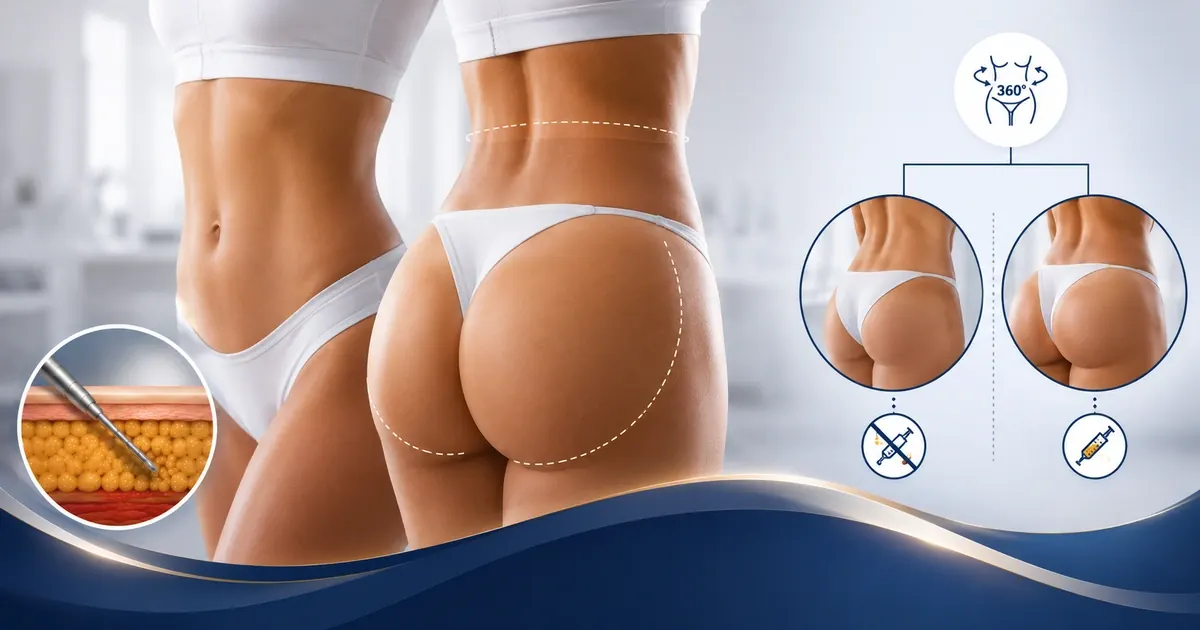
Lipo 360 — also called circumferential liposuction — removes subcutaneous fat from the entire midsection in one operative session: abdomen (upper and lower), flanks, love handles, and lower back. The "360" refers to the fact that fat is removed all the way around the torso, rather than from the front only.
It is a body-contouring procedure for patients near their ideal weight with good skin elasticity. It is not a weight-loss procedure and does not address visceral (deep) fat or loose abdominal skin. A review of 1,000 consecutive circumferential liposuction cases confirmed the procedure is safe when performed by experienced surgeons with careful fluid management.1
Exactly Which Areas Lipo 360 Covers
The term "360" signals circumferential coverage, but the specific zones treated can vary slightly between surgeons. The table below outlines the standard treatment map for a full Lipo 360 procedure.
| Zone | Coverage | Notes |
|---|---|---|
| Upper abdomen | Above the navel to the lower ribcage | Often the most difficult area to treat; requires careful technique to avoid irregularity |
| Lower abdomen | Navel to the pubic area | Frequently the primary concern for patients; responds well to liposuction when skin elasticity is good |
| Flanks (sides) | Lateral torso between the ribcage and hip | The "love handle" area; treated from both anterior and posterior approaches in a 360 procedure |
| Lower back | Lumbar region above the buttocks | Essential for true 360 contouring; omitting this zone leaves a visible ridge from the rear |
| Waist definition | Lateral waist narrowing | Achieved by reducing flank fat at the waist level; creates the hourglass silhouette |
| Upper back (bra rolls) | Fat above and below the bra line | Optional addition; not included in all Lipo 360 packages — confirm with your surgeon |
Some surgeons also include the upper hips or lateral thighs as part of an extended Lipo 360. Always confirm the exact zones included in your quoted procedure — packages vary between clinics, and pricing often reflects these differences.
What Results to Expect From Lipo 360 Alone
Lipo 360 without any add-on procedures delivers circumferential midsection slimming and improved waist-to-hip ratio. Patients with good skin elasticity typically see a well-defined waist, flatter abdomen, and elimination of the back-fat "overhang" that makes clothing fit poorly. Final results are visible at 3–6 months, once post-operative swelling has fully resolved — the first few weeks involve considerable swelling that can temporarily obscure the outcome.
What Lipo 360 alone does not deliver: it does not add volume anywhere, it does not lift or tighten loose skin, and it does not correct abdominal muscle separation. Patients with poor skin elasticity may experience some degree of skin irregularity or mild sagging after fat removal. Realistic result planning should account for these limitations, and any surgeon who promises a specific outcome without an in-person physical assessment should be treated with caution.
Full Lipo 360 guide — areas, candidacy, recovery and cost →Lipo 360 Alone (No BBL) — What Happens to the Fat
When a patient has Lipo 360 without a BBL, the aspirated fat is simply discarded after surgery. The goal is purely circumferential fat reduction and waist definition. No fat transfer takes place.
This is the most common approach. The majority of Lipo 360 patients are not interested in adding buttock volume, or they are not suitable BBL candidates, or they prefer a simpler procedure with a lower risk profile.
Who Chooses Lipo 360 Without a BBL
Patients who opt for Lipo 360 alone typically fall into one of these groups:
- Standard Lipo 360 candidates: Patients with moderate midsection fat who want circumferential contouring without buttock augmentation
- "Skinny" Lipo 360 candidates: Patients already at a lean body weight (BMI 20–24) who have localized fat pockets and want body refinement rather than dramatic volume change — often with smaller volumes removed
- Patients who lack sufficient donor fat: A BBL requires a meaningful amount of fat to harvest; very lean patients may not have enough to achieve a significant buttock augmentation result
- Patients who prefer lower risk: BBL carries additional risks not present in Lipo 360 alone (see below)
Lipo 360 + BBL — Adding Fat Transfer
When combined with a BBL (Brazilian Butt Lift), the fat removed during Lipo 360 is processed — centrifuged or filtered — and then re-injected into the buttocks and/or hips to add volume and shape. The two procedures are performed in a single operative session.
The combination is popular because it achieves two goals simultaneously: a slimmer waist and fuller buttocks, using the patient's own fat rather than implants.
What a BBL Adds — and the Added Risks
Adding a BBL meaningfully changes the risk profile of the procedure. The most serious concern is gluteal fat embolism — fat entering the gluteal blood vessels during injection and travelling to the lungs. This is a rare but potentially fatal complication.
The American Society of Plastic Surgeons (ASPS) has issued specific safety guidelines for BBL procedures, including requirements for subcutaneous-only injection (avoiding deep gluteal muscle injection), prone positioning restrictions, and surgeon training standards.2
When these guidelines are followed by experienced surgeons, the absolute risk is low — but it is not zero, and it is a risk that does not exist with Lipo 360 alone. Patients considering the combination should discuss this explicitly with their surgeon.
Other BBL-specific considerations:
- Requires longer operative time (typically 4–6 hours combined vs 2–4 hours for Lipo 360 alone)
- Extended recovery: patients cannot sit directly on their buttocks for 6–8 weeks post-operatively, requiring special cushions and positioning
- Fat survival rate: typically 50–70% of transferred fat is retained at one year; some resorption is expected, making final results visible later than Lipo 360 alone
- General anaesthesia is nearly always required for the combined procedure
BBL Fat Survival Rate: What to Expect
Not all of the fat transferred during a BBL will survive permanently. Studies consistently show that approximately 50–70% of grafted fat remains viable at the one-year mark, with the majority of resorption occurring in the first 3–6 months post-operatively. The exact survival rate depends on several factors: the processing technique used (centrifugation, filtration, or gravity separation), the injection technique, the depth of placement within the tissue, the patient's overall health and blood supply to the area, and post-operative care — particularly whether the patient avoids pressure on the buttocks during the early healing phase.3
Because significant resorption is expected, experienced BBL surgeons routinely overfill — transferring more fat than the final desired volume — to compensate for anticipated loss. This means that immediately after surgery the result will look larger than intended, and patients should not judge their final outcome until at least 6 months have passed. The practical implication for planning: if a patient has limited donor fat available from Lipo 360, the achievable BBL result will be proportionally smaller after accounting for resorption. Surgeons should discuss expected fat yield and projected post-resorption volume with patients before the procedure, so that expectations are calibrated to what is anatomically achievable.
Lipo 360 Without a Tummy Tuck — When That's Enough
Lipo 360 alone is appropriate for most patients seeking midsection contouring. A tummy tuck (abdominoplasty) is a separate, more extensive procedure that removes excess abdominal skin and repairs separated abdominal muscles (rectus diastasis). It involves a longer scar, longer recovery, and significantly more surgical complexity.
A tummy tuck is added to Lipo 360 only when:
- There is significant loose or overhanging abdominal skin that will not retract after fat removal
- There is documented rectus diastasis (abdominal muscle separation, common after pregnancy) that the patient wants repaired
- The patient has had massive weight loss resulting in a pannus (apron of skin)
For patients with good skin elasticity and no diastasis, Lipo 360 alone produces excellent contouring results without the additional recovery, scar, and cost of abdominoplasty.
Lipo 360 vs tummy tuck — full comparison →Risks: Lipo 360 Alone vs With BBL
Understanding the risk difference between these procedures is essential to informed consent. Lipo 360 and BBL share some risks (those common to any liposuction), but BBL adds a unique and serious category of its own.
Lipo 360 Standalone Risks
Lipo 360 without a BBL carries the standard risks of any liposuction procedure. These are well-characterised in the surgical literature and manageable with an experienced, board-certified surgeon:
- Contour irregularities: Uneven fat removal can leave bumps, divots, or asymmetry — the most common complication of liposuction
- Seroma: Fluid accumulation under the skin, particularly in the flanks and lower back; usually managed with aspiration
- Bruising and swelling: Expected and typically resolves within 4–8 weeks
- Numbness or altered sensation: Temporary in most cases; permanent numbness is uncommon
- Infection: Rare with appropriate surgical technique and prophylactic antibiotics
- Skin laxity: In patients with borderline skin elasticity, fat removal may result in mild skin sagging — assessed at pre-operative consultation
- Anaesthesia risks: Standard risks of general or tumescent anaesthesia apply
BBL-Specific Risks: Fat Embolism Warning
The BBL has a distinct and serious risk profile that does not apply to Lipo 360 alone. The primary concern is gluteal fat embolism — fat particles entering the inferior gluteal veins during injection and travelling to the pulmonary vasculature, causing a potentially fatal pulmonary embolism.
A 2017 multi-society task force survey estimated the BBL mortality rate at approximately 1 in 3,000 procedures, making it statistically the most dangerous elective cosmetic surgery performed at scale.2 Estimates across studies have ranged from 1 in 2,351 to 1 in 6,214, depending on methodology and reporting completeness. In 2018, ASPS, ISAPS, IFATS, and ISEBI issued a joint safety advisory mandating subcutaneous-only fat injection and prohibiting intramuscular injection into the gluteus maximus — the technique change most directly associated with fatal embolism.
Additional BBL-specific risks include:
- Fat necrosis: Areas of transferred fat that do not establish blood supply may necrose, causing firmness, discomfort, or visible irregularity
- Asymmetry: Uneven fat survival between sides is common; revision procedures are not uncommon
- Prolonged swelling and firmness: The buttocks may remain swollen and firm for several months before final shape emerges
- Deep vein thrombosis (DVT): Extended operative time and positioning increase DVT risk compared to Lipo 360 alone
Combined Procedure Risk Elevation
Performing Lipo 360 and BBL together in a single session extends operative time, increases total anaesthesia exposure, and results in greater overall physiological stress than either procedure alone. The following table summarises the comparative risk profile:
| Risk Category | Lipo 360 Alone | Lipo 360 + BBL |
|---|---|---|
| Contour irregularity | Low–moderate (liposuction standard) | Low–moderate (liposuction standard) |
| Seroma | Low–moderate | Low–moderate |
| Infection | Low | Low–moderate (longer procedure) |
| DVT / pulmonary embolism (non-gluteal) | Low | Moderate (extended operative time) |
| Gluteal fat embolism | None | Rare but potentially fatal; technique-dependent |
| Fat necrosis | None | Present (transferred fat zones) |
| Anaesthesia exposure | Standard (2–4 hrs) | Extended (4–6 hrs) |
| Overall mortality risk | Very low (standard lipo) | Higher; historically highest of elective cosmetic procedures |
Choosing an appropriately trained, board-certified surgeon who follows current ASPS BBL safety guidelines is the single most important risk-reduction factor for patients considering the combined procedure.
Recovery When Combining Lipo 360 and BBL
Recovery from the combined Lipo 360 + BBL procedure is substantially more demanding than recovery from Lipo 360 alone, primarily because the BBL places strict requirements on body positioning that affect every aspect of daily life for the first 6–8 weeks.
Sleeping and Sitting Positions: No Sitting for 6–8 Weeks
The most disruptive aspect of BBL recovery is the strict prohibition on sitting or lying directly on the buttocks during the early healing phase. Sitting compresses the newly grafted fat cells, reduces blood supply to them, and significantly increases the rate of fat resorption — reducing your final result. Most surgeons advise patients to avoid direct sitting for a minimum of 6 weeks, with some extending this to 8 weeks for larger-volume transfers.
Practically, this means:
- Sleeping position: Patients must sleep on their stomach (prone) or on their side for the first 6–8 weeks. Sleeping on the back is not permitted. Many patients find this extremely uncomfortable and should prepare for disrupted sleep.
- Sitting: When sitting is unavoidable — eating, working, travelling — patients must use a specialised BBL cushion (sometimes called a "donut cushion" or "BBL pillow") that transfers body weight to the backs of the thighs rather than the buttocks. Sitting on a regular chair without this cushion is prohibited.
- Driving: Patients cannot drive for at least 2–3 weeks and should use a BBL cushion when riding as a passenger. Long car journeys are not recommended in the first 4 weeks.
- Air travel: Most surgeons advise against flying for at least 4 weeks due to DVT risk from prolonged immobility and the inability to use a BBL cushion in a standard aircraft seat.
Patients combining Lipo 360 + BBL should assess whether their home setup, work situation, and lifestyle can realistically accommodate these restrictions before booking surgery.
Compression Garments: Lipo 360 vs BBL Garment
Compression garments after Lipo 360 and BBL differ in design, and wearing the wrong garment can damage the BBL result:
- Lipo 360 standalone: A standard high-waisted compression garment (stage 1 and stage 2) is worn continuously for the first 4–6 weeks. The garment covers the abdomen, flanks, and lower back with uniform compression to reduce swelling and support skin retraction.
- Lipo 360 + BBL: A specialised BBL compression garment is required — one designed with open panels or strategic cutouts over the buttocks to prevent compression of the grafted fat. Wearing a standard closed-back garment over the BBL area applies pressure that increases fat cell death and reduces fat survival. Patients must confirm that the post-operative garments provided by their clinic are appropriate for BBL recovery — not all clinics supply the correct design.
- Garment timeline: Stage 1 garments (medical grade, rigid) are typically worn for 3–4 weeks; stage 2 garments (lighter compression) for a further 4–8 weeks. Total garment wear is usually 8–12 weeks for the combined procedure, longer than Lipo 360 alone.
Activity Restrictions
Activity restrictions for the combined procedure are more extensive than for Lipo 360 alone. The following timeline applies to most patients, though individual surgeon protocols vary:
- Week 1–2: Rest at home. Light walking only to prevent DVT. No lifting, bending, or straining. Drain care if surgical drains are placed. Full-time compression garment wear.
- Week 3–4: Light daily activities may resume. No exercise. No direct sitting without BBL cushion. Return to sedentary desk work with cushion may be possible at 3–4 weeks for some patients.
- Week 5–6: Light lower-body activity (walking) permitted. No gym, running, or impact exercise. Sitting restrictions may begin to ease at week 6 per surgeon guidance.
- Week 7–8: Most positional restrictions lifted. Light gym activity (upper body) may resume at 6–8 weeks. Avoid direct pressure exercise on buttocks (cycling, rowing) until 8–10 weeks.
- 3 months: Full exercise and physical activity typically cleared. Final BBL result begins to stabilise, though some remodelling continues to 6–12 months.
Patients who cannot commit to these restrictions — particularly the no-sitting protocol — are not suitable candidates for the combined Lipo 360 + BBL procedure. Cutting the protocol short significantly increases the risk of poor fat survival and a suboptimal result.
Comparing Results, Recovery & Cost
| Lipo 360 Only | Lipo 360 + BBL | Lipo 360 + Tummy Tuck | |
|---|---|---|---|
| What changes | Slimmer midsection | Slimmer waist + fuller buttocks | Slimmer waist + tighter abdomen + scar |
| Anaesthesia | General or tumescent | General (almost always) | General |
| Operative time | 2–4 hours | 4–6 hours | 4–6 hours |
| Social downtime | 2–3 weeks | 3–4 weeks | 4–6 weeks |
| Full recovery | 6 weeks | 6–8 weeks | 8–12 weeks |
| Unique risks | Standard lipo risks | Gluteal fat embolism (rare) | Wound dehiscence, longer scar |
| Turkey all-in cost | $2,000–$4,500 | $3,500–$6,500 | $4,000–$7,000 |
| US all-in cost | $6,000–$15,000 | $10,000–$20,000 | $12,000–$25,000 |
Costs are approximate ranges. Actual fees vary by surgeon, facility, and geographic location.

Which Option Fits Your Goals?
There is no universally "best" combination — the right choice depends on your body, goals, and risk tolerance. A few general principles:
- Choose Lipo 360 alone if: Your goal is midsection slimming only; you have good skin elasticity; you want the simplest procedure with the lowest risk profile; or you lack sufficient donor fat for a meaningful BBL result.
- Consider adding a BBL if: You also want more buttock volume; you have adequate donor fat; you have had a thorough consultation with a board-certified surgeon who follows current ASPS BBL safety guidelines; and you understand and accept the additional risks.
- Consider adding a tummy tuck if: You have significant loose abdominal skin that will not retract, or diastasis recti that requires surgical repair. Lipo 360 alone will not address these.
The most important step is an in-person consultation with a board-certified plastic surgeon who can assess your skin elasticity, fat distribution, and anatomy before recommending any combination.
Frequently Asked Questions
-
Lipo 360 removes fat from the full midsection circumference. When combined with a BBL, the removed fat is processed and re-injected into the buttocks to add volume. Without a BBL, removed fat is simply discarded. Lipo 360 does not require a BBL — they are entirely separate procedures.
-
Yes — and most Lipo 360 patients do exactly that. Lipo 360 is a standalone circumferential fat removal procedure. A BBL is only added when the patient specifically wants buttock augmentation and is a suitable candidate.
-
For most Lipo 360 candidates, yes. A tummy tuck is only necessary when there is significant loose skin or abdominal muscle separation — typically after major weight loss or multiple pregnancies. Patients with good skin elasticity get excellent contouring results from Lipo 360 alone.
-
Yes. Adding a BBL introduces risks not present in Lipo 360 alone — most notably gluteal fat embolism, a rare but potentially fatal complication of gluteal fat grafting. ASPS has issued specific BBL safety guidelines. The combined procedure also requires general anaesthesia, longer operative time, and extended recovery. Lipo 360 alone does not carry these additional risks.
-
"Skinny Lipo 360" is an informal term for circumferential liposuction on lean patients (typically BMI 20–24) seeking subtle body refinement rather than large-volume fat removal. The surgical technique is the same as standard Lipo 360; only the volume removed and patient profile differ. It is not a separate surgical technique.
-
The BBL has historically carried the highest mortality rate of any elective cosmetic surgery performed at scale. A multi-society task force survey published in 2017 estimated a mortality rate of approximately 1 in 3,000 BBL procedures — primarily due to fatal gluteal fat embolism caused by inadvertent intramuscular injection of fat into the deep gluteal vasculature.2 Mortality estimates in the broader literature have ranged from 1 in 2,351 to 1 in 6,214 procedures depending on study methodology.
In response, ASPS and its international counterparts issued a 2018 joint safety advisory establishing strict technique protocols: fat must be injected only into the subcutaneous layer, never into or below the gluteus maximus muscle. Surgeons who adhere to these guidelines have reported significantly lower complication rates. When performed by an experienced, board-certified plastic surgeon following current ASPS BBL safety protocols, the absolute mortality risk is low — but it is not zero. Patients should ask their surgeon directly about their injection technique, training in BBL safety protocols, and their own complication and revision rates before consenting to the procedure.