
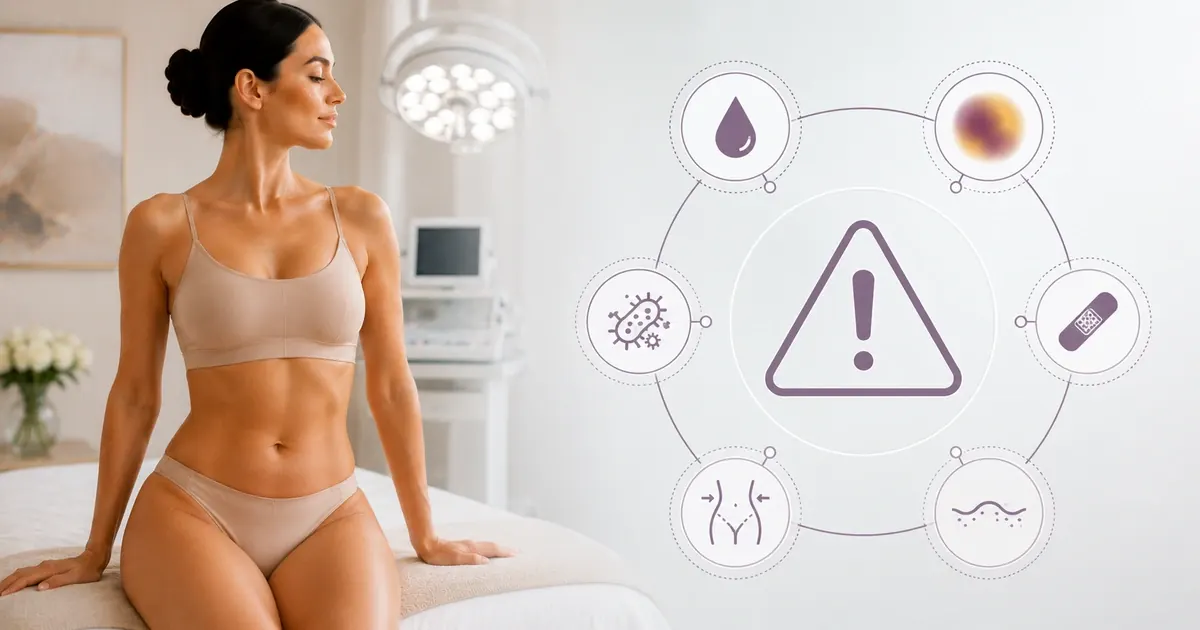
Common, Temporary Side Effects
The following effects are expected in virtually every liposuction patient. They are part of the normal healing process — not complications — and should be anticipated as part of the recovery timeline. For more on how to weigh these factors before booking, explore our full collection of safety guides.
- Swelling: Fluid accumulates in treated tissues as part of the inflammatory healing response. Peak swelling is typically at 24–72 hours; most resolves by 4–6 weeks, with full resolution at 3–6 months. The compression garment reduces swelling significantly.
- Bruising: Disruption of small blood vessels causes bruising that peaks at 3–5 days and typically resolves within 2–4 weeks. The epinephrine in tumescent fluid significantly reduces bruising compared to older liposuction techniques.
- Temporary numbness: Small sensory nerves in the treated area are disrupted during fat removal, causing tingling or numbness that can last weeks to several months. Permanent numbness is rare.
- Drainage from incisions: Pink-tinged tumescent fluid drains from the small incisions for 24–48 hours post-operatively. This is expected and resolves quickly; the incisions do not need to be kept tightly closed during this phase.
- Tightness and discomfort: The compression garment and post-operative swelling create a sensation of tightness in the treated area that most patients describe as uncomfortable but manageable with standard oral pain relief.
Less Common but Serious Risks
A systematic review and meta-analysis of liposuction complication rates confirms that serious complications are uncommon but not negligible — and that certain factors dramatically elevate individual risk.2
Seroma
Seroma is a collection of serous fluid under the skin at the surgical site. It presents as a soft, fluctuant swelling, usually apparent 1–3 weeks after surgery. Seromas are more common after large-volume procedures and those combined with abdominoplasty. Treatment is straightforward: aspiration (drainage) in the clinic using a needle — typically 1–3 sessions.
Contour Irregularity
Waviness, bumps, or asymmetry in the treated area can result from uneven fat removal, overlying skin laxity, or the healing process. Mild surface irregularity is common in the first months and may resolve spontaneously. Significant or persistent irregularity may require secondary liposuction or fat grafting.
Infection
Surgical site infection is rare in accredited facilities with proper sterile technique. Signs: localised redness, warmth, swelling with fever. Treatment: antibiotics; rarely surgical drainage. Most infections resolve fully with prompt treatment.
Deep Vein Thrombosis & Pulmonary Embolism
DVT (a blood clot in the leg veins) and PE (clot reaching the lungs) are the most serious preventable complications of liposuction. Risk rises substantially with: operative time >4 hours, combined procedures, high BMI, previous DVT history, and immobility post-operatively. A nationwide analysis of 69,424 patients confirms that VTE is the leading cause of serious liposuction morbidity.1 Prevention: early mobilisation, compression stockings, and in higher-risk cases chemical prophylaxis (blood thinners).
Fat Embolism Syndrome
Fat embolism occurs when fat particles enter the bloodstream and reach the lungs or brain. It is very rare after liposuction — most cases in the literature are associated with high-volume procedures or fat grafting.3 Symptoms: sudden shortness of breath, chest pain, altered consciousness. Medical emergency requiring immediate hospital treatment.
Visceral Perforation
Very rare — the cannula injures an underlying organ (most commonly bowel or bladder) if it passes beyond the intended fat layer. Almost exclusively associated with inexperienced operators or incorrect positioning of the patient during surgery. In accredited settings with experienced surgeons, this is an extremely rare event.
Will I Have Scars?
Yes — but they are small. Liposuction requires 3–5 mm incisions (cannula entry points) at 2–4 locations per treated area, placed in natural skin creases or hidden areas where possible. These heal to small, faint marks — not the prominent linear scars associated with a tummy tuck or lift procedure.
In most patients, these entry points fade to near-invisibility within 6–12 months and are not visible with normal clothing or standard body positioning. Patients with darker skin tones or a tendency to hyperpigmentation may have slightly more visible marks that take longer to fade. For more detail, see our liposuction scars guide.
Fibrosis After Liposuction — What It Is & Management
Post-liposuction fibrosis is a normal healing response in which scar tissue forms in the disrupted fat layer during recovery. It typically presents as areas of firmness, lumpiness, or hardness under the skin — sometimes with a lumpy or irregular texture visible at the surface. Many patients confuse early fibrosis with a poor result, when in fact it is a temporary healing phase.
Timeline: Fibrosis typically begins in weeks 2–4, peaks around 6–8 weeks, and progressively softens. Most cases resolve within 3–6 months. Severe fibrosis can persist longer.
Management:
- Manual lymphatic drainage (MLD) massage — the most evidence-supported intervention. MLD accelerates post-surgical fluid clearance and reduces fibrosis severity. Typically 4–8 sessions recommended in the first 4–8 weeks.
- Ultrasound therapy — external therapeutic ultrasound devices help break up fibrous tissue; often combined with MLD.
- Continued compression — wearing the garment for the full recommended duration reduces the extent of fibrosis.
Read our dedicated fibrosis after liposuction guide for a week-by-week management approach.
How Risk Is Minimised
The evidence is clear: the single most effective risk reduction strategy is surgeon and facility selection. Most serious complications are associated with avoidable factors:
- Choose a board-certified plastic surgeon — specialised training in complication management is critical
- Use an accredited facility — JCI, JCAHO, or AAAASF accreditation provides emergency protocols and equipment standards
- Limit fat volume per session — respect safe maximum volumes (generally ≤5 litres aspirate)
- Disclose all medications and medical history — blood thinners, cardiac conditions, and clotting history all require pre-operative adjustment
- Mobilise early post-op — gentle walking within hours of surgery significantly reduces DVT risk
- Wear the compression garment for the full recommended duration — reduces seroma, fibrosis, and contour irregularity
Warning Signs & When to Act
The following symptoms require immediate medical attention — do not wait for your next scheduled follow-up:
- Chest pain or shortness of breath — possible pulmonary embolism; call emergency services immediately
- Fever above 38.5°C (101.3°F) — possible infection; contact your surgeon the same day
- Rapidly worsening pain or swelling in the treated area — possible haematoma, seroma, or infection
- Hard, red, hot, painful swelling with skin discolouration — possible haematoma or deep infection; urgent evaluation needed
- Sudden leg pain, swelling, or warmth — possible DVT; seek emergency care
- Altered consciousness, confusion, or neurological symptoms — rare fat embolism presentation; emergency services immediately
Frequently Asked Questions
-
Swelling, bruising, and temporary numbness in the treated area — expected in virtually all patients. These are normal healing responses, not complications. Swelling resolves over 3–6 months; bruising in 2–4 weeks; numbness within weeks to months.
-
Yes, but they are tiny — 3–5 mm incisions placed in skin creases that heal to near-invisible marks within 6–12 months in most patients. They are not comparable to the surgical scars of a tummy tuck or lift procedure.
-
Fibrosis is scar tissue forming in the disrupted fat layer — creating firmness, lumpiness, or hardness under the skin. It is a normal healing response, typically peaking at 6–8 weeks and resolving with manual lymphatic drainage massage by 3–6 months. Read the full fibrosis guide for management approach.
-
Seroma (fluid collection under the skin) is uncommon overall but more frequent after large-volume procedures or when combined with abdominoplasty. It presents as a soft swelling 1–3 weeks post-op and is resolved easily by clinic drainage — typically 1–3 sessions.
-
Seek emergency care for: chest pain or shortness of breath (PE risk), sudden leg pain/swelling (DVT), fever above 38.5°C, rapidly worsening pain or swelling, hard red hot skin changes, or altered consciousness. These require same-day or emergency evaluation — do not wait.