
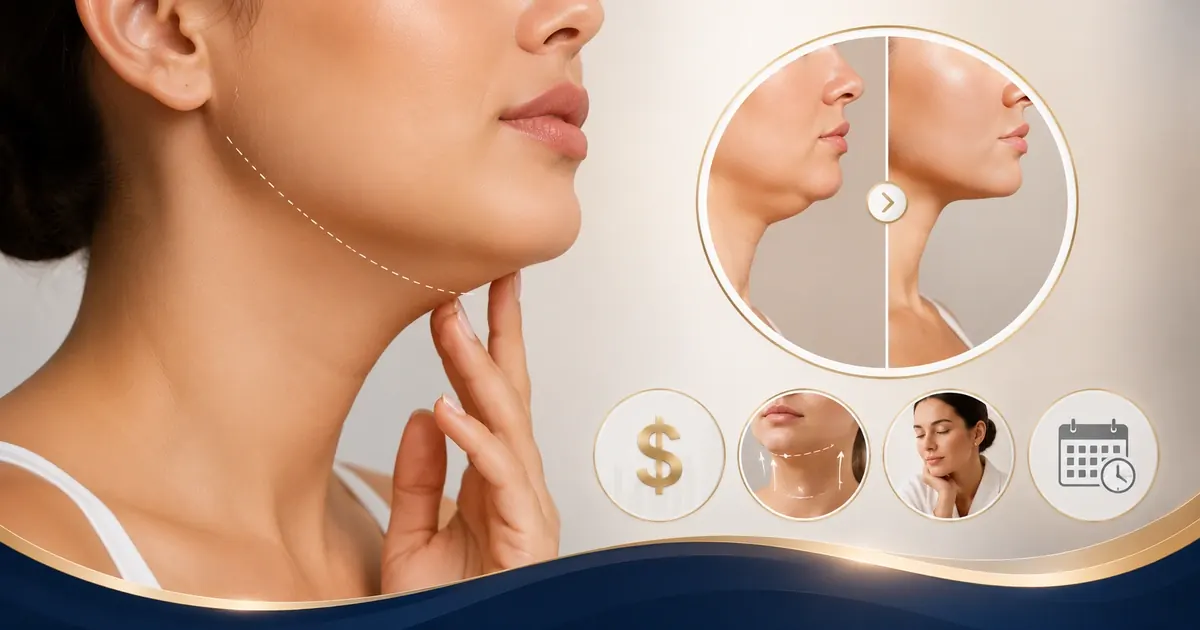
What Double Chin (Submental) Liposuction Treats
The double chin — known medically as submental fullness — results from a fat deposit that accumulates beneath the chin and above the hyoid bone. For many people this is largely genetic: the submental fat pad can be prominent even at a healthy body weight, and it is notoriously resistant to diet and exercise, as the ASPS procedure overview notes.2
Submental liposuction addresses this fat deposit directly. A surgeon inserts a small cannula (typically 2–3 mm) through one or two tiny incisions hidden in the natural crease under the chin, and vacuum pressure removes the fat. The result is a more defined jawline and neck contour.
The Submental Anatomy: What Drives the "Double Chin"
The submental region contains two anatomically distinct fat compartments. Preplatysmal fat sits directly beneath the skin and above the platysma muscle — this is the layer that liposuction most readily accesses and removes. Subplatysmal fat lies beneath the platysma itself, deeper in the neck. Standard liposuction does not reach the subplatysmal compartment; when this deeper layer is prominent, it contributes to a rounded neck profile that liposuction alone may not fully resolve. Surgeons performing neck lifts can address subplatysmal fat directly through the platysma, but this requires a more extensive procedure.
Genetics plays a substantial role in submental fullness independent of body weight. Twin studies and clinical observation consistently show that the size and location of the submental fat pad is partly heritable — meaning a lean, fit person may carry a prominent double chin simply because of how their fat distributes. The hyoid bone position also matters: a low-set hyoid creates an obtuse cervicomental angle and a less-defined neck contour that no amount of fat removal can fully correct, because the underlying bony structure limits how sharp the jawline can appear. This is why a thorough anatomical assessment — not just a BMI check — is essential before any submental procedure.
In practical terms, liposuction can effectively remove the preplatysmal fat layer and produce a significant improvement in most patients. What it cannot do is remove subplatysmal fat, tighten loose platysmal muscle bands, reposition a low hyoid, or improve skin that lacks the elasticity to retract after volume is removed. Understanding these limitations is what separates a well-planned procedure from a disappointing one.
Fat vs Skin Laxity — Why It Matters
Not every double chin is caused by excess fat alone. Some patients also have loose, crepey neck skin — a condition called platysmal banding or skin laxity — in which the neck muscle has separated or the skin has lost elasticity. Liposuction removes fat; it does not tighten skin.
A patient with primarily fat and good skin elasticity will see the skin retract naturally after fat removal, producing a clean result. A patient with significant pre-existing skin looseness may see the skin hang more noticeably after fat is removed — in that case, a neck lift (lower rhytidectomy) is a more appropriate procedure than liposuction alone, as published neck contouring research confirms.3
This distinction is the most important factor in candidacy. Any reputable surgeon will assess your skin elasticity before recommending an approach.
Full guide: Chin & Neck Liposuction — areas, techniques and candidacy →Who Is a Good Candidate?
The best candidates for double chin liposuction are people who:
- Have a localized fat deposit beneath the chin that is disproportionate to their overall body weight
- Are at or near a stable, healthy weight (BMI generally under 30)
- Have good skin elasticity — the skin springs back when pinched
- Are non-smokers or willing to stop well before and after surgery (smoking impairs healing)
- Have realistic expectations: liposuction improves contour, it does not reshape bone structure or treat platysmal banding
Age is a relative rather than absolute contraindication. Younger patients often have better skin elasticity; however, some patients in their 50s and 60s are excellent candidates if skin quality is good. Your surgeon will assess this at consultation.
Patients who are not good candidates include those with predominantly loose skin (rather than fat), those with active medical conditions that affect healing, and those seeking a dramatic change that liposuction alone cannot deliver.
How the Procedure Works
Double chin liposuction is most commonly performed under local tumescent anaesthesia as an outpatient procedure. A 2024 case series of 695 submental liposuction procedures performed under local anaesthesia reported high patient satisfaction with a low complication rate, supporting the safety of the outpatient approach.1
Step-by-step:
- Tumescent fluid: A dilute solution of saline, lidocaine (local anaesthetic), and epinephrine is injected into the submental fat. This numbs the area, minimises bleeding, and makes fat easier to remove.
- Small incisions: One incision (approximately 3–4 mm) is made just under the chin; sometimes a second is made behind each ear for access to the neck area.
- Cannula insertion: A thin cannula is inserted and moved in controlled strokes to break up and aspirate the fat.
- Closure: Incisions are typically closed with a single absorbable suture or medical tape. They are small enough to be hidden in natural skin creases.
- Compression: A chin strap or compression garment is applied immediately after surgery.
Total operative time is typically 30–60 minutes. Patients go home the same day and are generally comfortable within a few hours as the tumescent fluid wears off.
Technique Choices: Traditional vs Laser-Assisted
Standard tumescent liposuction — using a mechanically moved cannula under vacuum — is sufficient for the majority of submental cases, particularly in younger patients with good skin elasticity and well-defined preplatysmal fat. It is the most widely used technique, carries the longest safety record, and adds no device cost to the procedure. Where laser-assisted liposuction (most commonly SmartLipo, using a 980-nm or 1064-nm diode laser) may add incremental value is in patients who have borderline skin laxity: the thermal energy delivered by the laser fibre stimulates collagen remodelling in the overlying dermis, which can produce a modest skin-tightening effect on top of the fat removal. Surgeons sometimes choose laser assistance when they want to avoid recommending a full neck lift for a patient who is a borderline candidate for liposuction alone.
A randomised clinical trial evaluating 980-nm diode laser-assisted lipolysis versus traditional liposuction for submental rejuvenation found both techniques produced good outcomes with no major difference in complication rates.5 The laser group showed slightly better skin retraction scores, though the clinical significance was modest. The practical implication is that laser assistance is not routinely necessary for a good submental result — it is a tool with a specific use case (borderline skin laxity, desire to maximise retraction without a formal lift), not a universally superior technique. It also adds cost and requires a surgeon trained in its use. Ask your surgeon to explain their rationale if they recommend laser-assisted rather than traditional liposuction for your case.

Results: What's Realistic & How Long They Last
A successful submental liposuction produces a more defined jawline, reduced neck fullness, and improved facial profile. The improvement can be substantial for patients with good skin elasticity and significant preoperative fat.
What the results depend on:
- Skin elasticity: The biggest predictor of outcome. Good elasticity = good skin retraction = clean result.
- Volume removed: Larger fat deposits allow for more visible improvement; very small deposits produce more modest change.
- Neck anatomy: Patients with a prominent hyoid bone or low-set larynx have anatomic limitations that liposuction cannot change.
- Post-operative weight stability: Remaining fat cells in the area can enlarge with significant weight gain.
Results are permanent in the sense that removed fat cells do not regenerate. However, significant weight gain after surgery will cause remaining cells — throughout the body including the chin area — to enlarge. Most patients maintain their result well if weight remains stable.
Initial improvement is visible within 1–2 weeks as bruising resolves, but final results with full swelling resolution typically appear at approximately 3 months.
Recovery & the Chin Compression Garment
Chin liposuction has one of the shorter recovery timelines among liposuction procedures because of the small treatment area and the frequent use of local rather than general anaesthesia.
| Time after surgery | What to expect |
|---|---|
| Day 1–2 | Swelling, bruising, and mild soreness. Rest at home. Compression garment worn 24 hours. |
| Days 3–7 | Bruising and swelling begin to improve. Most patients return to desk work and light activity. |
| Week 2 | Visible bruising largely resolved. Social activity comfortable for most patients. Garment often transitioned to night-only wear. |
| Weeks 2–4 | Residual swelling continues to reduce. Compression garment worn as directed. |
| Month 3 | Swelling fully resolved in most patients. Final contour visible. |
Compression garment: A chin strap or facial compression wrap is applied immediately post-surgery and typically worn full-time for 1–2 weeks, then at night for a further 1–2 weeks. It supports skin retraction and reduces swelling. Follow your surgeon's specific protocol — durations vary.
What to avoid: Strenuous exercise and activities that raise your heart rate significantly for 2–3 weeks. Sun exposure to incision sites for 6–12 weeks (incisions are small but pigmentation changes are possible).
Full liposuction recovery timeline — week by week →Risks and Complications
Submental liposuction is among the lowest-risk liposuction procedures — the treatment area is small, the procedure is short, and it is routinely performed under local rather than general anaesthesia. Nevertheless, no surgical procedure is without risk, and patients should understand the full spectrum of possible outcomes before consenting.
Common Side Effects
Bruising and swelling are expected after submental liposuction and are not complications in the clinical sense — they are normal tissue responses to the procedure. Bruising typically peaks at days 2–4 and resolves within 1–2 weeks. Swelling takes longer: the majority clears by weeks 3–4, but subtle firmness and puffiness can persist for up to 3 months as the tissue remodels. Temporary numbness or altered sensation in the chin and neck is also common; the sensory nerves in the submental skin are fine and can be temporarily disrupted by the tumescent fluid and cannula movement. This almost always resolves fully within 6–12 weeks as nerve function returns. Patients should expect to feel tingling or patchy numbness in the treated area during this period.
Uncommon Complications
Contour irregularity — including slight bumpiness, asymmetry, or an uneven surface under the chin — can occur if fat removal is uneven across the treatment zone. It is more likely when large volumes are removed quickly, or when the cannula passes are not evenly distributed. Minor irregularities often smooth out as swelling resolves over 3 months; persistent irregularities may require a secondary touch-up procedure. Scarring at the incision site is generally minimal given the incision size (3–4 mm), but patients prone to hypertrophic scarring or keloids have a higher risk of a noticeable scar. Incision sites under the chin are well concealed, but patients with dark skin tones should discuss hyperpigmentation risk with their surgeon specifically.
Rare but Serious Complications
Marginal mandibular nerve injury — affecting the branch of the facial nerve that controls lower lip movement — is rare in experienced hands because the nerve runs superior to the typical cannula plane in submental liposuction. However, it is the most serious anatomical risk specific to this region and can cause temporary or (very rarely) permanent asymmetry of the lower lip or smile. Infection is uncommon given the small incision size and the antibiotic properties of tumescent fluid; prophylactic antibiotics are typically prescribed and patients should report any signs of increasing warmth, redness, or fever after the first 48 hours. Haematoma (blood pooling) is also possible but less common in the submental area than in larger-volume liposuction sites.
| Complication | Approximate frequency | Management |
|---|---|---|
| Bruising and swelling | Expected in virtually all patients | Resolves spontaneously within 1–4 weeks; compression and arnica may help |
| Temporary numbness | Common (~30–50% of patients) | Resolves within 6–12 weeks in the majority; no treatment required |
| Contour irregularity | Uncommon (~5–10%) | Observation for 3 months; minor touch-up liposuction or fat grafting if persistent |
| Hypertrophic scarring | Uncommon; higher risk in predisposed individuals | Silicone gel, steroid injection, or laser treatment |
| Infection | Rare (<1%) | Antibiotics; surgical drainage if abscess forms |
| Marginal mandibular nerve injury | Rare (<1% in experienced hands) | Usually temporary; monitoring and physiotherapy; permanent injury very rare |
| Haematoma | Rare (<1%) | Aspiration or surgical drainage depending on size |
How Much Does Chin Lipo Cost?
Chin liposuction is one of the more affordable liposuction procedures because it is a small area performed quickly under local anaesthesia.
| Location | Surgeon fee only | All-in (facility + anaesthesia) |
|---|---|---|
| United States | $2,500–$5,000 | $3,500–$7,000 |
| United Kingdom | £2,000–£4,000 | £2,500–£5,500 |
| Turkey (all-inclusive) | $1,200–$2,000 (surgeon + hospital + transfers + garment) | |
Factors that affect price: surgeon's board certification and experience, geographic location, whether laser-assisted or standard technique is used, and the extent of treatment (chin only vs. chin + neck). Adding neck liposuction or additional facial areas increases cost.
Chin liposuction is generally considered a cosmetic procedure and is not covered by health insurance in the US, UK, or most countries unless there is a documented medical indication (which is rare).
Full liposuction cost guide by area and country →Chin Lipo vs Kybella vs Neck Lift
Three main options exist for submental fullness, each suited to different patients and severity levels.
| Chin Liposuction | Kybella (deoxycholic acid) | Neck Lift | |
|---|---|---|---|
| What it does | Removes fat surgically | Dissolves fat cells with injections | Removes fat + tightens skin & muscle |
| Sessions needed | 1 | 2–6 (monthly) | 1 |
| Downtime | 1–2 weeks | 1–2 weeks per session (swelling) | 2–4 weeks |
| US cost | $3,500–$7,000 (once) | $1,200–$2,000 per session | $6,000–$15,000 |
| Best for | Moderate–large fat, good elasticity | Mild fat, avoids surgery | Loose skin + fat + muscle banding |
| Addresses skin laxity? | No | No | Yes |
Kybella (deoxycholic acid) is the main non-surgical alternative. A 2016 review confirmed it is effective for submental fat reduction, but notes that multiple sessions are required and that the injection-site swelling after each treatment can be significant — often comparable in visible disruption to a single surgical recovery.4
For patients primarily seeking fat reduction with good skin elasticity, liposuction typically produces more predictable, significant results in a single procedure. For patients who strongly prefer to avoid surgery and have mild fat, Kybella is a reasonable alternative. For patients with significant skin laxity or platysmal banding, a neck lift is more appropriate than either.
Frequently Asked Questions
-
In the United States, surgeon fees for chin liposuction range from $2,500 to $5,000. When facility and anaesthesia fees are added, total costs reach $3,500–$7,000. Turkey all-inclusive packages average $1,200–$2,000. Costs vary by surgeon experience, technique (standard vs laser-assisted), and geographic location.
-
Yes — the fat cells removed by liposuction are gone permanently. They do not regenerate. However, remaining fat cells in the submental area can enlarge if you gain significant weight after surgery. Most patients maintain their results well with stable weight.
-
It depends on your skin elasticity before surgery. Patients with good elasticity — the skin springs back when pinched — typically experience good natural skin retraction after fat removal. Patients with pre-existing skin laxity, older skin, or large volumes of fat removed are more likely to have residual looseness. This is why a thorough candidacy assessment is essential before proceeding.
-
Most patients return to desk work and light daily activity within 5–7 days. Social downtime — the period when bruising and swelling are noticeably visible — is typically 1–2 weeks. A chin compression garment is worn for 2–4 weeks. Residual swelling resolves over 6–8 weeks; final results are visible at approximately 3 months.
-
Liposuction removes fat in one surgical session; Kybella requires 2–6 injection sessions over several months. Liposuction generally produces more significant and predictable results and is often more cost-effective overall for moderate to large fat deposits. Kybella suits patients with mild fat who prefer to avoid surgery entirely. Both carry risks; consult a board-certified surgeon or dermatologist to determine which is appropriate for your anatomy.
-
Yes — submental liposuction is widely regarded as one of the lowest-risk liposuction procedures. A 695-case series published in 2024 (PMID 39306507) found a low complication rate when the procedure was performed under local anaesthesia by experienced surgeons.1 Because it is a small, superficial area treated under local rather than general anaesthesia, the systemic risks associated with larger-volume liposuction do not apply. Serious complications such as nerve injury or infection occur in fewer than 1% of cases in experienced hands. The most common side effects — bruising, swelling, and temporary numbness — are expected and resolve within weeks.