
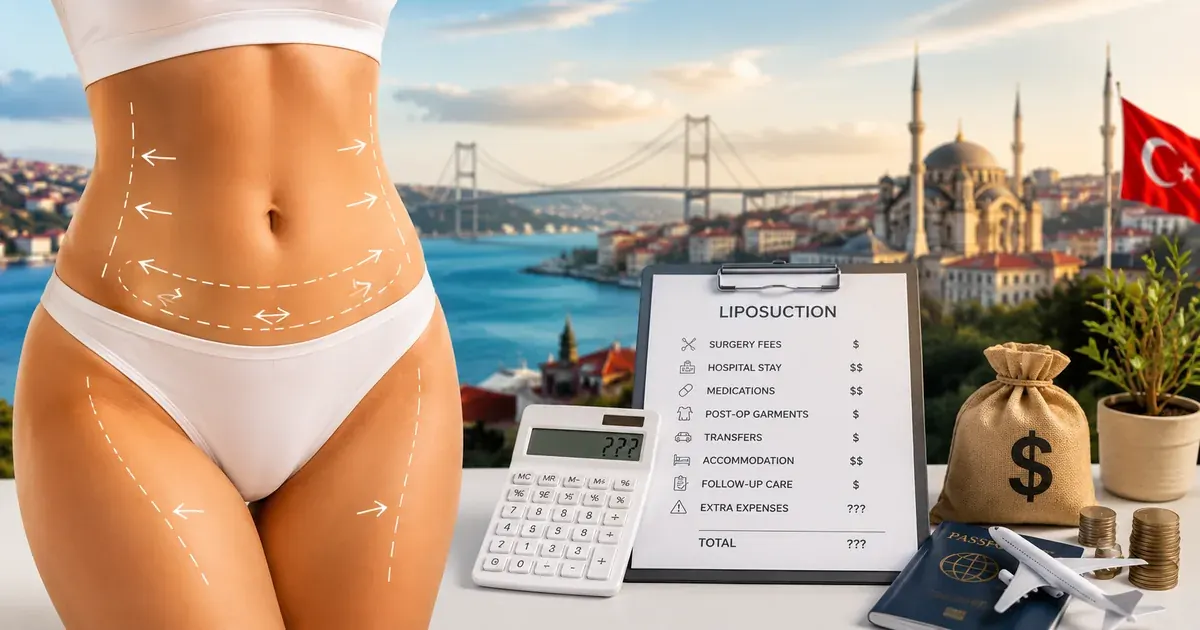
What the Headline Price Includes (and Doesn't)
The headline price you see advertised for liposuction in Turkey is almost always a package price — a bundled fee covering multiple components of your surgical journey. Understanding what that bundle legitimately should contain is the starting point for any realistic cost comparison.
What Reputable All-Inclusive Packages Cover
A well-structured all-inclusive liposuction package from a reputable Istanbul or Antalya clinic should include the following as standard, without additional charges:
- Surgeon's professional fee — the named operating surgeon's time for the procedure and post-operative consultations during your stay
- Anaesthesiologist fee — the anaesthesia team and all anaesthetic medications used during surgery
- Hospital or clinic facility fee — operating theatre, recovery room, nursing staff, and surgical consumables
- Pre-operative blood tests and ECG — conducted at the facility on the day before surgery
- Prescribed post-operative medications — antibiotics, anti-inflammatories, and pain management for the duration of your in-Turkey stay
- Stage 1 compression garment — the immediate post-surgical garment worn for the first 2–3 weeks
- Follow-up appointments during your stay — typically 1–2 wound checks and drain removal (if applicable)
- Private airport transfers — to and from Istanbul airport and between hotel and hospital for surgery and follow-up visits
- Patient coordinator — an English-speaking contact managing your schedule throughout
Some packages from higher-end clinics also include hotel accommodation (typically 5–7 nights at a 4-star hotel), pre-travel video consultation with the surgeon, and 24-hour coordinator access by WhatsApp. Confirm which tier you are being quoted.
"All-Inclusive" vs "Surgeon Fee Only" — How to Tell the Difference
Not every clinic uses the term "all-inclusive" in the same way. Some quotes labelled "package" or "all-inclusive" are actually surgeon-fee-only quotes that exclude the hospital facility, anaesthesia, and logistics. The difference can be £1,000–£2,500 hidden in the fine print.
A genuine all-inclusive quote will state: "This price includes surgeon, anaesthesiologist, hospital/clinic facility, pre-operative tests, post-operative medications, compression garment, and transfers." A surgeon-fee-only quote will either be vague about what is included or will only list the surgeon's name and technique. If the quote does not explicitly itemise the components, assume it is incomplete until you receive written confirmation otherwise.
Medical tourism coordinators — third-party agents who earn commission from clinics — sometimes present surgeon-fee quotes as "all-inclusive" to make their pricing appear competitive. This is one of the most common sources of price confusion in the Turkey market. Always request the itemised written breakdown directly from the clinic, not from a coordinator.
Quote Checklist — 10 Items to Confirm in Writing Before Booking
Before paying any deposit, obtain written confirmation of the following. Ambiguity on any item should be resolved before money changes hands:
- Named surgeon — full name of the surgeon who will operate (not "one of our experienced surgeons")
- Anaesthesia type and provider — general anaesthesia vs tumescent local; is the anaesthesiologist included in the fee?
- Named facility — the specific hospital or clinic where surgery will be performed
- Hotel accommodation — included or not? How many nights? Which hotel?
- Compression garment — Stage 1 included? Stage 2 included or extra?
- Medications — post-operative prescriptions included or charged separately?
- Pre-operative tests — blood work and ECG included in the package?
- Follow-up appointments — how many are included during your stay?
- Complication policy — written policy for what happens if a complication arises during or after your stay
- Revision policy — what is covered if you are unsatisfied with the aesthetic result, and for how long?
Costs Routinely Excluded From the Quote
The following costs are consistently absent from Turkish liposuction package prices. Budget for each of them separately — they are not hidden in the small print, they are simply not mentioned because they are your responsibility. Failing to account for them before making a cost comparison leads to systematically underestimating the true total.
Return Flights — £300–£800 From the UK, $600–$1,400 From the US
Flights are never included in any Turkish liposuction package, regardless of how the offer is worded. International return flights are entirely your cost. Typical ranges from major origin cities:
- London (Heathrow/Gatwick) to Istanbul: £300–£600 economy return at 6–8 weeks booking lead time; £450–£800 for last-minute or peak season
- Manchester to Istanbul: £280–£550 economy return
- New York (JFK) to Istanbul: $600–$950 economy return at standard lead time; $900–$1,400 at shorter notice
- Los Angeles to Istanbul: $700–$1,200 economy return
Note that flying within 4–6 weeks of liposuction carries a modestly elevated deep vein thrombosis (DVT) risk due to prolonged immobility. Surgeons typically recommend aisle seats, regular movement, and compression socks for post-operative flights over 4 hours. Confirm your surgeon's specific guidance before booking your return flight date.
Travel Insurance — Critical for Medical Evacuation Coverage
Standard UK and US travel insurance policies explicitly exclude complications arising from planned elective cosmetic surgery. The exclusion clause is typically worded as something like: "we do not cover costs arising from, or related to, any cosmetic or elective surgery undertaken during your trip." This means that if you develop a post-operative infection, seroma, or haematoma requiring treatment — or if you need medical evacuation to return home — your standard travel insurance will not pay.
You need a specialist medical travel insurance policy that explicitly covers planned cosmetic surgery and, critically, medical repatriation — the cost of being medically transported back to your home country by air ambulance, which can exceed £30,000 / $40,000 without coverage. These specialist policies are available from providers who serve the medical tourism market. They must be purchased before travel and before any symptoms arise. Budget £50–£200 for an appropriate policy depending on coverage level and procedure type.
Extra Hotel Nights If Recovery Extends
Most all-inclusive packages that include accommodation specify exactly 5 or 7 nights. If your surgeon recommends staying an additional night or two — due to swelling, wound concerns, or a late-detected seroma — those extra nights are your cost at full hotel rates. Istanbul 4-star hotel rates in the medical tourism areas (Sisli, Nisantasi) run £80–£150 / $100–$180 per night. If your companion is travelling with you and companion accommodation was not included in the package, budget accordingly for their stay throughout.
Prescription Medications Not Provided After Return
Turkish packages include the medications prescribed during your in-Turkey recovery phase. Once you return home, any ongoing prescriptions — antibiotics for a slow-healing wound, anti-inflammatories beyond the standard course, or medications to manage a minor complication — are not covered. In the US, out-of-pocket medication costs without applicable insurance cover can run $50–$200 per prescription. In the UK, NHS prescriptions cost £9.90 per item (2026 rate) for those not exempt. This is a minor cost but one to be aware of.
Compression Garments — Sometimes Excluded From Cheapest Quotes
Most reputable all-inclusive packages include a Stage 1 compression garment (worn for the first 2–3 weeks). However, the cheapest packages sometimes exclude garments entirely, and virtually no package includes a Stage 2 garment. Stage 2 garments — lighter compression worn from week 3 through week 6–8 — are universally your additional cost at £50–£150 / $60–$180 per garment. Patients who try to continue using the heavier Stage 1 garment beyond its recommended period, to avoid the cost of a Stage 2, risk compromising their final contour results.
| Cost item | Typically included in all-inclusive? | Typical excluded cost (if not included) |
|---|---|---|
| Surgeon's professional fee | Yes — always | — |
| Anaesthesiologist fee | Yes — in reputable all-inclusive packages | £400–£900 / $500–$1,200 if separate |
| Hospital/clinic facility fee | Yes — in reputable all-inclusive packages | £600–£1,500 / $800–$2,000 if separate |
| Pre-operative blood tests and ECG | Usually yes | £80–£200 / $100–$300 if separate |
| Stage 1 compression garment | Usually yes; sometimes excluded in cheapest quotes | £60–£120 / $80–$160 |
| Stage 2 compression garment | No — almost never included | £50–£150 / $60–$180 |
| Post-operative medications (during stay) | Usually yes | £40–£120 / $50–$150 if separate |
| Medications needed after return home | No | £10–£200 / $50–$300 depending on US/UK insurance |
| Hotel accommodation (5–7 nights) | In better packages; not always in budget packages | £400–£1,050 / $500–$1,260 at £80–£150/night |
| Extra hotel nights if recovery extends | No | £80–£150 / $100–$180 per extra night |
| Return flights | No — never | £300–£800 (UK) / $600–$1,400 (US) |
| Specialist travel insurance (cosmetic surgery) | No | £50–£200 / $70–$250 |
| Lymphatic drainage massage (home, post-return) | No | £40–£100 / $50–$150 per session; 4–8 sessions recommended |
| Revision surgery if needed after return | No — virtually never included | Full domestic rates: £2,000–£8,000+ / $3,000–$10,000+ |
The Revision and Complication Cost Risk
Cost comparisons between Turkey and domestic surgery typically ignore the most significant potential financial exposure: the cost of addressing complications or revisions once you have returned home. This is the category that can turn a £2,000 Turkey saving into a £5,000 net loss.
What Happens If You Need a Revision After Returning Home
Liposuction revisions — addressing contour irregularities, asymmetry, residual fat deposits, or over-correction — occur in a meaningful minority of cases. Published revision rates for experienced surgeons range from 2–8%; rates from less experienced operators or in more complex multi-area procedures are higher. When a patient has had surgery in Turkey and subsequently requires revision, they face a specific problem: the UK or US plastic surgeon they approach for revision has no working relationship with the Turkish operating surgeon and was not party to the original surgical plan.
Revision surgery for liposuction performed by a different surgeon — often called secondary liposuction or liposuction revision — is priced at full domestic rates. UK private rates for single-area revision liposuction start at £2,500–£4,500; multi-area revision starts at £4,000–£8,000. In the US, single-area revision typically costs $3,000–$6,000 all-in; multi-area $5,000–$12,000. These costs are borne entirely by the patient.
Travelling to Turkey Again for a Revision — Full Cost
Some Turkish clinics offer revision surgery within their written revision policy — typically within 6–12 months of the original procedure. In most cases, this means the surgeon's fee for the revision is waived, but you bear all travel, accommodation, and ancillary costs for a second trip. A second Istanbul trip costs roughly £800–£1,500 / $1,000–$2,000 in travel and accommodation alone. If the Turkish clinic's position is that no revision is warranted (while you disagree with the outcome), you have limited practical recourse given the distance.
The practical reality is that most patients who need a revision after Turkey liposuction manage it domestically, for cost, logistics, and confidence reasons. This means paying domestic revision rates on top of the original Turkey costs — erasing much or all of the initial saving.
Complication Treatment at Home — NHS and Most Insurers Do NOT Cover Elective Cosmetic Complications Abroad
The NHS will provide emergency treatment for life-threatening complications: a serious infection requiring hospitalisation, an adverse anaesthetic reaction identified post-travel, or any condition where delay would risk your life. However, the NHS will not provide cosmetic correction, revision surgery, or management of non-life-threatening complications arising from elective surgery you chose to have abroad. NHS Choices guidance on cosmetic surgery abroad specifically states that the NHS cannot be expected to address complications from privately arranged cosmetic procedures.
In practice, this means:
- A seroma (fluid accumulation) requiring repeated aspiration: you pay privately — typically £100–£200 per aspiration appointment
- Persistent swelling or delayed healing requiring assessment: private GP or plastic surgeon consultation, £100–£300 per appointment
- Contour irregularities requiring treatment: private plastic surgeon, £150–£400 consultation, then revision costs if surgery is recommended
- Infection manageable with oral antibiotics: GP-prescribed (NHS covers this, but the appointment slot competes with all other NHS demand)
Most UK private health insurance policies also exclude elective cosmetic surgery complications — they are treated equivalently to pre-existing conditions that the policy-holder actively created. US health insurance similarly excludes all complications of cosmetic procedures. This is not a quirk specific to Turkey — the same exclusion would apply to complications from a procedure you had at a domestic private cosmetic clinic. But the practical burden is heavier when the operating surgeon is in another country and your medical records may take weeks to obtain.
Statistics on Complications From Medical Tourism
A 2024 published analysis of adverse outcomes in cosmetic surgery medical tourism found that patients who experienced complications after travelling abroad for cosmetic procedures disproportionately reported not having independently verified their surgeon's credentials or their facility's accreditation status before booking.1 The same study found that inadequate post-operative aftercare planning — specifically the absence of a clear protocol for managing complications after returning home — was a consistent factor in cases that escalated to serious adverse outcomes.
A systematic review of medical tourism patient safety found that complication rates in cosmetic surgery medical tourism are not inherently higher than in domestic surgery when patients choose accredited facilities and verified surgeons — but are substantially higher when they do not.2 A study examining NHS complications from cosmetic surgery tourism specifically found that the most common presenting issues were wound infections, seromas, and contour dissatisfaction — the categories of complication that are manageable with adequate aftercare planning but become costly and distressing without it.3

Calculating the True All-In Total
The most reliable comparison is total money leaving your bank account, from first payment to end of recovery. Build your budget using the categories below rather than comparing headline package prices to domestic surgeon fees.
Sample Budget: London to Istanbul
The following budget is for a single-area liposuction procedure (abdomen or flanks) with a reputable Istanbul clinic, departing from London Heathrow or Gatwick on a standard economy return flight booked 6–8 weeks in advance. Hotel accommodation for 6 nights is included in the package; the patient travels with a companion (companion hotel nights are extra).
Sample Budget: New York to Istanbul
The following budget is for equivalent single-area liposuction departing from New York JFK, with the same 6-night hotel package assumption. The longer flight duration (approximately 10 hours) increases the base flight cost and strengthens the case for specialist travel insurance with medical repatriation cover.
| Cost category | London → Istanbul estimate | New York → Istanbul estimate |
|---|---|---|
| Liposuction package (single area, all-inclusive) | £1,500–£2,800 | $1,800–$3,500 |
| Return economy flights | £300–£600 | $600–$950 |
| Specialist cosmetic surgery travel insurance | £50–£150 | $70–$200 |
| Companion hotel (6 nights at £80/night, if not in package) | £0 (if companion room included) or £480 | $0 or $580 |
| Extra hotel nights (contingency, 1–2 nights) | £0–£300 | $0–$360 |
| Stage 2 compression garment | £60–£120 | $70–$150 |
| Medications after return home | £0–£60 | $0–$150 |
| Lymphatic massage at home (4–6 sessions) | £160–£500 | $200–$750 |
| Follow-up private consultation if needed at home | £0–£250 | $0–$350 |
| Lost income (1–2 weeks off work — varies) | Variable | Variable |
| Total (conservative estimate, no revision) | £2,200–£4,500 | $2,800–$6,000 |
| Total if revision needed at home (worst case) | £5,000–£12,000+ | $6,000–$16,000+ |
For Lipo 360 (multiple areas), multiply the package cost and add 20–30% to the logistical costs above for a representative estimate. These are ranges based on published market data — actual quotes will vary.
Lipo 360 cost in detail: US, UK, and Turkey breakdown →How to Compare Packages Fairly
The most common mistake patients make is comparing a Turkish all-inclusive package against a domestic surgeon's professional fee — two entirely different things. A fair comparison requires standardising both sides to the same definition of "all-in."
Standardise to All-In vs All-In (Never Surgeon Fee vs All-Inclusive)
When a UK surgeon quotes £5,000 for liposuction, that figure typically covers only the surgeon's professional fee, with operating room hire, anaesthesiologist, garment, and follow-up priced separately. Add those components and the true all-in is typically £7,000–£10,000. Compare that — not the £5,000 surgeon fee alone — against a Turkey all-inclusive package of £2,000–£3,000 (plus £700–£1,200 in travel costs), and the Turkey total of £2,700–£4,200 represents a genuine saving of £3,000–£6,000 over like-for-like costs.
When comparing two Turkey packages against each other, ensure both figures include the same components. A £1,800 package that excludes hotel, garment, and ECG is not cheaper than a £2,500 package that includes them — it is missing £600–£900 worth of services that will be charged separately or not provided.
The table below illustrates how a standardised all-in comparison changes the apparent saving for a single-area liposuction procedure. These are representative market ranges — individual quotes will vary.
| Cost component | UK private (single area) | Turkey all-inclusive + travel (London origin) |
|---|---|---|
| Surgeon's professional fee | £4,000–£8,000 | Included in package |
| Anaesthesiologist fee | £800–£1,500 (often separate) | Included in package |
| Hospital/clinic facility fee | £1,200–£2,500 (often separate) | Included in package |
| Garment, medications, tests | £200–£500 | Included in package |
| Turkey all-inclusive package | — | £1,500–£2,800 |
| Return flights (London → Istanbul) | — | £300–£600 |
| Travel insurance (specialist) | — | £50–£150 |
| Stage 2 garment + post-return extras | £150–£350 (post-op ongoing) | £150–£350 |
| True all-in total (no revision) | £6,350–£12,850 | £2,000–£3,900 |
| Potential saving (Turkey vs UK) | £3,000–£9,000 — but only realised if no revision is needed domestically | |
Verifying JCI or ISO Accreditation
JCI (Joint Commission International) accreditation is the most widely recognised international quality standard for hospitals. JCI accreditation involves rigorous on-site auditing of clinical standards, patient safety systems, infection control, staffing qualifications, and governance. The list of JCI-accredited organisations is publicly searchable at jointcommissioninternational.org. If a clinic claims JCI accreditation, verify it there — do not accept the clinic's own marketing as proof.
Turkish Ministry of Health accreditation is the domestic equivalent and is required for any legally operating hospital in Turkey. It is a minimum baseline, not a premium quality marker. Some clinics hold neither JCI nor Ministry certification for surgical procedures — operating in a grey area through affiliated hospitals. If a clinic cannot name the specific JCI-accredited hospital where your surgery will be performed, treat this as a red flag.
Finding Named Surgeon Credentials Before Committing
ISAPS (International Society of Aesthetic Plastic Surgery) membership requires board certification in the member's home country, plus adherence to ISAPS ethical standards. You can search for ISAPS members at isaps.org/discover/find-a-surgeon/.4 TPCD (Turkish Plastic Reconstructive and Aesthetic Surgery Association) is the Turkish national board for plastic surgery — equivalent to ASPS in the US or BAAPS in the UK. Board certification through TPCD requires completion of an accredited residency and examination.
The crucial check: find the surgeon's name on one of these registries independently — not via a link the clinic provides. Enter the name directly into the registry's own search. If the named surgeon does not appear in ISAPS or TPCD records, they are not board-certified in plastic surgery and are not the appropriate operator for your procedure.
Red Flags in Cheap Quotes
Price variability in the Turkey market is not random. Quotes that fall significantly below the Istanbul market floor reflect specific cost-cuts that have direct patient safety implications. The following patterns are well-documented indicators of problematic packages.
Prices Below Istanbul Market Floor — What That Means and Why It Happens
The current Istanbul market floor for a reputable, legitimately all-inclusive single-area liposuction package — meaning a board-certified TPCD surgeon operating in a JCI-accredited facility with all components included — is approximately $1,500–$1,800 / £1,200–£1,400 at the time of writing. Prices below this floor cannot be achieved without cutting one or more of these components:
- Using a general surgery or non-specialist doctor rather than a board-certified plastic surgeon
- Operating in a non-accredited clinic, private outpatient centre, or hotel-based facility rather than a properly equipped hospital
- Using local anaesthesia without a trained anaesthesiologist
- Providing no proper follow-up care or aftercare protocol
- Offering a surgeon fee only with facility costs unbundled and billed separately after arrival
Prices below £1,000 / $1,200 for an all-inclusive liposuction package should be treated with serious caution regardless of how the offer is presented.
No Pre-Booking Consultation With the Operating Surgeon
Any reputable Turkish clinic will offer — and any patient should insist on — a video consultation with the named operating surgeon before booking. This consultation serves several functions: it establishes that a specific named surgeon will perform your procedure (not a rotating locum), it allows the surgeon to assess your candidacy, and it gives you the opportunity to ask directly about their experience, complication rates, and revision policy. Clinics that cannot or will not connect you with the operating surgeon before payment are not operating transparently.
Pressure Tactics and Time-Limited Offers
Offers framed as "this price expires in 48 hours" or "we only have one slot left this month" are pressure tactics designed to prevent you from doing proper due diligence. Legitimate clinics do not need to pressure patients. The cost of a liposuction procedure does not change based on when in the week you book it. Any sense of artificial urgency should make you slow down rather than speed up your decision-making.
No Named Surgeon Before Payment Is Taken
This is a firm line. If a clinic asks you to pay a deposit before disclosing the name of the surgeon who will operate on you, do not pay. The surgeon's identity is the single most important variable in your outcome and safety. Operating anonymously — under the banner of a "clinic" or "medical tourism company" without a named surgeon — protects the facility from accountability and removes your ability to verify credentials independently. Any clinic operating legitimately will name the surgeon at or before the point of first quote.
| Red flag | What it typically indicates | Action |
|---|---|---|
| Price below £1,200 / $1,500 all-inclusive (single area) | Non-accredited facility, unverified surgeon, or incomplete quote | Ask for full itemised breakdown; verify facility JCI status independently |
| Surgeon not named before deposit requested | Rotating locum model; no accountability for operating surgeon | Do not pay until you have a named surgeon in writing |
| No pre-booking video consultation with surgeon | Coordinator-only model; surgeon has not assessed your candidacy | Insist on direct surgeon video call before committing |
| Time-limited offer ("48 hours only") | Pressure tactic to prevent due diligence | Treat as a reason to slow down, not speed up |
| No written complication or revision policy | Verbal-only reassurances; no contractual obligation | Require written policy before any payment |
| Vague quote with no itemised breakdown | Incomplete price; components will be added post-arrival | Request itemised written confirmation of every component |
| Clinic cannot name the specific hospital | Surgery may not be in an accredited facility | Require named hospital; verify JCI at jointcommissioninternational.org |
10 Questions to Ask Before Booking
The following questions, asked directly to the clinic (not to a third-party coordinator), reveal whether you are dealing with a transparent, high-standard provider or one cutting corners. The quality of the answers matters as much as the answers themselves — vague, deflecting, or combative responses to reasonable due-diligence questions are themselves a signal.
-
What is the full name of the surgeon who will perform my procedure?
Reveals: Whether the clinic can and will name your operating surgeon upfront. No name = red flag. -
Can you confirm your surgeon's TPCD membership number or ISAPS member status?
Reveals: Whether the surgeon is board-certified in plastic surgery — not just a general surgeon or an aesthetics practitioner. -
Which specific hospital will my surgery be performed in?
Reveals: Whether surgery is in a JCI-accredited facility or a non-accredited clinic. The named hospital's JCI status can be independently verified. -
Can I have a video consultation with my operating surgeon before I book?
Reveals: Transparency, and whether the relationship is with the surgeon or only with a coordinator. Clinics that refuse this are not operating openly. -
Can you provide an itemised written list of everything included in this price?
Reveals: Whether the quote is genuinely all-inclusive or a surgeon fee with extras bundled vaguely. Any well-run clinic produces this without hesitation. -
What is your written complication policy — who pays, what is covered, and for how long?
Reveals: Whether the clinic has thought through what happens when things go wrong. Verbal reassurance ("we take care of everything") is not a policy. -
What is your revision policy for aesthetic dissatisfaction?
Reveals: Whether any aesthetic revision is covered (and under what conditions), and what you would pay if you needed a revision outside that window. -
How do I reach the surgeon or a qualified medical professional after returning home?
Reveals: Aftercare seriousness. Direct surgeon WhatsApp or clinic email with named medical contact vs a general "coordinator inbox" are very different propositions. -
What are your cancellation and refund terms?
Reveals: Contractual fairness, and what exposure you have if you need to cancel due to illness, change of circumstances, or medical advice. -
How many liposuction procedures does your surgeon perform per year, and specifically for the technique being used on me?
Reveals: Volume and specialisation. A surgeon performing 3–5 liposuction cases per week in a specific technique has demonstrably more current experience than one doing 1–2 cases per month across multiple procedure types.
Frequently Asked Questions
-
The lower price reflects lower local operating costs — staff wages, facility overheads, and anaesthesia costs in Turkey are significantly less than in the US or UK. This is not primarily a reflection of lower clinical standards at accredited facilities. Turkey is one of the world's largest markets for aesthetic surgery by volume, with a well-established surgical infrastructure.4 The key is choosing a facility with JCI or Ministry of Health accreditation and a surgeon with TPCD or ISAPS board certification, which verifies training equivalent to Western standards.
-
Even in all-inclusive packages, the following are almost always excluded: international return flights (£300–£800 from the UK, $600–$1,400 from the US); specialist travel insurance with medical repatriation cover; hotel nights beyond those in the package; Stage 2 compression garment; prescription medications needed after returning home; lymphatic drainage massage; and any revision or complication treatment once you are back in your home country. Always request a written itemised breakdown to confirm exactly what your quote covers.
-
The NHS provides emergency treatment for life-threatening issues, but will not cover elective cosmetic surgery complications. You will pay privately at full domestic rates for non-emergency complication management — wound care, seroma aspiration, revision consultation, or corrective surgery. A 2024 study (PMID 38913202) found that patients requiring revision or complication management after medical tourism bore those costs locally.1 Specialist travel insurance with medical repatriation cover is essential, and must be purchased before travel — not after a complication arises.
-
Standard travel insurance policies typically exclude complications from planned elective cosmetic surgery. You need a specialist medical travel insurance policy that explicitly covers cosmetic surgery and, critically, medical repatriation — the cost of medically-supervised transport home if required, which can exceed £30,000 / $40,000. Specialist policies are available but must be purchased before travel. Do not rely on standard travel insurance without reading the exclusions carefully. Budget £50–£200 for an appropriate policy.
-
Verify three things independently: (1) Surgeon credentials — check TPCD or ISAPS membership directly on the respective websites, not via the clinic's own materials. (2) Facility accreditation — confirm JCI accreditation at jointcommissioninternational.org or Turkish Ministry of Health certification. (3) Written policies — obtain itemised inclusions, a named complication policy, and confirmation of the named operating surgeon. Any clinic that cannot provide all three warrants significant caution.
-
The cheapest packages are a serious red flag, not simply a bargain. Prices meaningfully below the Istanbul market floor (approximately $1,500–$1,800 / £1,200–£1,400 all-inclusive for a single area) typically reflect cost-cutting that directly affects patient safety: unverified surgeons, non-accredited facilities, or inadequate anaesthesia standards. A 2024 published analysis (PMID 38913202) found that complication rates were substantially higher when patients had not verified facility or surgeon credentials before travelling.1 The package model is legitimate; the cheapest execution of it often is not.