
What Is VASER Liposuction?
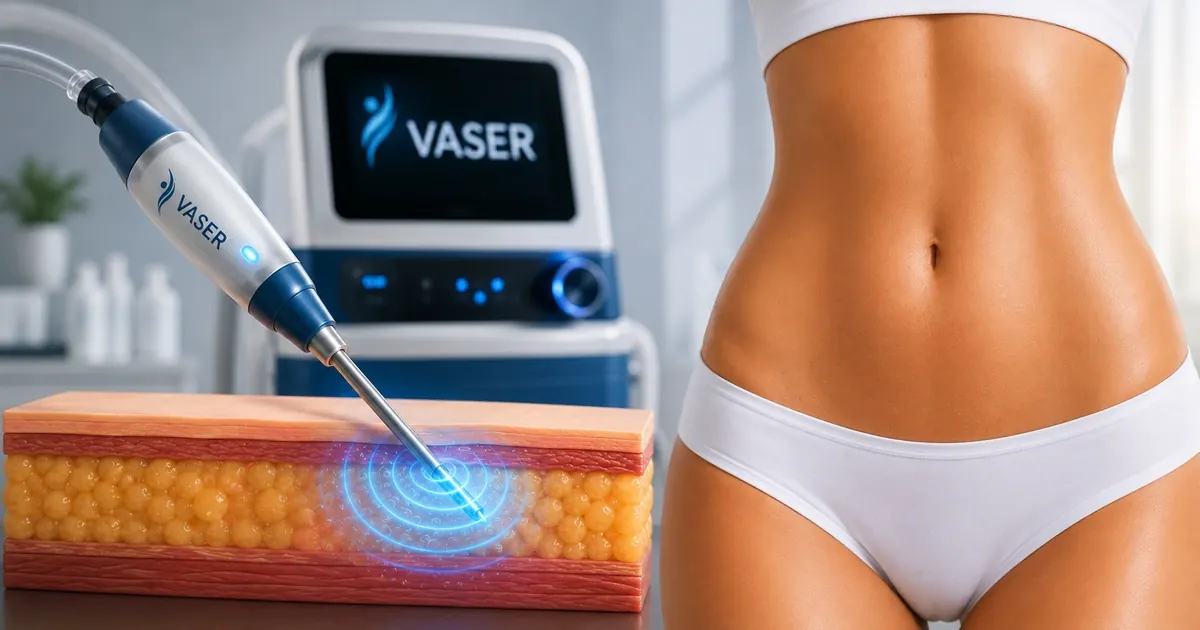
VASER (Vibration Amplification of Sound Energy at Resonance) is a form of ultrasound-assisted liposuction (UAL). A probe emitting high-frequency ultrasound energy is inserted into the fat layer after tumescent fluid infiltration. The sound waves create a cavitation effect — microscopic bubbles that expand and collapse at the fat cell membranes, disrupting and emulsifying them.1
The key property that distinguishes VASER from earlier ultrasound devices is its selectivity: VASER's pulsed ultrasound energy predominantly affects fat cells, which are more resonant at the target frequency, while leaving blood vessels, nerves, and fibrous connective tissue relatively intact. The emulsified fat is then suctioned conventionally.
VASER was developed in the late 1990s–2000s as a refinement of first-generation UAL devices. Third-generation VASER systems (current) offer improved probe designs and energy-delivery modes compared to earlier UAL.2
VASER Generations: First to Third
The first commercial UAL systems, introduced in the early 1990s, used continuous-wave ultrasound delivered through a solid titanium probe. While effective at emulsifying fat, these first-generation devices generated significant heat at the probe tip, leading to a higher rate of skin burns, seromas, and prolonged procedural times. The technology was adopted unevenly because the margin between effective and damaging energy levels was narrow, demanding considerable operator experience. Second-generation systems attempted to address this with modified probe geometries and intermittent energy delivery, reducing — but not eliminating — the thermal risk.
VASER, introduced commercially in the early 2000s and refined through successive hardware updates, represents the third-generation paradigm. Its grooved probe design increases the surface area of ultrasound emission, allowing lower peak energy levels to achieve the same fat emulsification effect. Pulsed (rather than continuous) energy delivery further reduces heat accumulation. The result is a device that operates with a much wider safety margin than its predecessors — the basis for its adoption in high-definition work, where the probe is used close to the dermis in superficial planes that first-generation devices could not safely approach.2
VASER vs First-Generation UAL
The critical clinical difference between VASER and first-generation UAL is tissue selectivity. Early UAL devices disrupted fat through a combination of cavitation and direct thermal injury — the heat generated was non-selective, affecting surrounding fibrovascular stroma as well as fat. This produced the beneficial outcome of fat emulsification but also a higher incidence of skin necrosis, delayed wound healing, and seroma, particularly in thin patients or superficial planes. The technique was accordingly restricted to deep fat compartments, limiting its utility for contouring.
VASER's pulsed, lower-energy delivery achieves fat emulsification predominantly through acoustic cavitation rather than heat, leaving the fibrovascular scaffold largely intact. Randomised intraindividual studies comparing modern UAL approaches have confirmed that current VASER technology produces comparable contouring outcomes to traditional suction-assisted liposuction while preserving the structural integrity of the treated tissue.3 This structural preservation is precisely what enables VASER Hi-Def surgery: a surgeon can work in superficial fat planes without the burn risk that made first-generation UAL unsuitable for detailed sculpting.
How VASER Differs From Traditional Liposuction and Laser Lipo
| Feature | Traditional (SAL/PAL) | Laser Lipo (LAL) | VASER (UAL) |
|---|---|---|---|
| Energy type | Mechanical (no energy) | Light energy (heat) | Sound energy (ultrasound) |
| Tissue selectivity | Low — purely mechanical | Moderate — heat affects all tissue | High — spares vessels, nerves, connective tissue |
| Skin tightening | None | Modest (best evidence) | Some (different mechanism) |
| Fibrous fat effectiveness | Difficult (PAL helps) | Moderate | Excellent |
| HD sculpting capability | Limited | Moderate | Best — gold standard |
| Unique complication | Contour irregularity | Thermal burn | Seroma (higher risk) |
A randomised intraindividual study comparing two ultrasound-assisted liposuction devices on the abdomen confirmed that VASER-type UAL produces comparable outcomes to traditional approaches with its characteristic tissue-sparing property.3
For the full detailed comparison, see Laser vs VASER vs Traditional Liposuction.
VASER Hi-Def Liposculpture
VASER Hi-Def is a refinement technique that uses VASER's precision to remove fat in anatomically specific zones that correspond to the natural lines of underlying muscle groups — creating the appearance of defined musculature rather than simply reducing volume.
The technique was originally described for male abdominal sculpting (abdominal etching / six-pack appearance) but has been extended to other areas including the chest, arms, back, thighs, and buttocks in both male and female patients.4
Key characteristics of VASER Hi-Def:
- Removes fat superficially (close to the skin) in targeted zones — technically demanding, higher risk of contour irregularity if done incorrectly
- Requires the patient to have enough muscle development to benefit from definition — it reveals muscle, it does not create it
- Typically requires a very experienced VASER surgeon — fewer surgeons offer true Hi-Def compared to standard VASER
- Recovery can be longer and swelling more pronounced than standard VASER due to more superficial tissue disruption
Areas Suited to Hi-Def Work
| Area | Effect Achieved | Requires |
|---|---|---|
| Abdomen (male) | Six-pack / rectus abdominis definition | Developed rectus muscles; BMI typically <25 |
| Abdomen (female) | Two-pack or linea alba highlighting; flat, toned appearance | Good skin elasticity; core muscle tone |
| Chest (male) | Pectoral border definition; lower chest crease | Developed pectoralis major; no significant gynecomastia gland |
| Arms | Bicep / tricep separation; lean upper arm contour | Adequate arm musculature; good skin tone |
| Flanks / back | Oblique definition; erector spinae grooves | Low body fat percentage in area; back muscle development |
| Thighs | Quadriceps separation; inner-thigh gap contouring | Thigh muscle development; skin with reasonable elasticity |
| Buttocks perimeter | Gluteal crease accentuation; lateral hip definition | Gluteus muscle volume; often combined with fat transfer |
Hi-Def Candidacy: The Muscle Requirement
The most important — and most commonly misunderstood — aspect of VASER Hi-Def candidacy is that the procedure reveals existing muscle, it does not manufacture it. A patient who is at an appropriate body fat percentage but has limited underlying muscle development will not achieve the six-pack or pectoral definition they may have seen in promotional imagery. VASER Hi-Def removes the layer of fat that obscures the muscle borders; if those borders are not meaningfully developed, the result is a flat, reduced contour rather than a sculpted, athletic one. Surgeons routinely assess muscle development as part of the Hi-Def consultation, and candidates who lack adequate muscular foundation are typically directed toward standard VASER or traditional liposuction instead.4
Body fat percentage is the other key variable. Hi-Def results are most pronounced — and most predictable — at lower body fat percentages, generally under 20% for women and under 18% for men. Patients with higher body fat can still undergo the procedure, but the degree of visible definition will be limited by the remaining deep fat layer VASER does not target. Most experienced Hi-Def surgeons ask patients to reach a stable, reasonable body weight before surgery rather than operating on a patient planning to lose significant weight post-procedure, since weight gain after Hi-Def sculpting redistributes fat asymmetrically and can distort the sculpted result.
Best Candidates and Areas for VASER
VASER is especially suitable for:
- Patients seeking high-definition sculpting (abdominal, chest, arm definition)
- Fibrous fat areas that are difficult to suction conventionally: male flanks, upper back, gynecomastia (male chest), bra fat
- Patients who have had previous liposuction in an area (fibrous/scarred tissue responds better to VASER's energy than to mechanical cannula)
- Large-volume procedures where the tissue-sparing property reduces bruising and recovery time
May not be necessary for:
- Standard fat removal in soft, non-fibrous areas (thighs, abdomen without HD goals) — traditional lipo achieves equivalent results
- Very small areas where any lipo technique is appropriate
VASER can be combined with fat transfer (BBL, facial fat grafting) as the emulsified fat from VASER has shown good viability for transfer purposes.

Results, Recovery and Cost
Results
Fat removal results from VASER are permanent — removed fat cells do not regenerate. For standard VASER procedures, the final contour is apparent at 3–4 months once all swelling resolves. For VASER Hi-Def, full results may take up to 4–6 months as superficial tissue changes take longer to settle.
Recovery
Recovery from VASER is broadly similar to traditional liposuction by procedure size:
- 1–2 weeks social downtime for small areas (1–2 treated areas)
- 2–4 weeks for multi-area procedures or Hi-Def cases
- Compression garment worn for 4–6 weeks
- Return to exercise: typically 3–6 weeks depending on areas treated
VASER swelling may feel firmer than traditional lipo in the initial weeks, which can concern patients — this is normal and resolves. Seroma (fluid collection) risk is somewhat higher with VASER if excessive energy is applied; an experienced surgeon monitors for this at follow-up.
Cost
VASER procedures cost approximately 15–30% more than traditional liposuction for the same area, reflecting equipment and training costs. VASER Hi-Def is significantly more expensive due to the surgical complexity:
| Procedure | Typical US all-in range |
|---|---|
| VASER — single area (e.g. abdomen) | $5,000–$8,500 |
| VASER — multiple areas (e.g. abdomen + flanks) | $7,000–$14,000 |
| VASER Hi-Def (abdominal sculpting) | $8,000–$18,000 |
| Turkey all-inclusive VASER packages | $2,500–$5,000 USD |
VASER Risks and How They Compare to Traditional Lipo
VASER's complication profile overlaps substantially with traditional liposuction — the procedure is still surgery under tumescent anaesthesia, and the majority of risks are shared. However, VASER introduces one distinctive risk that is higher than with mechanical liposuction: seroma. Understanding the full risk picture helps patients make an informed choice and know what to monitor post-operatively.2 5
Seroma: VASER's Highest Unique Risk
A seroma is a collection of serous fluid (lymphatic fluid and plasma) that accumulates in the dead space created when fat is removed. All liposuction carries some seroma risk, but VASER's ultrasound energy disrupts lymphatic channels more extensively than mechanical cannula work, increasing the likelihood of fluid weeping into the treatment cavity. Seromas typically present as a soft, fluctuant swelling at 1–3 weeks post-operatively — after the initial surgical swelling has begun to settle. Small seromas often resolve spontaneously with continued compression garment wear; larger ones require aspiration (needle drainage) at a follow-up visit, which is a minor office procedure.
The seroma risk is closely related to the total energy delivered during the procedure. Surgeons who use excessive ultrasound time — either because of inexperience or because the treated area is very large — produce more lymphatic disruption. Appropriate technique, conservative energy dosing relative to the volume being treated, and meticulous tumescent fluid management are the primary controls. Experienced VASER surgeons in the 261-case series achieved a seroma rate that remained within acceptable bounds precisely because energy was managed carefully.2
Standard Liposuction Risks That Also Apply to VASER
Beyond seroma, patients undergoing VASER face the same categories of risk as any liposuction procedure: contour irregularity (particularly in Hi-Def cases worked in superficial planes), prolonged swelling, temporary numbness or altered sensation in the treated area, bruising, asymmetry, and the general risks of anaesthesia and surgery (infection, DVT, pulmonary embolism — rare but serious). Skin laxity and loose skin following large-volume removal are anatomical risks regardless of technique. The American Society of Plastic Surgeons recommends discussing the full complication profile with a board-certified surgeon before any liposuction procedure.5
What Experienced Surgeons Do to Minimise Seroma
High-volume VASER surgeons employ several consistent strategies to keep seroma rates low. First, energy time is kept proportional to volume: VASER probes are used to emulsify fat rather than to continue applying ultrasound energy after adequate emulsification is achieved. Second, the compression garment is fitted before the patient leaves the operating room and worn continuously for the first two weeks — external compression reduces the dead space in which fluid can accumulate. Third, post-operative lymphatic drainage massage (manual lymphatic drainage, MLD) is commonly prescribed from week two onwards to encourage reabsorption of residual fluid. Finally, early follow-up at one and two weeks allows the surgeon to identify subclinical fluid collections that can be aspirated before they become large enough to cause discomfort or risk secondary infection. Centres with the lowest reported seroma rates combine all four of these strategies routinely.
| Complication | Frequency in 261-case VASER series2 | Notes |
|---|---|---|
| Seroma | Reported; most common specific complication | Higher than traditional lipo; managed with aspiration and compression |
| Contour irregularity | Low — comparable to traditional lipo | Higher risk in Hi-Def superficial work; surgeon experience critical |
| Transient numbness / dysaesthesia | Common; typically resolves within weeks | Ultrasound energy around nerves; generally temporary |
| Skin burns / thermal injury | Rare with VASER (low with pulsed delivery) | More common with first-generation UAL; not a primary VASER risk |
| Infection | Rare — comparable across lipo techniques | Standard surgical precautions apply |
| Asymmetry | Low; technique-dependent | Any liposuction technique carries this risk |
| Serious systemic complications (DVT/PE) | Very rare; comparable to other lipo | Standard thromboprophylaxis protocols apply |
Frequently Asked Questions
-
Not universally. VASER excels for HD sculpting, fibrous fat areas, and patients with previous lipo. For routine fat removal in soft areas, traditional lipo achieves comparable results at lower cost. The best technique depends on your goals and anatomy — discuss with a surgeon experienced in both.
-
Yes. A 261-case series of third-generation VASER reported an acceptable complication rate comparable to traditional liposuction. The specific risk to manage is seroma — somewhat higher with VASER than traditional if excessive ultrasound energy is applied. An experienced surgeon will use appropriate technique and monitor post-operatively.
-
VASER Hi-Def removes fat in specific anatomical zones to enhance or reveal muscular definition — most commonly for a six-pack abdominal appearance. It is technically demanding, requires significant underlying muscle, and should only be performed by a highly experienced VASER surgeon. Not all clinics offering "VASER" offer true Hi-Def.
-
Standard VASER is 15–30% more than traditional lipo for the same area. In the US, a single area runs $5,000–$8,500 all-in; multi-area $7,000–$14,000. VASER Hi-Def starts at $8,000–$18,000 due to complexity. Turkey all-inclusive packages are $2,500–$5,000 USD.
-
1–2 weeks social downtime for small areas; 2–4 weeks for multi-area or Hi-Def procedures. Compression garments for 4–6 weeks. Final results visible at 3–4 months (Hi-Def: 4–6 months). Swelling in the first weeks may feel firmer than traditional lipo — this is normal.
-
Yes — VASER is well-suited to procedures that combine liposuction with fat transfer. The gentle acoustic cavitation of VASER preserves a high proportion of viable fat cells compared to mechanical liposuction, which physically shears cells with the cannula. VASER-harvested fat is used for Brazilian Butt Lift (BBL) and facial fat grafting, where fat cell survival is critical to achieving durable, long-lasting results. The fat is harvested, processed (typically centrifuged or filtered), and injected into the recipient site in the same operative session.