
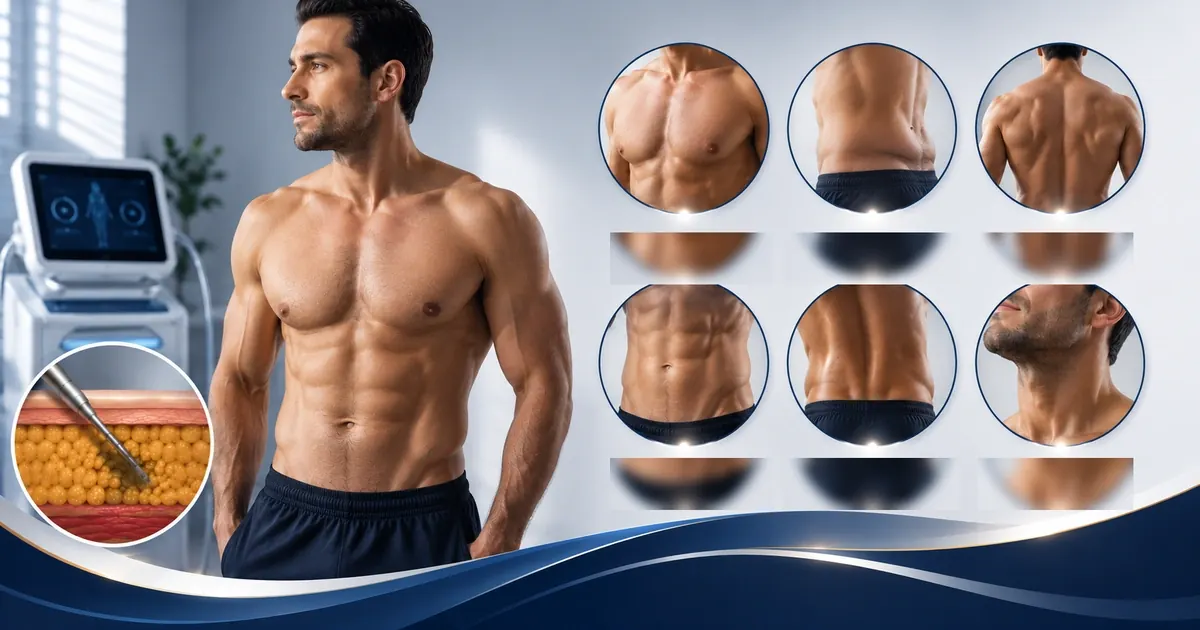
How Male Fat Differs From Female Fat
Surgeons consistently report that male liposuction is technically more demanding than female liposuction performed at equivalent volumes. This is not a matter of patient size or fitness — it reflects fundamental differences in how subcutaneous fat is structured in male bodies and where it preferentially accumulates.1
Fibrous Fat Architecture in Men
Subcutaneous fat does not exist as a pure, free-floating lipid mass. It is organised into lobules — clusters of fat cells — separated and held in place by a three-dimensional lattice of fibrous connective tissue septa (fibrous strands). This architecture varies significantly between sexes. In women, the septa in superficial fat layers tend to run perpendicular to the skin surface in loosely organised vertical columns, which makes the tissue relatively pliable. In men, the septa are more densely cross-linked and arranged in a diagonal, interlocking pattern — particularly in androgen-sensitive areas such as the flanks, upper abdomen, and chest.1
This fibrous architecture has a direct consequence in the operating room: a conventional suction-assisted liposuction (SAL) cannula works by physically breaking fat lobules apart and aspirating the contents. Against dense fibrous septa, the cannula meets significant mechanical resistance — requiring more forceful movements, more passes, and generating greater trauma to surrounding tissue. The result, when surgeons use traditional technique on fibrous male fat, is increased bruising, less predictable fat removal, and a higher risk of contour irregularity than the same procedure performed on softer female fat.
Subcutaneous vs Visceral Distribution Differences
Body fat exists in two distinct compartments. Subcutaneous fat sits between the skin and the deep fascia — it is accessible to liposuction. Visceral fat is stored within the abdominal cavity around the internal organs, beneath the peritoneum — it is entirely inaccessible to any surface liposuction technique.
Sex hormones strongly influence which compartment fat preferentially accumulates in. Oestrogen promotes subcutaneous fat deposition, particularly in the hips, thighs, and buttocks — the classic "gynoid" distribution. Testosterone promotes visceral fat storage and upper-body, truncal subcutaneous accumulation. Men, particularly as testosterone declines with age, accumulate proportionally more visceral fat than women of comparable overall body weight.2
This distinction is critical for setting realistic expectations in male patients. A man whose abdominal protrusion is predominantly driven by visceral fat will see limited external improvement from liposuction, even if the subcutaneous layer is successfully reduced. The visceral component — which drives the classic "beer belly" rounded protrusion under the muscle — is untouched. Surgeons assess this during consultation, often using a pinch test and abdominal palpation to estimate the ratio of subcutaneous to visceral bulk. Men with a predominantly visceral distribution are counselled that liposuction is a poor tool for their primary concern.
Why Technique Matters More for Men
Given the fibrous architecture of male fat, technique selection has a larger impact on outcomes in male patients than in female patients. Ultrasound-assisted liposuction (UAL), and specifically VASER, addresses the fibrous resistance problem directly. VASER probes emit high-frequency ultrasound that creates acoustic cavitation — microscopic bubble formation and collapse at fat cell membranes — which emulsifies the fat including the fibrous septa surrounding it. Once emulsified, the tissue loses its mechanical resistance and can be suctioned with far less physical force than traditional technique requires.1
Power-assisted liposuction (PAL) — which uses a rapidly vibrating cannula rather than acoustic energy — also improves efficiency in fibrous fat by reducing the manual force a surgeon must apply. PAL is a useful alternative where VASER is not available. The key point for male patients is that traditional SAL is the least efficient option for their tissue type; surgeons experienced with male body contouring overwhelmingly prefer an energy-assisted modality.
Read: VASER Liposuction — How It Works, Benefits & Who It's For →Common Male Treatment Areas
While liposuction can be applied to virtually any subcutaneous fat deposit in either sex, male patients show markedly different area preferences from female patients. The following sections cover the three most common male treatment areas in detail.
Love Handles and Flanks
The flanks — the lateral and posterolateral fat deposits extending from the waist to the iliac crest — are consistently the most commonly treated area in male liposuction patients.2 Colloquially called love handles, this deposit is both androgen-sensitive (accumulating in men even at relatively low overall body fat) and highly fibrous, making it a textbook case for VASER technique.
The appeal of flank liposuction for men is the silhouette change it produces. Reducing the lateral waist width and restoring a more tapered torso profile addresses one of the most visible signs of weight change in male patients — the loss of the V-shape from shoulder to waist. Even modest volume removal (400–800 mL per side) produces a meaningful visual change because the flank sits at the waist — the waist-to-hip ratio is clinically the key measurement, and reducing the flank directly improves it.
Surgeons approach the flanks through small access incisions in the natural skin creases of the lower back and lateral hip. Because the area is fibrous, most surgeons use VASER pre-treatment before aspirating. Results are among the most predictable in male liposuction — the flank has a single fat layer, no major underlying structures at risk, and excellent skin contracture capacity in men under 50.
Abdomen and Hi-Def Abs Etching
Abdominal liposuction in men ranges from standard volume reduction (treating the fat layer without attempting definition) to high-definition sculpting — a technique that removes fat in the precise anatomical zones corresponding to the rectus abdominis and external oblique muscles to simulate or enhance visible muscular definition.
Standard abdominal lipo addresses the excess subcutaneous fat layer (both above and below the umbilicus) and is appropriate for men whose primary goal is a flatter, less prominent abdomen. The result is a volume reduction — not a sculpted appearance — and is a reasonable expectation for the majority of male patients who do not have well-developed abdominal musculature.
Hi-def abdominal etching has grown substantially in demand among younger male patients seeking visible definition without extensive gym effort. The technique, most commonly performed with VASER, removes fat along the linea alba, the linea semilunaris, and the transverse tendinous intersections — the natural anatomical lines that define the rectus "boxes." It also removes fat over the oblique margins to sharpen the V-line from ribcage to groin. The result, when patient selection is appropriate, is a markedly more athletic-looking torso even without significant muscle mass change.4
Chin and Neck
Submental (under-chin) liposuction has seen significant growth in male patients and is now one of the most common facial contouring procedures across all demographics. In men, the submental fat pad is typically denser and more fibrous than in women, but the area is still highly amenable to liposuction because the volumes involved are small (typically 20–100 mL) and the target area is anatomically well-defined.
Male patients particularly value submental lipo for the jawline definition it produces — it restores the mandibular border as a visible feature rather than a line obscured by a fat roll. Most male patients undergoing chin lipo do not need a neck lift or platysmaplasty unless there is significant skin laxity or platysmal banding present, which a surgeon will assess at consultation. Recovery is typically 5–7 days of visible swelling, with most patients presentable within a week using appropriate compression.
| Area | Male-specific considerations | Best technique | Recovery notes |
|---|---|---|---|
| Love handles / flanks | Dense fibrous fat; androgen-sensitive; excellent skin contracture under 50 | VASER or PAL — SAL is less efficient against fibrous tissue | 1–2 weeks social downtime; compression 4–6 weeks; gym at 3–4 weeks |
| Abdomen (standard) | Visceral fat must be ruled out as primary cause; fibrous in upper abdomen | VASER preferred; PAL acceptable for standard volume reduction | 2–3 weeks social downtime; compression 6 weeks; core exercise at 6 weeks |
| Abdomen (hi-def etching) | Requires developed rectus muscles; BMI typically <27; subcutaneous fat <2 cm | VASER only — hi-def work requires ultrasound-assisted precision | 3–4 weeks restricted; final results visible at 4–6 months |
| Chest (pseudogynecomastia) | Fat only — must confirm no glandular component before lipo-only plan | VASER; compression vest essential post-op | 5–10 days social; upper body restrictions 4–6 weeks |
| Chin / neck | Small volumes; check for platysmal banding and skin laxity | SAL or VASER both effective at small submental volumes | 5–7 days swelling; presentable in 1 week with compression |
| Gynecomastia (mixed) | Glandular excision required alongside lipo; confirm with clinical exam / ultrasound | VASER + open or pull-through gland excision | 1–2 weeks social; chest restrictions 6 weeks; drain may be used |
Male Chest: Liposuction vs Gynecomastia Surgery
The male chest is the most complex area in male body contouring because the same outward appearance — fullness or protrusion of the breast area — can have two completely different underlying causes requiring different surgical approaches. Getting this distinction wrong is one of the most common reasons for unsatisfactory chest results in men.3
What True Gynecomastia Is
Gynecomastia is defined as the proliferation of glandular breast tissue in males. Histologically, it involves a benign increase in ductal and stromal breast tissue — the same type of tissue that constitutes the functional breast in females. Gynecomastia is common: population studies estimate prevalence of 30–65% depending on age group and diagnostic criteria, with peaks in neonatal period, adolescence, and older age (driven by hormonal changes). The majority of cases are idiopathic or related to hormonal fluctuations; a minority are driven by medications (spironolactone, some antipsychotics, anabolic steroids), hypogonadism, or rare tumours.2
On examination, true gynecomastia presents as a firm, sometimes tender, disc of tissue palpable directly beneath the nipple-areola complex. Glandular tissue has a characteristically rubbery, concentric feel distinct from the soft, diffuse compressibility of fat. The glandular disc can range from a small button (Grade I) to a fullness that creates a female-appearing breast contour (Grade III).
The critical surgical implication: glandular breast tissue does not respond to liposuction. It cannot be aspirated through a cannula because it is a fibrovascular solid tissue, not an emulsifiable fat deposit. A surgeon who attempts to treat true gynecomastia with liposuction alone will remove the overlying and surrounding fat but leave the gland intact — the patient wakes up with less chest fat but a visible, firm dome of residual tissue under the nipple. This is a recognisable outcome and requires revision.
Pseudogynecomastia — Fat Only, Suitable for Lipo Alone
Pseudogynecomastia is chest fullness in males caused entirely by fat accumulation rather than glandular growth. It occurs in the same anatomical location as true gynecomastia but has no glandular component — the breast area feels soft, diffuse, and compressible throughout, with no firm subareolar disc. Pseudogynecomastia is directly linked to overall body fat percentage and responds to liposuction in the same way any other fatty deposit does.
For pseudogynecomastia, VASER liposuction alone is a definitive treatment. Because the chest fat in males is typically fibrous (male chest fat shares the dense septal architecture of other androgen-sensitive areas), VASER is the preferred technique. Results are generally excellent — a well-executed VASER procedure removes the chest fat and allows the skin to contract to the new contour, producing a flat, masculine chest appearance. No incisions beyond tiny access ports are required; scarring is minimal.
How to Tell the Difference
Three assessment tools reliably distinguish true gynecomastia from pseudogynecomastia:
1. Clinical examination and pinch test. The examining surgeon places thumb and forefinger on either side of the nipple and brings them together, pressing through the breast tissue. Glandular tissue is firm, rubbery, and discrete — it offers resistance that fat does not. Fat is soft, uniform, and compressible throughout the pinch. An experienced hand reliably distinguishes the two on examination alone in straightforward cases.
2. Ultrasound imaging. Breast ultrasound has become the standard adjunct when the clinical picture is ambiguous. Glandular tissue appears as a hypoechoic, fan-shaped or disc-shaped structure behind the nipple on ultrasound. Fat shows as uniform, hyperechoic tissue without this pattern. Ultrasound also estimates gland size, which informs surgical planning — small glands may require only a pull-through excision through the existing cannula ports; larger glands require a periareolar incision.3
3. Mammography is used selectively — typically in older men or where ultrasound findings are indeterminate — to rule out rare male breast pathology. It is not routinely required for straightforward gynecomastia assessment in younger males.
When Lipo Alone is Sufficient vs Combined Gland Excision
The decision framework is straightforward once the anatomy is characterised:
- Pseudogynecomastia (fat only): VASER liposuction alone — no excision required.
- True gynecomastia, Grade I–II with thin fat layer: Lipo to remove surrounding fat, combined with pull-through or open periareolar gland excision.
- True gynecomastia, Grade III or skin excess: Lipo, gland excision, and potentially skin resection (more complex procedure, may require a scar at the areola margin or beyond).
- Mixed presentation (common): VASER lipo plus gland excision — the most frequent scenario in clinical practice, as many men have both fatty excess and a small-to-moderate glandular component.3
| Feature | Pseudogynecomastia | True Gynecomastia |
|---|---|---|
| Underlying tissue | Fat only | Glandular breast tissue (± fat) |
| Feel on palpation | Soft, diffuse, fully compressible | Firm, rubbery disc beneath nipple |
| Tenderness | Usually absent | Often present, especially in active/adolescent phase |
| Ultrasound appearance | Uniform fat signal; no subareolar disc | Hypoechoic fan-shaped glandular tissue behind nipple |
| Link to body weight | Direct — worsens with weight gain | Independent — present regardless of weight |
| Appropriate procedure | VASER liposuction alone | Gland excision (± lipo for surrounding fat) |
| Scars | Tiny ports only (1–3 mm) | Periareolar incision (lower half of areola margin) |
| Anaesthesia | Local + sedation or GA | General anaesthesia standard |
| US cost range | $4,500–$8,000 | $6,000–$12,000 (lipo + excision) |
How Male Liposuction Works
The technical steps of male liposuction differ from a female procedure in three areas: preoperative marking strategy, technique selection for fibrous fat, and — for hi-def cases — the precision mapping of anatomical sculpting zones.
Marking Strategy for Male Fibrous Fat
Preoperative marking is performed with the patient standing — gravity determines the fat distribution that surgery addresses, and supine positioning on the operating table shifts everything. For male flanks and abdomen, surgeons mark the outer border of the treatment zone, the central volume zone (where the most fat will be removed), and the feathering zone — a transition area where fat removal tapers to nothing, blending the treated area into surrounding untreated tissue. Abrupt transitions between treated and untreated areas are the primary cause of visible contour irregularity; meticulous feathering prevents this.
For hi-def work, marking is significantly more detailed. The surgeon draws the anatomical lines of the muscle borders directly on the skin, using the patient's own anatomy (visible or palpable) as the template. The rectus abdominis intersections, linea semilunaris, oblique lines, and pectoral borders are individually marked. These markings guide the precise VASER probe passes that will remove fat along those anatomical boundaries.
VASER or PAL as Preferred Technique for Male Fat
After tumescent fluid infiltration (which reduces bleeding and provides anaesthesia in the fat layer), the surgeon introduces the VASER probe through tiny access incisions, typically 3–4 mm. The probe is passed through the fat in smooth, overlapping strokes. The ultrasound energy emulsifies the fat — including the fibrous septa that make manual aspiration in males difficult. Emulsification time is proportional to the volume and fibrous density being treated. Once the fat is emulsified, it is aspirated with a conventional cannula using significantly less mechanical force than would be required in traditional SAL.1
PAL, which uses a motorised vibrating cannula rather than ultrasound, achieves a similar mechanical advantage against fibrous fat through a different mechanism. The rapid reciprocating motion (approximately 4,000 cycles per minute) breaks fibrous connections as the cannula traverses the fat, allowing more efficient aspiration without the ultrasound energy step. PAL is widely available and is a reasonable choice for fibrous male fat in centres where VASER is not offered.
Hi-Def Sculpting for Athletic Definition
In hi-def male abdominal work, after standard deep fat removal, the surgeon transitions to selective superficial fat removal along the pre-marked muscular lines. The VASER probe is used to emulsify fat in these narrow anatomical channels. The goal is not uniform fat removal but shaped removal — more fat is taken precisely at the line, tapering rapidly to normal depth on either side. The visual effect post-healing is a shadow line corresponding to each muscle border, creating the impression of surface relief (defined musculature) rather than just flat reduction.4
The superficial work involved in hi-def techniques carries a higher technical demand and a higher risk of contour irregularity than deep-only fat removal. Overcorrection at any single line creates a permanent groove; undercorrection at all lines produces no visible definition. This is why true hi-def work should only be performed by surgeons with extensive experience in the technique specifically — not simply any surgeon offering VASER.

Recovery for Male Patients
Recovery from male liposuction follows the same general trajectory as female recovery but with some practical differences driven by the treatment areas most common in men — particularly the chest — and male patients' typical activity patterns (gym and manual work).
Compression Vest for Chest Procedures
Following chest liposuction (whether for pseudogynecomastia alone or combined with gland excision), continuous compression via a fitted vest is essential. The chest is an anatomically challenging area for compression because the volume removed leaves a relatively large dead space in a location that moves with every arm movement and breath. Without adequate continuous compression, this dead space fills with fluid (seroma) and the skin fails to adhere to the new contour.
Surgeons typically fit the compression vest in the operating room before the patient emerges from anaesthesia. The vest is worn continuously — day and night — for the first three to four weeks, then part-time (daytime only or sleeping only) for a further two to four weeks. Removing it early is the single most common patient-driven cause of seroma and suboptimal chest contour following male chest lipo.
Gym and Upper Body Activity Restrictions
Male patients consistently push against activity restrictions, and the gym is the area of most friction in post-operative management of male lipo patients. The reasons for restrictions are tissue-biological rather than precautionary: in the first three to four weeks post-liposuction, the treated fat layer is undergoing remodelling — vessels are regenerating, the fibrous framework is contracting, and the skin is adhering to the new subcutaneous contour. Vigorous physical activity during this phase increases blood flow to the area, drives inflammation, worsens and prolongs swelling, and mechanically disrupts the adherence process.
The specific restrictions that apply to male patients after chest or abdominal lipo include: no chest press or push-up movements (which stress the treated chest or abdominal areas directly), no overhead lifting, and no activities that significantly raise intra-abdominal pressure for the first four to six weeks. Light lower body activity (walking) is generally permitted from week two. Cardiovascular exercise (cycling, treadmill) typically resumes at three to four weeks. Full gym return, including upper body work, is usually cleared at six weeks with the surgeon's sign-off at the follow-up visit.
| Stage | Activity allowed | Return to gym / sport timeline |
|---|---|---|
| Days 1–3 | Rest; short walking only; compression garment worn continuously | No gym; no driving |
| Days 4–7 | Light walking; most desk work possible; driving if not on opioids | No gym; no lifting |
| Week 2 | Return to sedentary work; light domestic activity; walking increased | Light walks only; no weights; no cardio machines |
| Weeks 3–4 | Most non-strenuous activities; compression garment continues (part-time after week 4) | Treadmill walking, stationary cycling at moderate intensity; lower body weights (light) |
| Weeks 5–6 | Near-normal daily activity; abdominal binder may still be recommended for heavy activity | Most cardio; lower body weights; upper body resumes at surgeon clearance (typically week 6) |
| 6+ weeks | Full activity (surgeon clearance) | Full gym including chest press, deadlift, upper body — surgeon confirmed at follow-up |
| 3–6 months | Residual firmness and minor swelling continue to resolve | Final sculpted results visible; hi-def results clearer as all swelling settles |
Results and Realistic Expectations
Male liposuction outcomes vary significantly by area and by what the patient's anatomy can support. Setting accurate expectations before surgery is one of the most important parts of the consultation process.
Love Handles and Flanks — What Actually Changes
Flank liposuction produces the most consistent and predictable results in male liposuction. The flank fat deposit is straightforwardly subcutaneous with no visceral component, the skin in this area tends to contract well in patients under 50, and even modest volume removal (400–800 mL per side) produces a visible waist taper. Patients typically report that the change is most apparent in fitted shirts — the compression of fabric over the hips no longer creates the "muffin top" bulge at the waistband.2
What does not change: the width of the bony pelvis and iliac crest (structural), the degree of muscle bulk at the flanks (if the patient is heavily muscled, some apparent width remains from muscle), and any visceral contribution to lower abdominal protrusion. Most patients rate their flank results highly when these realistic limits are set upfront.
Hi-Def Abs — Qualification Criteria
Hi-def abdominal sculpting has the strictest candidacy criteria of any liposuction technique. The following variables are assessed at consultation:4
- BMI: Most experienced hi-def surgeons work best at BMI 22–27. Upper limit is approximately 30, though results are less dramatic above 27.
- Subcutaneous fat thickness: A subcutaneous fat layer under approximately 2 cm over the rectus when measured by ultrasound or pinch is optimal. Thicker fat layers mean more fat remains after removal, partially obscuring the definition even post-operatively.
- Muscle development: The rectus abdominis, external obliques, and (for men seeking V-lines) the lower abdominal musculature must be meaningfully developed. The procedure etches the lines between muscles; if the muscles are poorly developed there are no borders to etch. Candidates who have never trained their core are often not suitable.
- Skin quality: Significant stretch marks, very loose skin, or poor turgor (common after substantial weight loss) reduce the quality of hi-def results — the skin will not adhere smoothly to the sculpted contour as it does in patients with good skin tone.
- Visceral fat: As discussed, a prominent visceral fat compartment means the abdominal wall bulges outward regardless of the subcutaneous etching. Candidates with a significant visceral component do not achieve satisfying hi-def results.
Permanence and How to Maintain Results
Fat cells removed by liposuction do not regenerate. The treated areas have a permanently reduced fat cell count. However, the fat cells that remain in the treated area — and fat cells in untreated areas throughout the body — can still enlarge with weight gain. Significant weight gain after liposuction does not cause fat to return exclusively to the treated area; it tends to distribute across the body, but the proportional distribution changes. Patients who gain substantial weight after male abdominal liposuction may find that the abdomen fills more slowly than before (because there are fewer cells there) but that other untreated areas accumulate more fat relatively.5
Maintaining results long-term requires keeping body weight stable — not necessarily at an athletic low, but without a significant upward trend. The structural change liposuction produces is permanent at any stable weight; the aesthetic result is proportional to how that stable weight compares to the operative weight.
Cost of Male Liposuction
Male liposuction pricing in the United States follows the same structure as female procedures — cost is area-based and reflects surgeon fee, anaesthesia, facility, compression garments, and post-operative care. However, gynecomastia surgery carries a premium over equivalent-area fat-only liposuction because it involves excision under general anaesthesia with a periareolar incision, additional operative time, and the complexity of combining two techniques.5
| Area / Procedure | US all-in range (USD) | Turkey all-inclusive (USD) |
|---|---|---|
| Love handles / flanks (both sides) | $4,000–$7,000 | $2,200–$3,500 |
| Abdomen (standard volume reduction) | $5,000–$9,000 | $2,500–$3,800 |
| Abdomen + flanks (combined) | $7,000–$13,000 | $3,000–$4,500 |
| Hi-def abdominal etching (VASER) | $8,000–$16,000 | $3,500–$6,000 |
| Chest lipo only (pseudogynecomastia) | $4,500–$8,000 | $2,200–$3,500 |
| Gynecomastia surgery (lipo + gland excision) | $6,000–$12,000 | $3,000–$5,000 |
| Chin / submental | $3,000–$5,500 | $1,500–$2,800 |
Gynecomastia Surgery vs Lipo-Only Cost Comparison
The cost premium for true gynecomastia surgery over pseudogynecomastia lipo reflects several factors. General anaesthesia (rather than local plus sedation) is typically required for excision work, adding $800–$1,500 to the facility and anaesthesia bill. The surgeon fee increases because the procedure is longer and more technically complex — lipo plus excision in a fibrous male chest typically runs 90–150 minutes versus 45–75 minutes for fat-only lipo. A periareolar incision requires precise closure and follow-up wound management that fat-only lipo (tiny port closures) does not. When a drain is placed, additional follow-up visits are needed for its removal. Insurance coverage for gynecomastia surgery is available in some US cases where the condition causes documented functional or psychological impact — this is worth exploring with the insurer before committing to self-pay, as coverage can reduce out-of-pocket cost substantially.
See full liposuction cost guides by area and country →Frequently Asked Questions
-
Yes — in several clinically relevant ways. Male subcutaneous fat has a denser, more fibrous connective tissue architecture than female fat, making it mechanically harder to suction with a conventional cannula. Surgeons treating male patients typically use energy-assisted techniques — VASER ultrasound or PAL power-assisted liposuction — rather than traditional suction-assisted liposuction. Men also tend to carry more visceral (intra-abdominal) fat, which liposuction cannot address, meaning overall cosmetic improvement can be more limited in men with significant visceral bulk. Aesthetic goals also differ — men more commonly seek angular, defined contours rather than smooth global volume reduction.
-
High-definition liposuction — most commonly performed with VASER — can create or enhance the appearance of abdominal muscle definition by removing fat in anatomically precise zones corresponding to the rectus abdominis and oblique borders. The procedure reveals existing muscle; it does not create it. Candidates need meaningful underlying abdominal musculature, a BMI typically under 27, and a relatively thin subcutaneous fat layer. Men with significant visceral fat or poorly developed abdominal muscles are not good hi-def candidates and will not achieve visible six-pack results.
-
The distinction depends on whether chest fullness is caused by fat or glandular breast tissue. True gynecomastia involves a firm disc of glandular tissue beneath the nipple that cannot be removed by liposuction — it requires surgical excision. Pseudogynecomastia is fat accumulation only and responds well to VASER liposuction alone. A clinical pinch test (firm and rubbery = gland; soft = fat) combined with ultrasound imaging reliably distinguishes the two. Many men have a mixed presentation requiring combined VASER lipo and gland excision for the best result.
-
Social downtime for isolated chest liposuction (pseudogynecomastia, fat only) is typically 5–10 days. A compression vest is worn continuously for 3–4 weeks, then part-time for another 2–4 weeks. Upper body exercise, heavy lifting, and chest press movements are restricted for 4–6 weeks to allow the subcutaneous tissue to adhere to the new contour. For combined gynecomastia surgery (lipo plus gland excision), recovery is similar but most surgeons add 1–2 extra weeks of upper body restriction due to the excision wound at the areola margin.
-
In the United States, male liposuction costs range from approximately $4,000–$7,000 all-in for love handles or flanks, $5,000–$9,000 for the abdomen, $4,500–$8,000 for chest fat-only treatment, and $6,000–$12,000 for gynecomastia surgery (lipo plus gland excision). Hi-def abdominal sculpting starts at $8,000–$16,000. All-inclusive packages in Turkey typically run $2,200–$4,500 USD for most male areas, covering clinic, anaesthesia, compression garments, and post-operative care.
-
For most male treatment areas, yes. Male subcutaneous fat is fibrous and mechanically resistant; VASER's acoustic cavitation emulsifies this fat more efficiently and with less physical force on surrounding tissue, reducing bruising and enabling more thorough removal. VASER is particularly advantageous for love handles, the male chest, and high-definition abdominal etching. PAL is a strong alternative for fibrous areas where VASER is not available. For very soft, non-fibrous male fat deposits, traditional liposuction achieves comparable results at lower cost — but fibrous areas, which are the majority in male patients, are genuinely better suited to VASER.